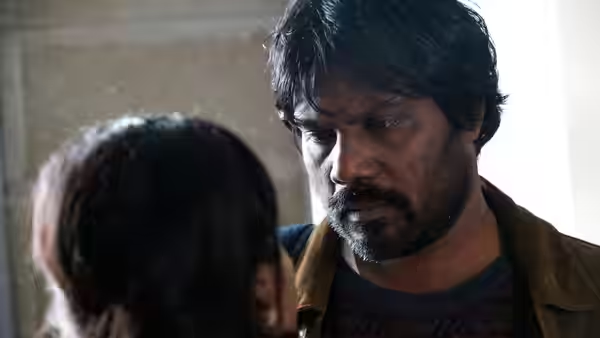
Jacques Audiard follows three Sri Lankan strangers posing as a family onto a Paris housing estate, and for ninety minutes the film is patient, exact and quietly moving. Then it reaches for a louder film, and the louder film is worse.
Jacques Audiard has spent a career putting people with nothing into rooms with people who have something and watching what they do. A Prophet (2009) did it with a prison; Rust and Bone (2012) with a car park and a killer whale tank. Dheepan does it with a housing estate on the edge of Paris and three Sri Lankans who have agreed to call one another husband, wife and daughter so that France will let them in. For an hour and a half it is among the most careful things he has made. The last stretch is not.
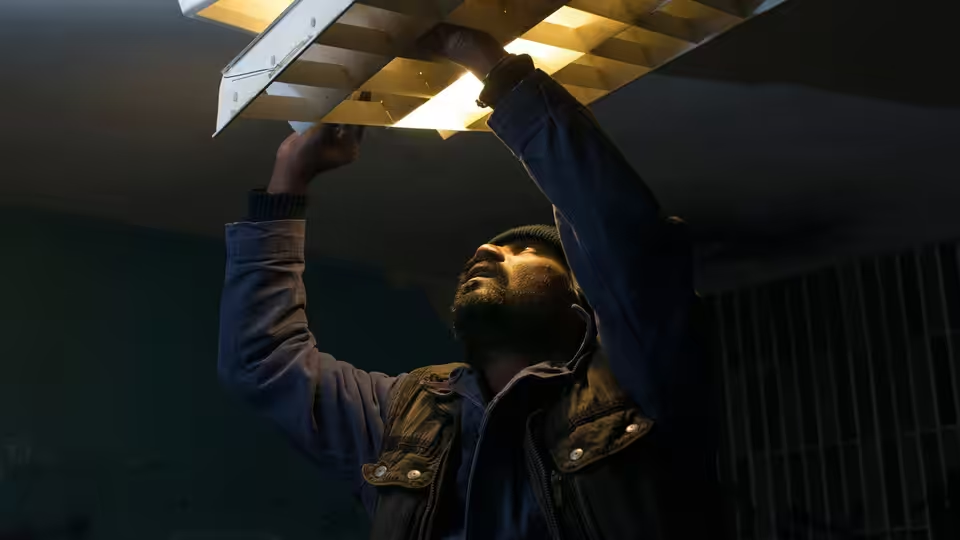
Éponine Momenceau shoots the opening in shallow focus and darkness. The war is palm fronds, a pyre and a man’s face lit from below; France is a cluster of flashing novelty headbands bobbing through the black as Dheepan hawks them to diners who do not look up. It is as good a picture of a man without papers as we have seen. On the estate she keeps the camera inside flats and stairwells, so the dealers on the opposite block are always in the frame and never quite in focus.
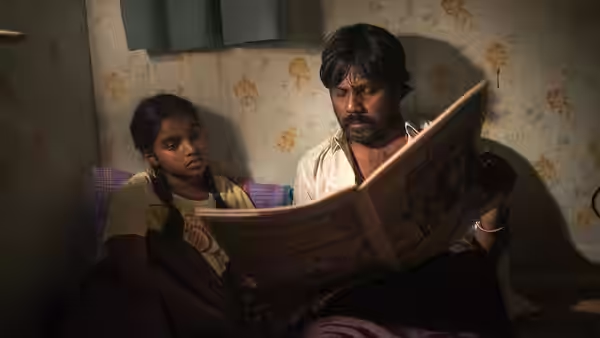
The three leads are the film. Jesuthasan plays Dheepan as a man who has decided not to speak until he has to, heavy and watchful. Srinivasan’s Yalini is impatient, sharp and funny, a woman who did not ask for a husband or a child and says so; the scene where she asks Dheepan whether he finds French people funny is the lightest thing in the film and the truest. Vinasithamby, as Illayaal, is left in a school corridor and told to make friends, and she makes the loneliness of that look like work. Then Illayaal asks Yalini for the ordinary kindnesses of a mother, and Yalini tells her flatly that she is not her mother. That exchange upset us more than anything in the film’s noisier final half hour, and it is two people in a kitchen.
Michel Barthélémy builds the estate as a place with its own geography: Hall C, where the trouble lives; Monsieur Habib’s flat, tidy and silent; the roof where Brahim’s crew keep watch. Rottiers plays Brahim with an electronic tag on his ankle and good manners, asking Yalini polite questions about her country over the food she has cooked, and the politeness is more frightening than any threat would be. Marc Zinga’s Youssouf, who shows Dheepan the job, thinks the estate can be improved. Nicolas Jaar’s music is low electronics and long tones that arrive underneath scenes, and Juliette Welfling cuts the days as routine, mopping and cooking and school, so that a family forms through repetition rather than speeches. A visit from Dheepan’s old commander, Colonel Cheran (Vasanth Selvam), says that the war can follow a man to a Paris suburb.
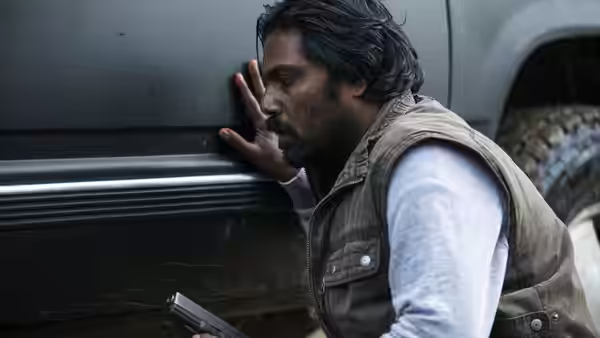
That scene makes the point. The film then decides to make it again with a gun. Audiard and his co-writers Thomas Bidegain and Noé Debré turn a film about three people learning to live together into a film about a soldier who cannot stop being one. The dealers’ war flares, and Dheepan’s past is asked to pay for a climax we will not describe. The film we had been watching made its case in kitchens and stairwells. The new one makes it with the camera held low and the sound turned up, and we sat there wondering who had asked for it.
The reviews so far split on this, and most come down, as we do, on the side of the family. Audiard has always liked the moment when a quiet man proves he can hurt people. In A Prophet that moment was the whole film and it was earned. Here it arrives late, in a film that had already found a better subject and did not need rescuing.
See it for the first ninety minutes, which are as humane and exact as anything Audiard has made. Treat the final stretch as a second, lesser film that happens to share a cast. It runs 115 minutes and carries a 15 certificate, and nearly everything that earns the certificate arrives at once.