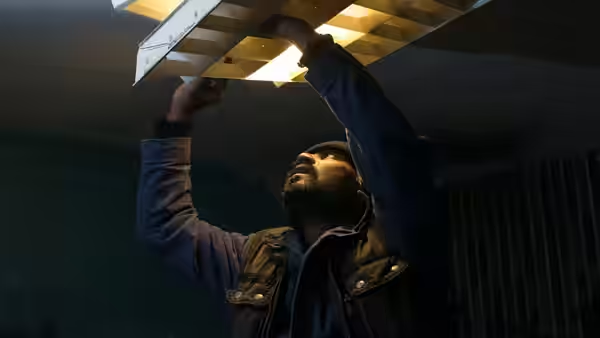
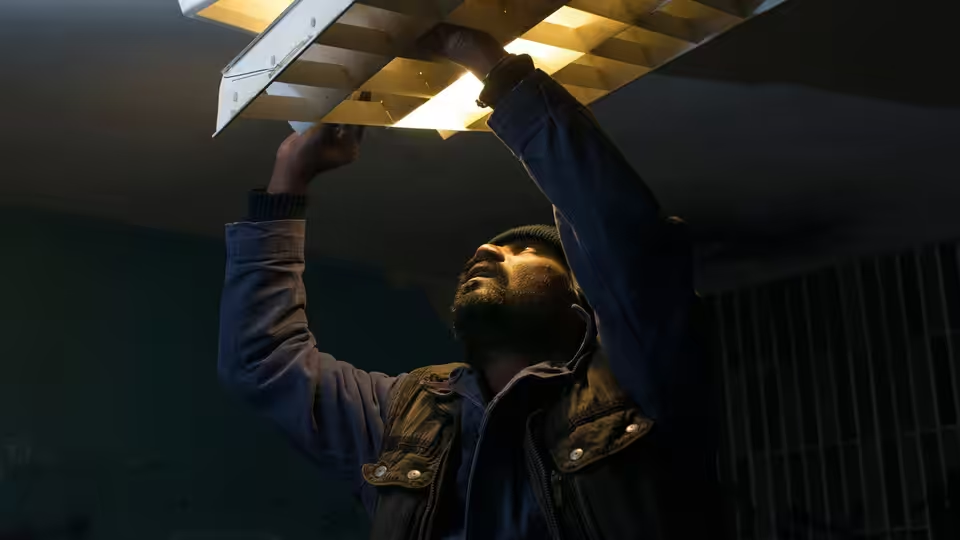
Dheepan (Antonythasan Jesuthasan) reaches up to repair a ceiling light in a dim room
Film review

Dheepan

2015 · Directed by Jacques Audiard · 1h 55m

In a sentenceA borrowed wife, a borrowed daughter, a borrowed name, and a last act borrowed from a different film

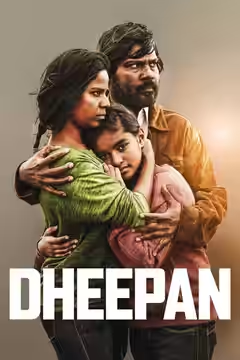
Sri Lanka, as the civil war ends. A Tamil Tiger fighter burns his uniform in a refugee camp, takes the passport of a dead man called Dheepan (Antonythasan Jesuthasan), and is handed a wife and daughter he has never met: Yalini (Kalieaswari Srinivasan), a young woman who would rather be in London, and Illayaal (Claudine Vinasithamby), an orphaned girl nobody else has claimed. The three fly to France as a family. Dheepan sells light-up trinkets on the pavements of Paris, then lands a job as caretaker on a housing estate in the suburbs, where the stairwells belong to the dealers who work for Brahim (Vincent Rottiers). Yalini cooks for Brahim’s uncle, Monsieur Habib (Faouzi Bensaïdi), Illayaal starts at the local school, and three strangers have to learn to look like a family before anyone notices they are not.

Plays from YouTube when you press play; nothing loads from them until then.

Fi1m review

Jacques Audiard follows three Sri Lankan strangers posing as a family onto a Paris housing estate, and for ninety minutes the film is patient, exact and quietly moving. Then it reaches for a louder film, and the louder film is worse.

Jacques Audiard has spent a career putting people with nothing into rooms with people who have something and watching what they do. A Prophet (2009) did it with a prison; Rust and Bone (2012) with a car park and a killer whale tank. Dheepan does it with a housing estate on the edge of Paris and three Sri Lankans who have agreed to call one another husband, wife and daughter so that France will let them in. For an hour and a half it is among the most careful things he has made. The last stretch is not.

Éponine Momenceau shoots the opening in shallow focus and darkness. The war is palm fronds, a pyre and a man’s face lit from below; France is a cluster of flashing novelty headbands bobbing through the black as Dheepan hawks them to diners who do not look up. It is as good a picture of a man without papers as we have seen. On the estate she keeps the camera inside flats and stairwells, so the dealers on the opposite block are always in the frame and never quite in focus.

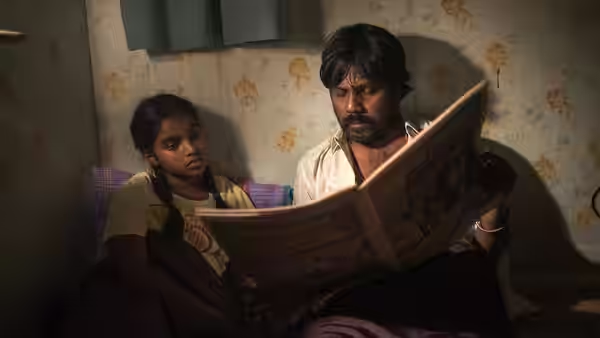
The three leads are the film. Jesuthasan plays Dheepan as a man who has decided not to speak until he has to, heavy and watchful. Srinivasan’s Yalini is impatient, sharp and funny, a woman who did not ask for a husband or a child and says so; the scene where she asks Dheepan whether he finds French people funny is the lightest thing in the film and the truest. Vinasithamby, as Illayaal, is left in a school corridor and told to make friends, and she makes the loneliness of that look like work. Then Illayaal asks Yalini for the ordinary kindnesses of a mother, and Yalini tells her flatly that she is not her mother. That exchange upset us more than anything in the film’s noisier final half hour, and it is two people in a kitchen.

Michel Barthélémy builds the estate as a place with its own geography: Hall C, where the trouble lives; Monsieur Habib’s flat, tidy and silent; the roof where Brahim’s crew keep watch. Rottiers plays Brahim with an electronic tag on his ankle and good manners, asking Yalini polite questions about her country over the food she has cooked, and the politeness is more frightening than any threat would be. Marc Zinga’s Youssouf, who shows Dheepan the job, thinks the estate can be improved. Nicolas Jaar’s music is low electronics and long tones that arrive underneath scenes, and Juliette Welfling cuts the days as routine, mopping and cooking and school, so that a family forms through repetition rather than speeches. A visit from Dheepan’s old commander, Colonel Cheran (Vasanth Selvam), says that the war can follow a man to a Paris suburb.

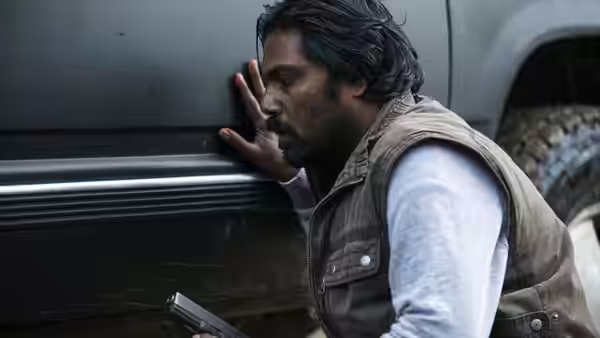
That scene makes the point. The film then decides to make it again with a gun. Audiard and his co-writers Thomas Bidegain and Noé Debré turn a film about three people learning to live together into a film about a soldier who cannot stop being one. The dealers’ war flares, and Dheepan’s past is asked to pay for a climax we will not describe. The film we had been watching made its case in kitchens and stairwells. The new one makes it with the camera held low and the sound turned up, and we sat there wondering who had asked for it.

The reviews so far split on this, and most come down, as we do, on the side of the family. Audiard has always liked the moment when a quiet man proves he can hurt people. In A Prophet that moment was the whole film and it was earned. Here it arrives late, in a film that had already found a better subject and did not need rescuing.

See it for the first ninety minutes, which are as humane and exact as anything Audiard has made. Treat the final stretch as a second, lesser film that happens to share a cast. It runs 115 minutes and carries a 15 certificate, and nearly everything that earns the certificate arrives at once.

Critical consensus AI synthesised

64
Positive
11
Mixed
8
Negative
2

Most critics come down in the film’s favour, though rarely by a wide margin. The praise gathers almost entirely around the makeshift family at the centre: three Sri Lankan strangers posing as relatives to reach France. Antonythasan Jesuthasan and Kalieaswari Srinivasan are singled out again and again, and the reviews agree that the quiet early stretch, in which the three begin to behave like a family, is where Audiard’s film is strongest.

The reservations cluster just as tightly on the final act. A large share of the reviews, positive and mixed alike, say the late turn towards violence is abrupt, heavy-handed or out of keeping with the drama before it. The spread is wide: The Wrap calls it a triumph, while The AV Club dismisses it as a crude imitation of Taxi Driver that squanders a promising opening. Many of the mixed verdicts belong to critics who admired most of the film and could not forgive its ending.

Evening Standard
4 May 2016 · Charlotte O'Sullivan
80*

O'Sullivan finds the film a touching, compelling account of trying to find a place to call home. She praises Audiard's fresh perspective on why people leave home and the human need for warmth, brightness and excitement.

Read the full review →
Slant Magazine
23 May 2017 · ★★★★ · Jesse Cataldo
80

Cataldo finds the film didactic and ultimately shallow, though its performances and characterization have real strength. He especially praises the invented family’s convincing bonds, while faulting the climax for sidelining its women and abandoning the domestic story.

Read the full review →
The Guardian
21 May 2015 · Andrew Pulver
80*

Pulver finds the film an immensely powerful, understated work, though less immediately electrifying than Audiard’s earlier films. He praises its lyricism and attention to the small details through which a makeshift family grows closer.

Read the full review →
Time Out
24 May 2015 · ★★★★ · Dave Calhoun
80

The four-star rating indicates a positive verdict. The available description highlights the story of three Sri Lankans posing as a family to escape to France.

Read the full review →
IndieWire
3 May 2016 · B · David Ehrlich
77

Ehrlich calls it a strong film that falters when Audiard abruptly turns the story toward violent salvation, though its final moments recover. He praises Antonythasan Jesuthasan’s performance and the cinematography’s dignified portrayal of the family’s growing comfort.

Read the full review →
Empire
4 April 2016 · Liz Moody
75*

Moody finds the film painful but rewarding, with a heartening note of resilience. She particularly praises the quietly dignified portrayal of ordinary lives amid violence and social strife.

Read the full review →

Straight answers AI written, from our review

Is Dheepan worth watching?
Dheepan is worth watching for its first ninety minutes, a patient and quietly moving study of three strangers posing as a family on a Paris estate, and we scored it 68. The final stretch turns into a louder, lesser film about a soldier with a gun, so it suits viewers who value the three lead performances over a tidy whole.
How long is Dheepan, and what is it rated?
Dheepan runs 1h 55m. It is a crime and drama film.
Where can I watch Dheepan in Türkiye?
Dheepan is not on any streaming or rental service in Türkiye at the moment. It is available in 22 other countries; change your country at the top of the page to see where. Availability is checked daily.
How violent or frightening is Dheepan, and is it suitable for children?
Dheepan carries a 15 certificate in the UK and an R in the US, and is not suitable for children. The film is a drama about refugees and drug dealers on a housing estate, mostly quiet and tense rather than frightening, but nearly everything that earns the certificate arrives at once in a violent final half hour.
How does Dheepan compare to A Prophet?
Dheepan and A Prophet are both Jacques Audiard films about a man with nothing placed among men with power, but the earlier film is the stronger of the two. In A Prophet the slow turn to violence is earned over every minute; in Dheepan it arrives late and pulls a humane family drama off course. Choose Dheepan for its leads and A Prophet for the complete film.
What should I watch after Dheepan?
After Dheepan, try A Prophet (2009, Fi1m 86): Audiard’s prison film, where the slow turn to violence is earned over every minute. Then La Haine (1995, Fi1m 90): One day on a Paris estate, black and white and furious, and it still holds.

Cast

Awards

Cannes Film Festival, 2015

Won
Palme d'Or

If you liked this, try…

  1. A Prophet (2009, Fi1m 86)Audiard’s prison film, where the slow turn to violence is earned over every minute.

  2. Dirty Pretty Things (2002) · not reviewed yetTwo undocumented workers in a London hotel; Stephen Frears keeps the thriller on a leash.

  3. La Haine (1995, Fi1m 90)One day on a Paris estate, black and white and furious, and it still holds.

  4. Sin Nombre (2009) · not reviewed yetA migrant journey north on the roof of a train, with a gang at its heels.

  5. Le Havre (2011) · not reviewed yetKaurismäki hides a refugee boy in a shoeshine’s kitchen; dry, kind and oddly hopeful.