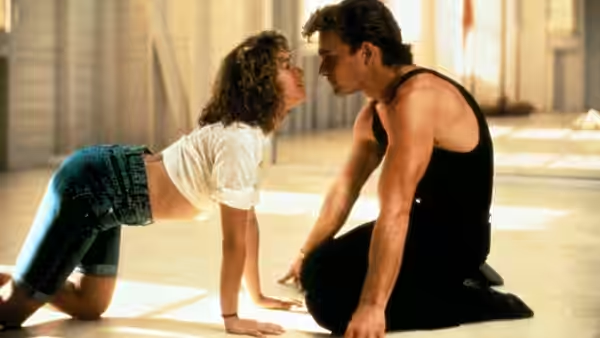
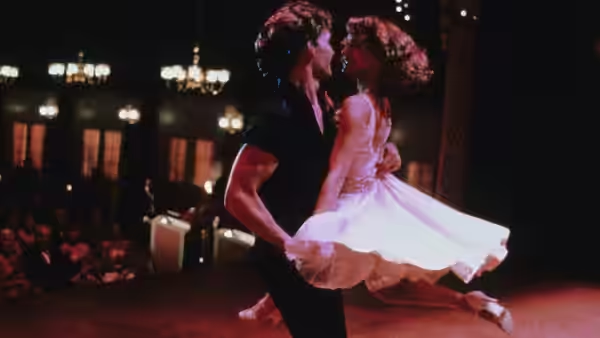
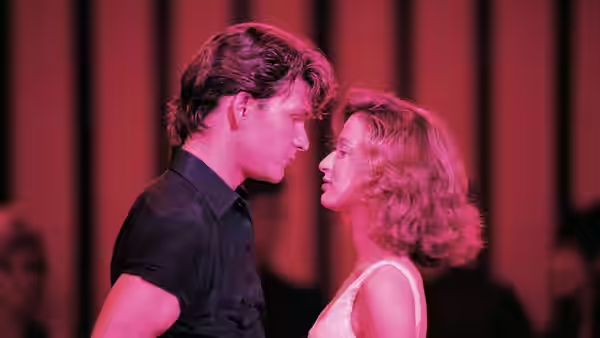
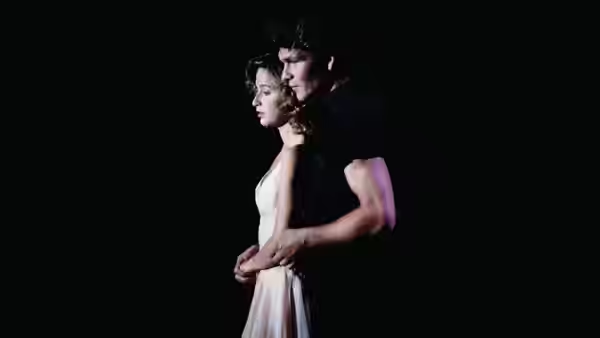
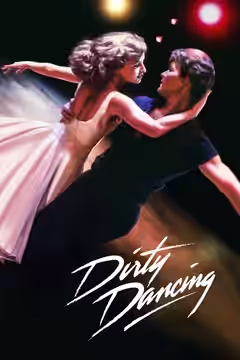
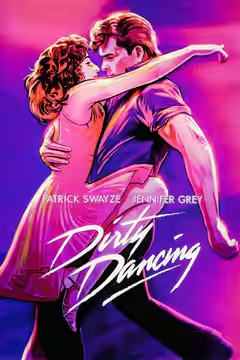
Baby (Jennifer Grey) lifted above the water by Johnny (Patrick Swayze)
Film review

Dirty Dancing

1987 · Directed by Emile Ardolino · 1h 40m · BBFC 12

In a sentencePatrick Swayze dances, and suddenly the dialogue seems a perfectly reasonable price to pay

Baby Houseman (Jennifer Grey) is drawn to Johnny Castle (Patrick Swayze), and dance becomes a way for them to get closer. Their developing relationship puts physical attraction and personal confidence alongside the effort of moving together. Jake Houseman (Jerry Orbach) and Penny Johnson (Cynthia Rhodes) also figure in their story, with Max Kellerman (Jack Weston), Lisa Houseman (Jane Brucker) and Marjorie Houseman (Kelly Bishop) among the surrounding characters. Rock-and-soul music accompanies a romance in which the couple learn about one another through dancing as well as conversation.

Plays from YouTube when you press play; nothing loads from them until then.

Fi1m review

Jennifer Grey and Patrick Swayze make Dirty Dancing a romance worth believing in, even when the dialogue invites resistance. The dancing earns the affection that the familiar plotting sometimes takes for granted.

Dirty Dancing is a good romantic film with a story that rarely surprises us and dancing that repeatedly does. Emile Ardolino understands that attraction becomes convincing when we can see two people respond to one another, without a speech explaining how much they feel. He gives Jennifer Grey and Patrick Swayze the space to make that happen. At 100 minutes, the film also has the sense not to make a modest story into a lengthy examination of itself.

Jennifer Grey makes Baby Houseman easy to care about because she never seems entirely certain of the impression she is making. There is eagerness in the performance, but also the awkwardness of trying to look as though everything comes naturally. We were moved by her concentration when she dances with Patrick Swayze; wanting to get it right becomes something more personal than mastering a routine. Her effort gives the romance a vulnerability that the dialogue cannot always supply.

Patrick Swayze’s Johnny Castle is more persuasive in motion than in conversation, and the film is sensible enough to exploit that. His assurance could make the pairing feel unequal; instead, he seems alert to what his partner is doing, so the attraction has something to build on. Eleanor Bergstein’s writing is less reliable when it has to give him comparable interest away from the dancing. He can feel like a romantic ideal whose character has been filled in only as far as the story requires.

That writing is also where the film’s earnestness occasionally becomes a problem. Too much dialogue sounds ready to be remembered, and the familiar course of the romance can make us aware of the next step before the characters take it. Yet Eleanor Bergstein gives the people enough warmth to stop them becoming mere obstacles or rewards. Even when we recognise the formula, the couple’s reactions keep the scenes from feeling entirely predetermined.

Jeffrey Jur’s cinematography is most useful when it lets us watch both dancers responding to each other. Peter C. Frank’s editing keeps pace with the music without making the movement difficult to follow. Those are straightforward virtues, but they matter when the physical work is doing so much of the storytelling. Away from the dancing, the photography is less distinctive, and David Chapman’s production design does little to change that. The surroundings give the performers somewhere to stand without often becoming interesting in themselves.

John Morris’s music is less memorable than the rock-and-soul songs, which supply much of the film’s warmth and physical energy. Music can make a romantic scene seem more persuasive than the acting deserves, but here the central performances hold up their end. The dancing is erotic because each partner appears to be paying attention to the other’s body. The pleasure comes from watching that attention become mutual, and the songs give it time to develop.

For a dance romance, the reservation is how often the spoken scenes leave us waiting for the music to start again. Emile Ardolino can rely on his leads to keep us interested through most of those passages, though the script occasionally makes their work unnecessarily difficult. We recommend it with some tolerance for lines that announce their importance before they have earned it. Give the dancing a chance before deciding that the sentiment is too much.


Critical consensus AI synthesised

73
Positive
6
Mixed
4
Negative
0

Most critics respond warmly to Dirty Dancing, with praise centred on the dancing, the romance and the charm of its performers. The more enthusiastic reviews find the central relationship believable and the characters’ growth involving, giving the film something beyond the pleasure of watching its stars dance. The music and lively storytelling also win approval, while even several qualified responses acknowledge an earnestness that helps the familiar material work.

The reservations concern how much substance and visual care sit beneath that appeal, rather than whether the film offers any pleasure. Variety praises Jennifer Grey and the dance sequences but finds Patrick Swayze’s character unconvincing and the film shallow. Slant Magazine is more critical of the formula and visually lazy filmmaking, though it credits the lively characters with keeping the romance engaging. The spread runs from enthusiasm to mixed approval, with no wholly negative verdict among the supplied scores.

Los Angeles Times
21 August 1987 · Sheila Benson
90*

Benson finds the film smart, funny, touching, and deeply involving. She especially praises the dancing and the believable performances that make its characters’ growth resonate.

Read the full review →
Empire
1 January 2000 · Caroline Westbrook
80*

The critic finds the film immensely charming and enduringly appealing. Its cheesy, quotable dialogue and euphoric final dance are singled out as key pleasures.

Read the full review →
Evening Standard
10 April 2012
80*

The capsule celebrates the film as a lively teen movie that still works. It singles out the dancing, rock-and-soul music, and storytelling for praise.

Read the full review →
Radio Times
★★★★ · Sue Heal
80

Heal finds that the film works a curious, charismatic magic and that the central relationship never feels false. She especially praises the fabulous, highly erotic dancing.

Read the full review →
Time Out
14 February 2017 · ★★★★ · Ellie Walker-Arnott
80

The page identifies the film as a review, but the review text is unavailable. Its metadata highlights the romance and Patrick Swayze’s dancing while noting the film’s return for its thirtieth anniversary.

Read the full review →
The Guardian
· Peter Bradshaw
70*

Bradshaw finds the film amiable and sees it as embodying the purest spirit of the 1980s. He singles out its defining decade-era spirit for praise.

Read the full review →

Straight answers AI written, from our review

Is Dirty Dancing worth watching?
Dirty Dancing is worth watching for its convincing central romance and expressive dancing; we score it 79 out of 100. Jennifer Grey and Patrick Swayze make the attraction believable, though we recommend some tolerance for familiar plotting and dialogue that tries too hard to be memorable.
How long is Dirty Dancing, and what is it rated?
Dirty Dancing runs 1h 40m and is rated 12 by the BBFC in the UK. It is a drama and music film.
Where can I watch Dirty Dancing in the UK?
Dirty Dancing is streaming on Disney+ in the UK. Availability is checked daily; the links above go straight to each service.
How violent or frightening is Dirty Dancing, and is it suitable for children?
Dirty Dancing has a UK 12 certificate, making it a more suitable choice for teenagers than younger children. We would flag the erotic quality of the dancing and the emphasis on physical attraction; the certificate alone does not establish how much violence or frightening material it contains.
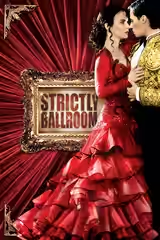
How does Dirty Dancing compare to Strictly Ballroom?
Dirty Dancing is the stronger choice for a tender, physically convincing romance, while we favour Strictly Ballroom for comedy and a taste for excess. Both use dancing to make a familiar courtship engaging, but their weaknesses differ: Dirty Dancing strains for memorable dialogue, while Strictly Ballroom sometimes lets its comedy shout.
What should I watch after Dirty Dancing?
After Dirty Dancing, try Strictly Ballroom (1992, Fi1m 83): Another dance romance that understands the pleasure of being a little excessive. Then The Red Shoes (1948, Fi1m 92): For dancing filmed with the intensity of an entire life at stake.

Cast

Awards

Amanda Award for Best Foreign Feature Film, 1988

Won
Amanda Award for Best Foreign Feature Film

If you liked this, try…

  1. Strictly Ballroom (1992, Fi1m 83)Another dance romance that understands the pleasure of being a little excessive.

  2. The Red Shoes (1948, Fi1m 92)For dancing filmed with the intensity of an entire life at stake.

  3. Shall We Dance? (1996) · not on Fi1m yetA quieter Japanese account of how dancing can unsettle a carefully managed life.

  4. Girlhood (2014) · not on Fi1m yetFemale friendship, music and the precarious business of deciding who to become.

  5. Love & Basketball (2000) · not on Fi1m yetAnother romance where physical skill makes attraction visible before anyone explains it.