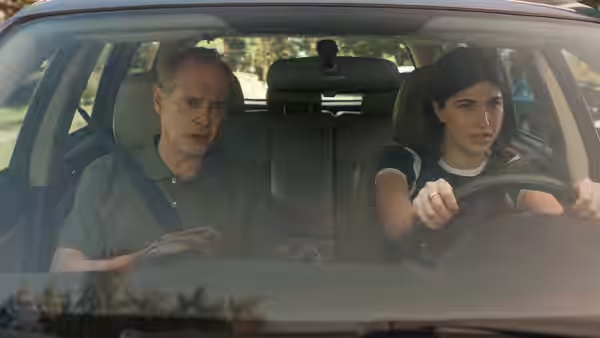
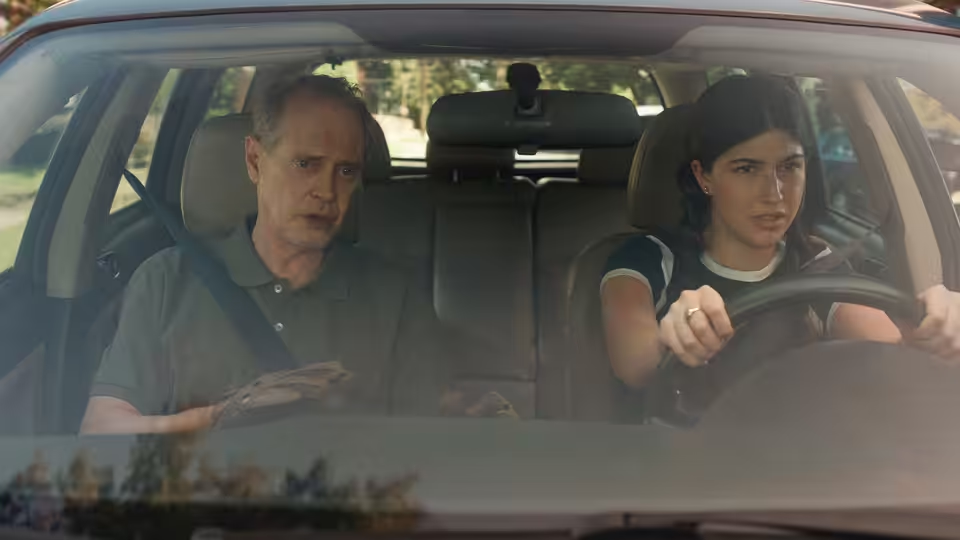
Steve Buscemi rides in a car driven by a young woman
Film review

Don't Say Good Luck

2026 · Directed by Julia Hart · 1h 36m · MPA PG-13

In a sentenceThe school musical is about pie, the mother has a diagnosis, and everybody in the house keeps setting the table anyway

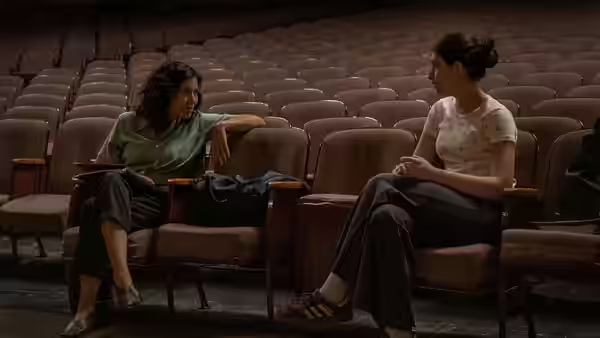
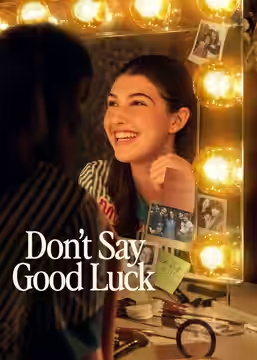
Sophie Birenbaum (Sunny Sandler) is in her last year of high school and has just been cast as the lead in the school’s production of Waitress, the Sara Bareilles musical about a woman who bakes pies to keep her life together. At home, her mother Elizabeth (Melanie Lynskey) has learned that her cancer has come back. Her father Ted (Max Greenfield) keeps the meals and the calendar going, her brothers Caleb (Matan Friedman) and Ethan (Eitan Friedman) are told less than they notice, and Sophie has rehearsals every evening. She wants to open the show with her mother in the audience. Elizabeth wants her to carry on as if nothing were wrong, and neither of them is sure the other means it.

Plays from YouTube when you press play; nothing loads from them until then.

Fi1m review

Julia Hart’s small, sincere film about a girl rehearsing a school musical while her mother’s cancer returns is honestly acted and mostly unsentimental. Melanie Lynskey is the reason to watch it; the school half of the story is a good deal thinner than the home half.

Julia Hart has made a film about a girl who gets the lead in her school musical in the season her mother’s cancer comes back. That set-up has a trapdoor under it, and many films have fallen straight through. This one mostly does not. It is small, honestly acted and short, and at its best in the Birenbaum kitchen. It is worth your evening if you are willing to be upset. We would not send you to it for the musical.

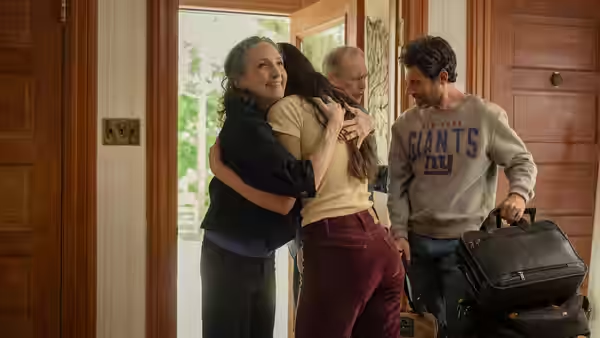
Sophie Birenbaum (Sunny Sandler) is cast as the lead in Waitress, and the film cuts between her rehearsals and a house where nobody says quite what they mean. Her mother Elizabeth (Melanie Lynskey) wants the show to go on and wants to be there. Her father Ted (Max Greenfield) keeps the calendar, the meals and the brothers, Caleb (Matan Friedman) and Ethan (Eitan Friedman), in order. The script, by Laura Hankin, Jordan Horowitz and Hart, treats the illness as a household fact rather than an event. People still have to eat and get to school.

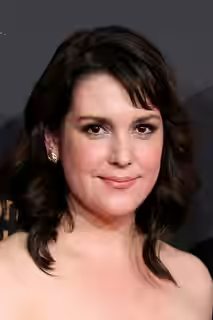
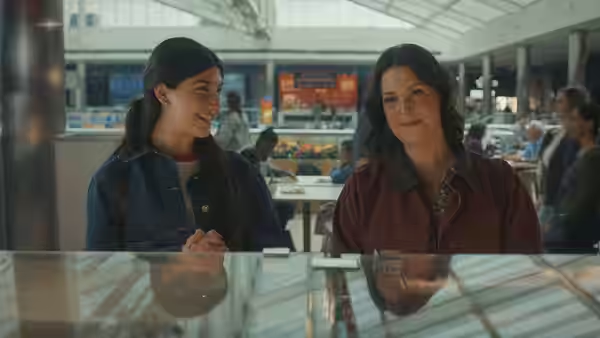
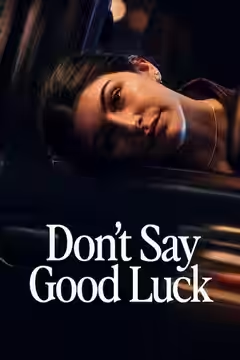
Lynskey is the reason to watch. She plays Elizabeth as a woman who has done this once already and knows the etiquette: who to tell, how to be told things, how to make a joke land before anyone can pity her. She is funny, and never brave in the way films usually mean it. Near the end of the first act, in a car outside the school, she tells Sophie something ordinary about the week and cannot get the next sentence out. We cried, and were a little annoyed with ourselves for how easily it happened. Nothing in the staging asks for it. Bryce Fortner holds the shot through the windscreen and does not move, and Lynskey simply runs out of words.

Sandler is good, and better than the school scenes around her. Sophie is self-absorbed in the way teenagers are, and the script lets her be, which is rare; she is allowed to be cross that her mother’s illness is making her late for rehearsal, and the film does not punish her for it. Sandler sings well enough to be believed as the best singer in a school, which is the standard required. Greenfield plays Ted as a man who has decided that being cheerful is a job and is doing it slightly too hard; the one scene where he stops is the second time the film got us.

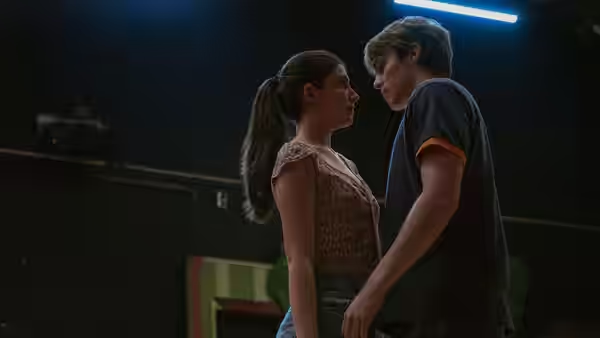
The school half is where it thins out. Stephanie Beatriz, as Ms. Parker, has less to do than her billing suggests, and the students around Sophie (Scarlett Estevez, Jack Champion, Emma McNulty) get one trait each. The Waitress material, Bareilles’s songs about a woman who bakes her feelings into pies, mirrors what is happening at home so plainly that we could see each rhyme coming. Steve Buscemi and Bebe Neuwirth turn up as Dale and Linda, and either would have been worth more scenes than they get.

Hart’s restraint mostly looks like taste and occasionally like caution. Tim Grimes’s house is cluttered and lived in, with a fridge covered in paper and a hallway of shoes, and Fortner lights it warm and low, so the family scenes look like evening even when they are not. Vanessa Porter puts Sophie in the pale diner uniform for rehearsals and keeps Elizabeth in soft layers that grow bulkier as the film goes on. Yuli’s score is a few piano figures and then silence, and stays out of the way of the show tunes. Shayar Bhansali cuts it to 96 minutes and nothing outstays its welcome; the school scenes could have gone harder still.

Set against Hart’s earlier films, Fast Color and Stargirl, this is the most conventional thing she has made. It is also the one we felt most. Most critics like it a little more than we do; they are right about the performances and generous about the rest. It is a well-made television film in shape and scale, and there is no shame in that.

Watch it at home with someone you do not mind crying in front of, and do not expect to remember the songs.

Critical consensus AI synthesised

75
Positive
8
Mixed
2
Negative
0

Most critics like Don’t Say Good Luck, and the praise gathers around two performances. Melanie Lynskey, as a mother whose cancer has returned, is named in nearly every review as the film’s emotional centre, and several call her work quiet and true rather than showy. Sunny Sandler, as the daughter preparing to lead her school’s production of Waitress, is credited with more range and maturity than the reviews expect from a teenage lead. The writing is praised for treating the diagnosis as something the family lives with rather than a countdown, and for keeping the high-school scenes light without making the rest feel trivial.

The spread is fairly wide. Two reviews are lukewarm: Radio Times finds a competent television weepie with flat characters and a self-centred protagonist, and The Times thinks the daughter shines while the film around her does not. Even admirers mention contrivances and thin supporting roles, and one notes the film skirts the grimmer realities of the illness.

RogerEbert.com
12 August 2026 · Tomris Laffly
86*

The critic praises the film as a disarmingly lovely coming-of-age tale with a gently simmering tragedy, highlighting Sunny Sandler's wonderful performance as Sophie and the compassionate script that honors both her high-school world and family challenges. They single out the emotional maturity and range of Sandler's portrayal, along with Hart's sensitive direction that avoids clichés.

Read the full review →
The AV Club
13 August 2026 · B+ · Monica Castillo
83

The review describes a tender yet grounded weepy focused on living with a cancer diagnosis rather than death, praising its realistic depiction of family dynamics, levity amid tragedy, and strong performances, especially Melanie Lynskey as the mother. It notes the film earns its emotional payoff through character relationships rather than melodrama.

Read the full review →
IndieWire
12 August 2026 · Kate Erbland
82*

The critic calls it a tender and honest coming-of-age cancer drama with a welcome high school musical element that will break viewers' hearts. It highlights the strong performances by Melanie Lynskey and Sunny Sandler and the film's blend of grief and everyday life.

Read the full review →
Variety
12 August 2026 · Guy Lodge
80*

The critic describes it as an honest four-hanky weepie that works, commending Sunny Sandler and Melanie Lynskey for giving genuine soul to the mother-daughter heartbreaker and Hart's sensitive, open-hearted direction. They single out the care and compassion in the writing and performances that avoid flat stereotypes.

Read the full review →
Los Angeles Times
13 August 2026 · Mary McNamara
79*

The critic calls it a moving argument for aspirational television and a tender ode to parental support, praising Melanie Lynskey's quietly transcendent performance as the mother and the film's emotionally resonant portrayal of a loving family. They single out the authentic feelings and message despite skirting some grim realities.

Read the full review →
The Hollywood Reporter
12 August 2026 · Angie Han
78*

The critic praises the film as a sensitive, fine-grained drama about a teen navigating her mother's cancer recurrence while starring in her high school production of Waitress. It singles out the authentic, tender mother-daughter relationship and performances by Sunny Sandler and especially Melanie Lynskey for praise, while noting minor narrative and supporting-character issues.

Read the full review →

Straight answers AI written, from our review

Is Don't Say Good Luck worth watching?
Don't Say Good Luck is worth an evening for anyone willing to be upset by a small, honestly acted family drama, and we scored it 71. Melanie Lynskey, as a mother whose cancer has returned while her daughter rehearses a school musical, is the reason to watch. The school half is thinner than the home half, and we would not go to it for the songs.
How long is Don't Say Good Luck, and what is it rated?
Don't Say Good Luck runs 1h 36m and is rated PG-13 by the MPA in the US. It is a comedy and music film.
Where can I watch Don't Say Good Luck in the US?
Don't Say Good Luck is streaming on Netflix in the US. Availability is checked daily; the links above go straight to each service.
How violent or frightening is Don't Say Good Luck, and is it suitable for children?
Don't Say Good Luck is a UK 12 and contains no violence to speak of; what it asks of a viewer is the ability to sit with a mother's cancer diagnosis and a household that keeps setting the table anyway. Nothing frightens, but two scenes made us cry. Younger children may find it slow and sad; teenagers, especially those who have been in a school show, are its natural audience.
How does Don't Say Good Luck compare to Terms of Endearment?
Don't Say Good Luck is a smaller, gentler film than Terms of Endearment, and the earlier film is the better of the two. Brooks's drama is funnier, covers thirty years and lets its people be hard to like; Hart's is 96 minutes of one family in one season, more careful and less memorable. Choose Hart for restraint, Brooks for the full weepie.
What should I watch after Don't Say Good Luck?
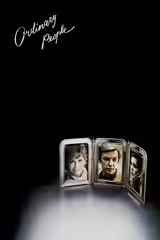
After Don't Say Good Luck, try Terms of Endearment (1983, Fi1m 81): The mother-and-daughter weepie everyone else is measured against, and still funnier than most. Then The Farewell (2019, Fi1m 84): A family decides not to tell grandmother she is dying, and dinner goes on regardless; and Ordinary People (1980, Fi1m 81): A well-off family fails to talk about a loss; quiet, exact and hard to shake.

Cast

If you liked this, try…

  1. Terms of Endearment (1983, Fi1m 81)The mother-and-daughter weepie everyone else is measured against, and still funnier than most.

  2. Waitress (2007) · not on Fi1m yetThe film the musical came from; pies, a bad marriage and a diner worth living in.

  3. The Farewell (2019, Fi1m 84)A family decides not to tell grandmother she is dying, and dinner goes on regardless.

  4. Sing Street (2016) · not on Fi1m yetDublin schoolboys form a band to impress a girl; the songs are actually good.

  5. Ordinary People (1980, Fi1m 81)A well-off family fails to talk about a loss; quiet, exact and hard to shake.