Julia Hart’s small, sincere film about a girl rehearsing a school musical while her mother’s cancer returns is honestly acted and mostly unsentimental. Melanie Lynskey is the reason to watch it; the school half of the story is a good deal thinner than the home half.
Julia Hart has made a film about a girl who gets the lead in her school musical in the season her mother’s cancer comes back. That set-up has a trapdoor under it, and many films have fallen straight through. This one mostly does not. It is small, honestly acted and short, and at its best in the Birenbaum kitchen. It is worth your evening if you are willing to be upset. We would not send you to it for the musical.
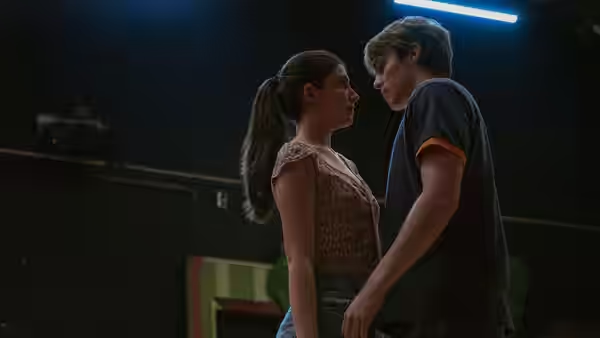
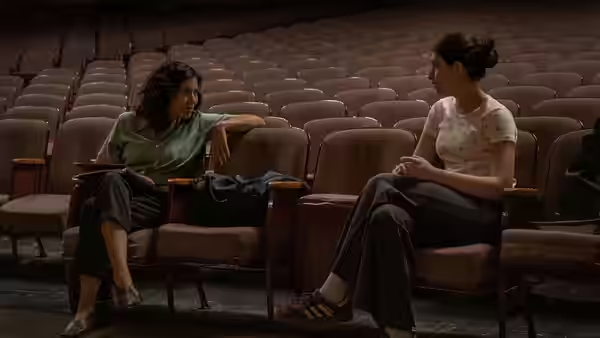
Sophie Birenbaum (Sunny Sandler) is cast as the lead in Waitress, and the film cuts between her rehearsals and a house where nobody says quite what they mean. Her mother Elizabeth (Melanie Lynskey) wants the show to go on and wants to be there. Her father Ted (Max Greenfield) keeps the calendar, the meals and the brothers, Caleb (Matan Friedman) and Ethan (Eitan Friedman), in order. The script, by Laura Hankin, Jordan Horowitz and Hart, treats the illness as a household fact rather than an event. People still have to eat and get to school.
Lynskey is the reason to watch. She plays Elizabeth as a woman who has done this once already and knows the etiquette: who to tell, how to be told things, how to make a joke land before anyone can pity her. She is funny, and never brave in the way films usually mean it. Near the end of the first act, in a car outside the school, she tells Sophie something ordinary about the week and cannot get the next sentence out. We cried, and were a little annoyed with ourselves for how easily it happened. Nothing in the staging asks for it. Bryce Fortner holds the shot through the windscreen and does not move, and Lynskey simply runs out of words.
Sandler is good, and better than the school scenes around her. Sophie is self-absorbed in the way teenagers are, and the script lets her be, which is rare; she is allowed to be cross that her mother’s illness is making her late for rehearsal, and the film does not punish her for it. Sandler sings well enough to be believed as the best singer in a school, which is the standard required. Greenfield plays Ted as a man who has decided that being cheerful is a job and is doing it slightly too hard; the one scene where he stops is the second time the film got us.
The school half is where it thins out. Stephanie Beatriz, as Ms. Parker, has less to do than her billing suggests, and the students around Sophie (Scarlett Estevez, Jack Champion, Emma McNulty) get one trait each. The Waitress material, Bareilles’s songs about a woman who bakes her feelings into pies, mirrors what is happening at home so plainly that we could see each rhyme coming. Steve Buscemi and Bebe Neuwirth turn up as Dale and Linda, and either would have been worth more scenes than they get.
Hart’s restraint mostly looks like taste and occasionally like caution. Tim Grimes’s house is cluttered and lived in, with a fridge covered in paper and a hallway of shoes, and Fortner lights it warm and low, so the family scenes look like evening even when they are not. Vanessa Porter puts Sophie in the pale diner uniform for rehearsals and keeps Elizabeth in soft layers that grow bulkier as the film goes on. Yuli’s score is a few piano figures and then silence, and stays out of the way of the show tunes. Shayar Bhansali cuts it to 96 minutes and nothing outstays its welcome; the school scenes could have gone harder still.
Set against Hart’s earlier films, Fast Color and Stargirl, this is the most conventional thing she has made. It is also the one we felt most. Most critics like it a little more than we do; they are right about the performances and generous about the rest. It is a well-made television film in shape and scale, and there is no shame in that.
Watch it at home with someone you do not mind crying in front of, and do not expect to remember the songs.