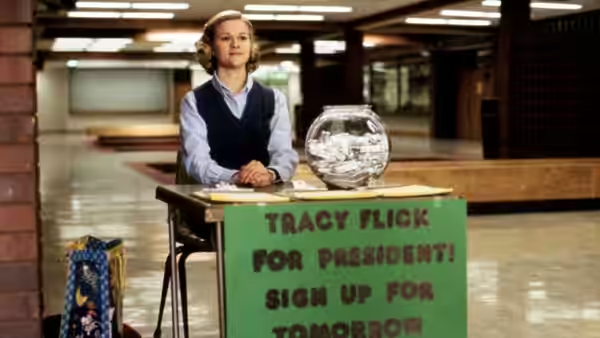
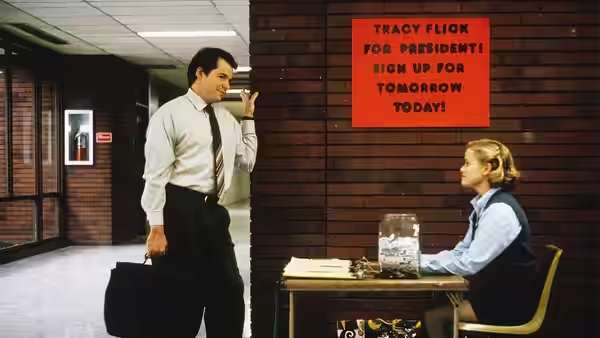
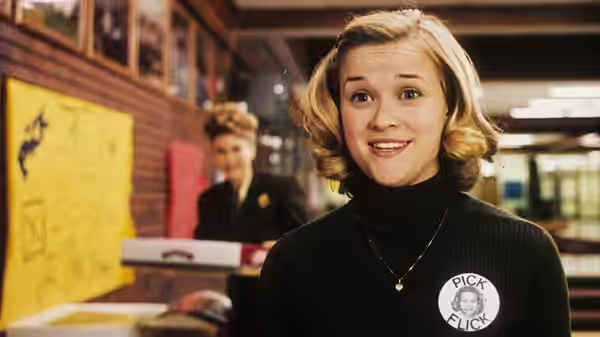
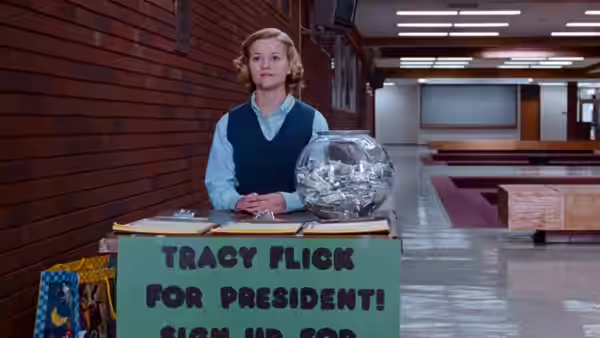
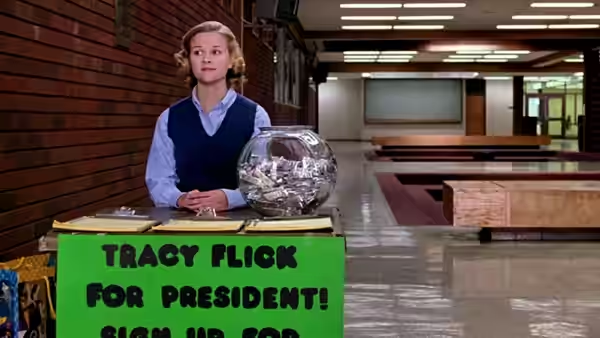
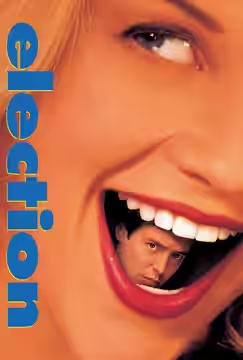
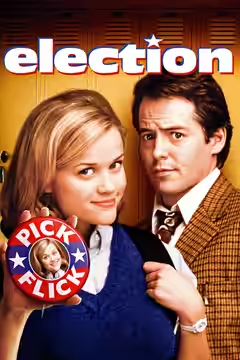
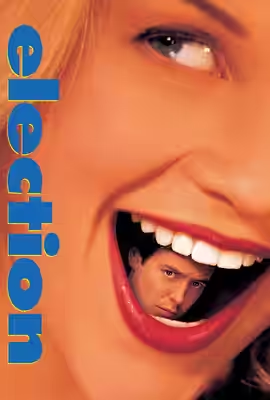
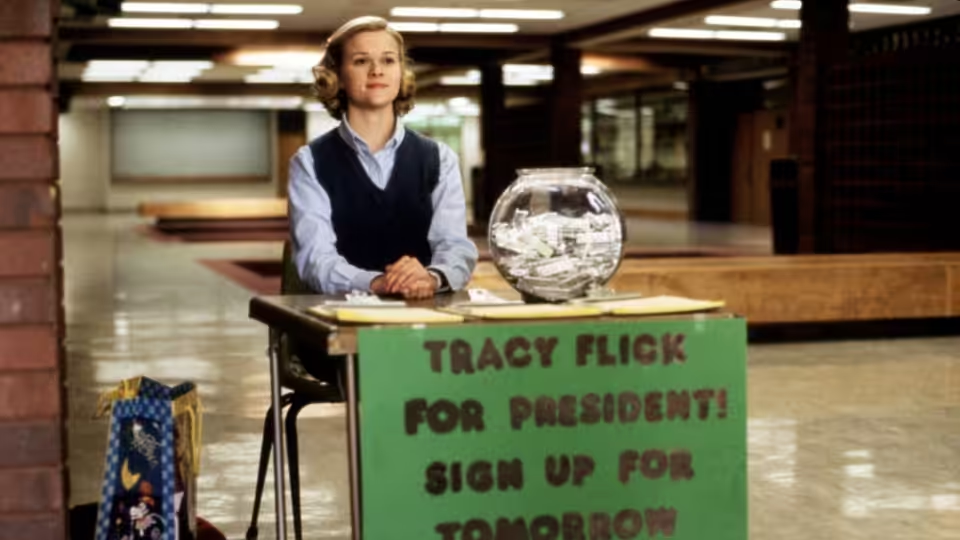
Tracy Flick (Reese Witherspoon) stands behind her campaign table in a school hallway
Film review

Election

1999 · Directed by Alexander Payne · 1h 43m · RO 12

In a sentenceThe school election would be much less unpleasant without all that adult supervision

Jim McAllister (Matthew Broderick) is a high-school teacher whose working life becomes entangled with a student election. Tracy Flick (Reese Witherspoon) is an overachiever who takes the contest seriously, and her ambition brings the teacher’s own frustrations into focus. As the campaign exposes rivalries among pupils and adults, questions of fairness become tangled up with personal grievances. The story moves between different characters’ accounts of events, following the distance between their stated principles and their behaviour. Chris Klein and Jessica Campbell also appear as Paul and Tammy Metzler in Alexander Payne’s adaptation of Tom Perrotta’s novel.

Plays from YouTube when you press play; nothing loads from them until then.

Fi1m review

Alexander Payne’s Election is a sour, funny school comedy with an unusually clear view of adult self-deception. Reese Witherspoon and Matthew Broderick make its cruelty worth watching, even when the direction presses a joke harder than it needs to.

Alexander Payne’s Election makes a high-school contest nasty enough to justify the attention usually reserved for grown-up politics. It is a sharply funny comedy, especially good at showing how a reasonable explanation can conceal an unreasonable dislike. Jim McAllister, played by Matthew Broderick, gives us an adult’s view of the proceedings without earning an adult’s authority. His attitude towards Reese Witherspoon’s ambitious Tracy Flick is the trouble. Payne lets us understand it before asking us to examine it.

Broderick is excellent at making resentment sound like a professional concern. Jim’s account of himself is persuasive partly because he seems so much less strenuous than Tracy; he does not require us to admire his effort every moment. We were embarrassed by how readily we sided with him. The performance makes disliking a pupil feel reasonable before we have properly considered what she has done to deserve it. Broderick keeps that expectation of sympathy audible beneath Jim’s explanations.

Witherspoon gives Tracy enough force to make that dislike comprehensible, without accepting that it is fair. Her determination can be exhausting to watch, and the performance does not soften it into an invitation to feel protective. Payne notices how easily a girl’s ambition gets treated as bad manners. We can see why she irritates Jim and still think he ought to know better. The comedy depends on both actors holding their positions, and Witherspoon does not surrender hers for an easy moment of likeability.

Payne and Jim Taylor’s screenplay, adapted from Tom Perrotta’s novel, is careful about who gets to explain themselves. The competing voice-overs prevent Jim’s version from becoming the only one available. They also let the characters give themselves away while making a defence. Even the people behaving badly can tell a plausible story about why they are right, and the script allows us to hear it. The dialogue is funny because the excuses sound usable, including by people who would consider themselves above this sort of behaviour.

James Glennon’s cinematography serves the faces well, keeping the contrast between Tracy’s eagerness and Jim’s distaste easy to read. Jane Ann Stewart’s production design makes the school feel ordinary enough for the intensity of the contest to seem faintly absurd. The setting matters because this struggle must share space with the routine business of teaching. Rolfe Kent’s music helps enlarge these small grievances into events the characters consider momentous. We do not have to agree with their assessment to enjoy the fuss.

Kevin Tent’s editing handles the shifts between accounts briskly, and the freeze-frames give the performances an extra comic emphasis. That emphasis is also our small reservation. At times Payne seems too eager to make somebody look ridiculous, with the musical cues and visual punctuation underlining what an actor has already made clear. The humour becomes coarser when it tells us whom to laugh at, particularly in a film otherwise so alert to unfair judgement.

The 103-minute running time feels right for a dispute this concentrated. As a school comedy, Election gains enormously from letting the teacher be as questionable as the pupil. The political parallels are clear enough without treating every character as a representative of some larger constituency. Its attention to individual excuses keeps the satire funny even when the behaviour becomes painful to watch. Watch it with someone who will argue about which of these people is being treated fairly.

Critical consensus AI synthesised

78
Positive
7
Mixed
0
Negative
1

Most critics greet Election as a sharp, darkly funny satire that uses a high-school contest to examine American ambition, political hypocrisy and resentment. Praise centres on the precise dialogue and the performances of Reese Witherspoon and Matthew Broderick, whose competing frustrations give the comedy much of its bite. The reviews also value the shifting viewpoints: voice-overs let several characters make their case, while the humour leaves space for sympathy and the pain of failure.

The disagreement is less about individual weaknesses than whether the satire works at all, with enthusiasm dominating but one strongly negative response widening the spread. The Independent finds the characters cartoonish and one-dimensional, and the humour insufficient, despite acknowledging the literate script and cast performances. Where that review sees immaturity, most critics find a perceptive account of adult failings within school politics, with enough nuance to keep its targets human.

RogerEbert.com
30 April 1999 · ★★★★/4 · Roger Ebert
100

The critic praises the film as a wicked satire on high school elections and ambition that sees the story through a teacher's eyes while balancing sympathy for its characters. It stands out from other teen movies by offering a parable about elections and the types of people who run for office.

Read the full review →
Empire
1 January 2000 · Kim Newman
85*

The critic praises the film as an outstanding, brilliantly scripted high-school satire that incisively examines American mores with sharp characters and black humour, calling it excellent and funny yet painful.

Read the full review →
The Hollywood Reporter
19 April 1999 · Michael Rechtshaffen
85*

The critic calls it a sharp, funny high school satire that is the best among recent teen films and a winning sophomore effort from Alexander Payne. He singles out Reese Witherspoon's deliciously driven performance as the overachiever Tracy Flick and praises Payne's deft integration of voice-overs, freeze frames, and musical cues.

Read the full review →
The New Yorker
19 April 1999 · David Denby
85*

The critic hails the film as a wonderful satirical comedy that uses the school election as a prism for an acute comic analysis of success and failure in American life. Payne and Taylor are singled out as perhaps the only true social satirists working in American movies at the time.

Read the full review →
Los Angeles Times
23 April 1999
80*

The review describes the film as a sharp and merciless comedy and the best high school adventure since Heathers, with expert performances and a fierce teen satire that adults will cherish. It highlights the film's dark comic style, precise dialogue, and ability to make viewers complicit in its wicked schemes.

Read the full review →
Radio Times
7.2/10 · David Parkinson
72

The review positions it near the top of high-school movies as a dark, funny twist on the popularity contest theme, with inspired casting of Matthew Broderick against Reese Witherspoon's manipulative overachiever. It highlights the sly satire of contemporary American politics through the school microcosm and calls the result astute, offbeat and uproarious.

Read the full review →

Straight answers AI written, from our review

Is Election worth watching?
Election is worth watching for anyone who likes a school comedy with real spite in it, and we scored it 86. Matthew Broderick and Reese Witherspoon make the teacher and the pupil equally questionable, which is the film's chief pleasure. Our one reservation is that Alexander Payne sometimes underlines a joke the actors have already landed.
How long is Election, and what is it rated?
Election runs 1h 43m and is rated 12 by the RO in Romania. It is a comedy and drama film.
Where can I watch Election in Romania?
Election is available to rent from Amazon Prime Video from lei 9.99. Availability is checked daily; the links above go straight to each service.
How violent or frightening is Election, and is it suitable for children?
Election carries a 15 certificate in the UK and is not a film for children, though its adult content is verbal rather than violent or frightening. The cruelty is in the characters' behaviour towards each other and in the lies they tell about it. Older teenagers who can take an unflattering view of adults should manage it comfortably.
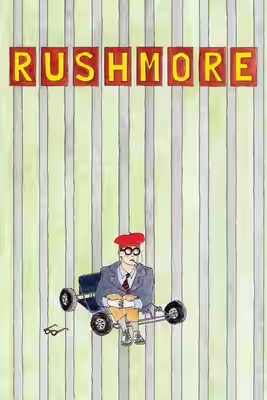
How does Election compare to Rushmore?
Election is the sourer and sharper of the two, while Rushmore is warmer and more openly eccentric. Both are school comedies in which adult vanity does more damage than teenage misbehaviour, but Payne's film keeps a colder eye on its teacher. We would send someone wanting a funny argument about fairness to Election, and someone wanting sadness under the jokes to Rushmore.
Is Election based on a true story or a book?
Election is based on a novel by Tom Perrotta, adapted for the screen by Alexander Payne and Jim Taylor; it is not a true story. The screenplay keeps the device of competing accounts, so several characters get to explain themselves and give themselves away. You do not need to have read the book to follow or enjoy the film.
What should I watch after Election?
After Election, try Rushmore (1998, Fi1m 83): Another school where adult vanity proves more disruptive than teenage misbehaviour. Then The Thick of It (2005, Fi1m 94): Political work becomes a succession of personal humiliations, grudges and desperate excuses.

Cast

Awards

Academy Awards, 2000

Nominated
Best Writing, Adapted Screenplay

If you liked this, try…

  1. Rushmore (1998, Fi1m 83)Another school where adult vanity proves more disruptive than teenage misbehaviour.

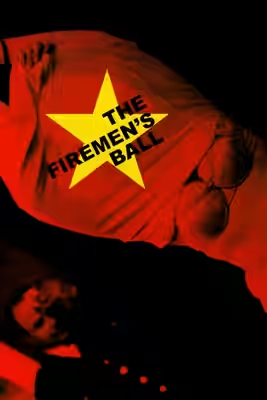
  2. The Firemen's Ball (1967) · not reviewed yetA public celebration exposes the petty grievances and incompetence of its organisers.

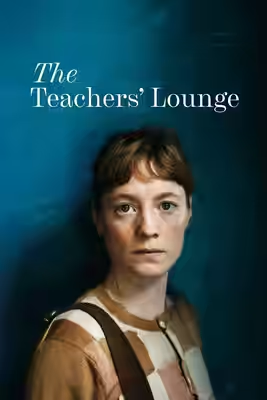
  3. The Teachers' Lounge (2023) · not reviewed yetA school dispute makes professional certainty increasingly difficult to separate from stubbornness.

  4. The Class (2008) · not reviewed yetClassroom authority gets a less comic, equally searching examination through everyday disagreements.

  5. The Thick of It (2005, Fi1m 94)Political work becomes a succession of personal humiliations, grudges and desperate excuses.

Free account

Know what to watch tonight

Two lists that know where things are streaming, collections you can share, your own score beside ours, and Discover that remembers what you have seen.

  • Want to see, sorted by what is streaming now
  • Seen, with your score out of ten
  • No adverts, ever