The opening half hour, about a lonely boy who wants to be taken away, is close to Pixar’s best. What follows is bright, busy and kind, and it is also the story you expect, told at the pace of someone who has told it before.
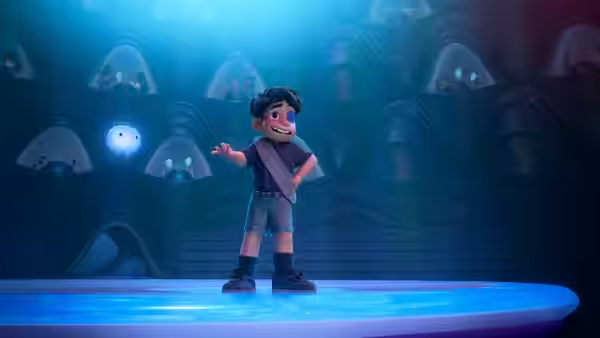
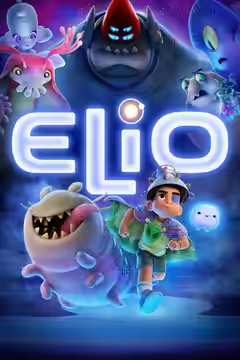
Elio is an orphan living with his aunt Olga Solís (voiced by Zoe Saldaña), and he wants nothing on Earth so much as to be off it. He gets his wish. A beam picks him up and drops him in the Communiverse, a council of alien ambassadors who have asked for Earth’s leader and take it for granted that the small boy in front of them must be him. Three directors are credited, Domee Shi, Adrian Molina and Madeline Sharafian, and the screenplay has three names on it too, Julia Cho, Mark Hammer and Mike Jones. You can feel the hands. The result is decent, warm and busy, and it is at its best before it leaves the ground.
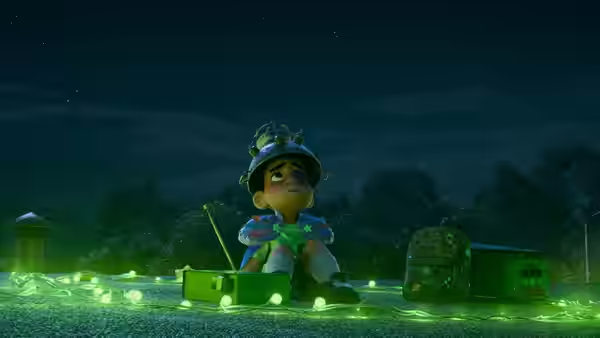
The Earth scenes are the film’s argument for itself. Elio is not a cute lonely child; he is a rude, hurt one, and Yonas Kibreab voices him with the flat, defended tone of a boy who has decided that wanting things is a mistake. Saldaña plays Olga as someone doing a job she did not apply for and trying not to let it show. We were moved earlier than we expected, and by something small: a boy talking to the night sky as if it were the only thing that might answer, while his aunt stands in the doorway not knowing what to say. Nothing in the film’s last hour lands as cleanly as that.
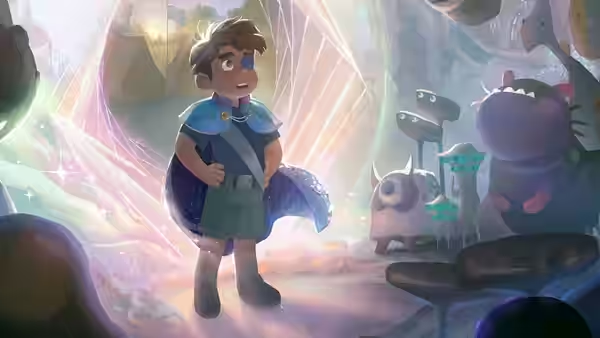
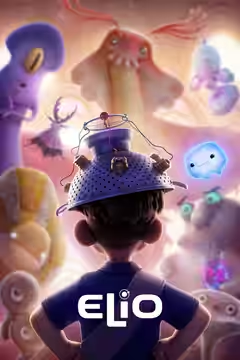
The Communiverse is Harley Jessup’s design, and for ten minutes it is a pleasure. It glows from the inside, all translucent walls and floating platforms, and the ambassadors are a menagerie: a creature like a jellyfish, one like a stack of stones, a computer called Ooooo (Shirley Henderson) that is essentially a talking puddle. Danielle Feinberg and Matt Aspbury light the Earth in flat daylight and the orange of sodium lamps, and the Communiverse in pinks and greens that come from nowhere in particular. Then we noticed it never changes. A place built to contain the whole galaxy looks the same in every scene, and after a while the eye stops working.
What holds the middle together is Glordon. Remy Edgerly voices him, the son of Lord Grigon (Brad Garrett), a warlord who is mostly armour and gravel, and Glordon is a soft pink grub with no arms, a wide mouth and no wish to fight anyone. Every scene he shares with Elio is better than the scenes around it, because the two of them are simply talking, two boys who each think the other has the easier life. The father-and-son thread that grows out of this is the strongest thing in the second half, and it belongs to the supporting cast. That tells you something about where the writing’s attention went.
Once Elio’s deception is found out, the film turns into a rescue and a chase, with a duplicate Elio left behind on Earth (Kibreab voices both) to keep Olga from noticing. Anna Wolitzky and Steve Bloom cut this stretch fast, so scenes keep ending a beat before they have said anything, and Rob Simonsen’s score swells at each reveal to tell us how to feel about it. The lesson, that the thing which sets you apart is the thing that will save you, arrives on schedule and is then said aloud, twice. We were never bored. We were rarely surprised, and in a film about the whole of space that seems a waste.
Against the studio’s own record it sits in the middle. Shi’s Turning Red (2022) and Molina’s Coco (2017) each had one idea and a very particular family to hang it on; this has the shape of those films and fewer of the particulars. It is a marked step up in charm and looks from recent Pixar, and a step down from the ones people still quote.
Take a child, if you have one to hand. They will adore Glordon, and so, if we are honest, did we. Grown-ups get a fine half hour and then a pleasant, well-lit wait. It runs 98 minutes and carries a PG.