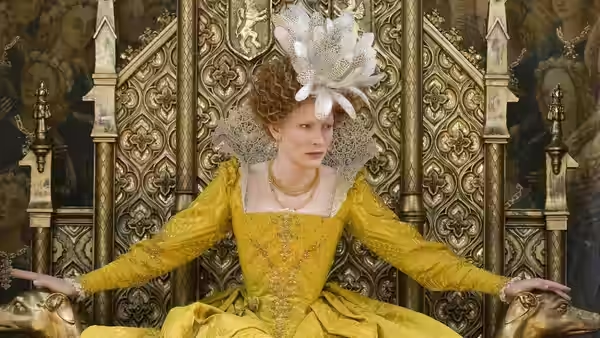
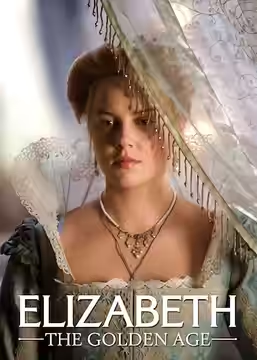
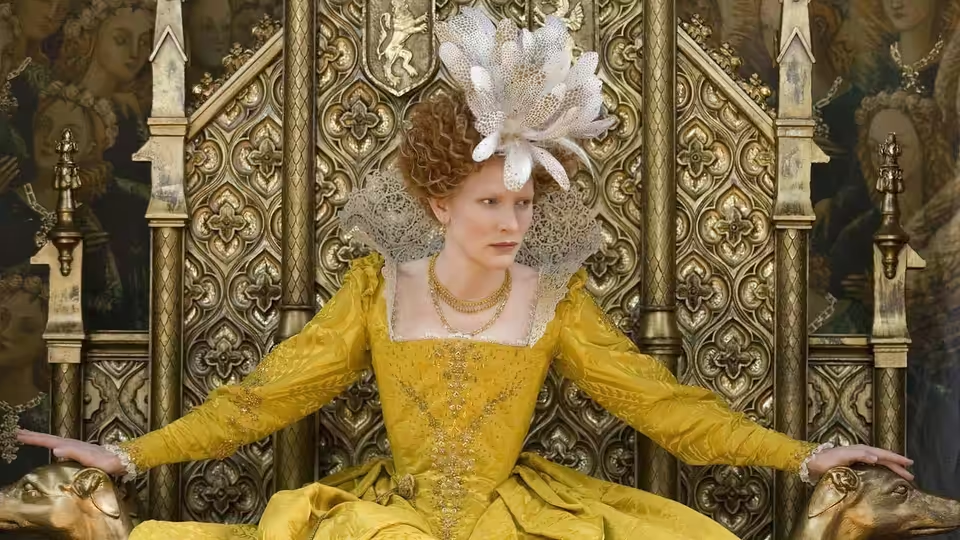
Elizabeth I (Cate Blanchett) sits on an ornate throne in a yellow gown
Film review

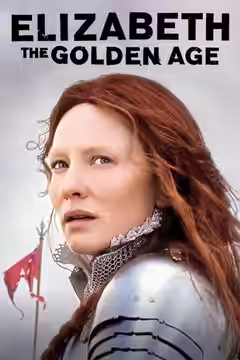
Elizabeth: The Golden Age

2007 · Directed by Shekhar Kapur · 1h 54m

In a sentenceElizabeth I against Philip II, and both of them losing to the orchestra

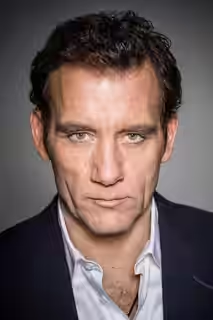
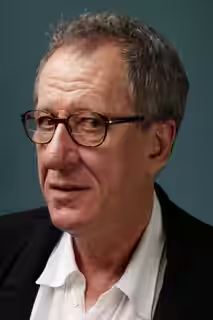
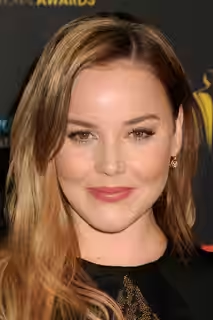
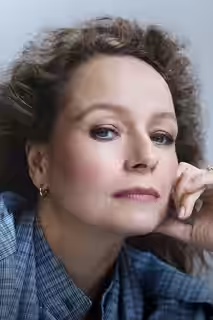
Elizabeth I (Cate Blanchett) has been on the throne for decades, and Catholic Europe wants her off it. In Spain, King Philip II (Jordi Mollà) is building a fleet and praying over it. At court, her spymaster Sir Francis Walsingham (Geoffrey Rush) hunts Jesuit plotters, among them Robert Reston (Rhys Ifans), while her cousin Mary, Queen of Scots (Samantha Morton) writes letters from Fotheringhay under the eye of her jailer Amyas Paulet (Tom Hollander). Elizabeth receives a parade of suitors she has no intention of marrying, and then Sir Walter Raleigh (Clive Owen), back from the New World with potatoes, tobacco and a request for ships. She is taken with him, and asks her lady-in-waiting Elizabeth Throckmorton (Abbie Cornish), known as Bess, to keep him close. The Armada is coming.

Fi1m review

Cate Blanchett is as good as she was nine years ago, and Shekhar Kapur has surrounded her with more of everything: more music, more candles, more camera angles, more Spain. The dresses are superb and the drama is thin.

Nine years after Elizabeth, Shekhar Kapur and Cate Blanchett return to the same queen, now long on the throne and surrounded by people who want her off it. Michael Hirst and William Nicholson’s screenplay runs three stories at once: King Philip II of Spain (Jordi Mollà) building a fleet and praying over it, Mary, Queen of Scots (Samantha Morton) writing letters from a locked house, and Elizabeth herself falling for a sailor with mud on his boots. Kapur wants all three played at the same pitch for 114 minutes, and the pitch he picks is the top one.

Blanchett is the reason it holds together at all. She plays Elizabeth as a woman who has been performing for so long that she can hear her own effects and is tired of them. When Kapur stops moving the camera and lets her look in a mirror, the film is briefly about something. The parade of suitors is funny, Blanchett taking a nervous young archduke’s hand and watching him sweat, and her scenes with Geoffrey Rush’s ailing Walsingham have the shorthand of two people who have kept the same secrets for decades.

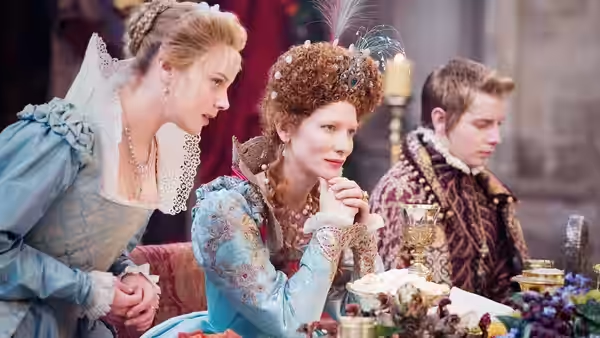
Morton gives Mary a soft Scots burr and a stillness nothing else here has, and Tom Hollander, as her jailer Amyas Paulet, plays a decent man who disapproves of his prisoner’s cushions. Rhys Ifans hisses pleasantly as the Jesuit Robert Reston. Abbie Cornish, as Elizabeth Throckmorton, the lady-in-waiting sent to keep Raleigh company, has little to do but be looked at. Clive Owen is the difficulty. He plays Sir Walter Raleigh as a man who has read about swagger, and he delivers Hirst and Nicholson’s speeches about the sea as though reading them off a card. We did not believe for a moment that this queen would lose sleep over this man, and the middle of the film needs us to.

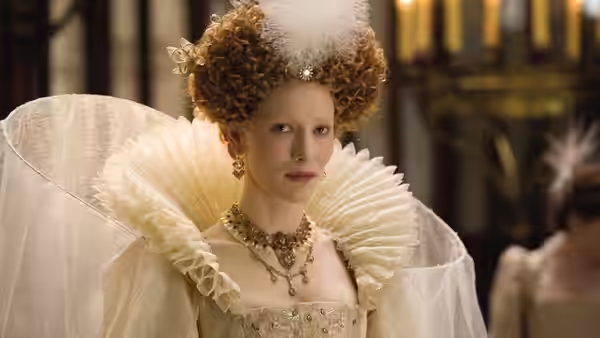
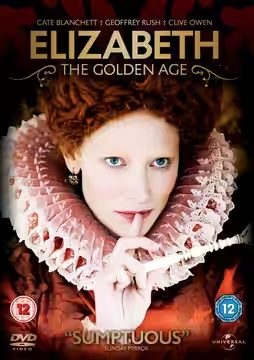
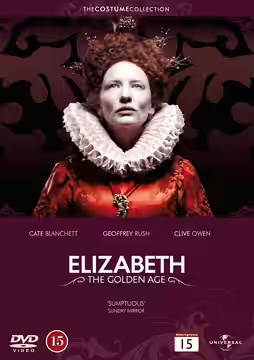
Alexandra Byrne’s costumes are the best thing in it. The collars stand up behind Blanchett’s head like sails; the gowns go from gold to red to black as the news gets worse; there is a white nightdress for the cliffs and gilt armour for the horse. Remi Adefarasin shoots much of it from above, or through grilles and between pillars, so the queen is always behind bars of one kind or another. It is a clear idea and he has it about forty times. Guy Hendrix Dyas gives England grey stone and high windows, and Philip’s Spain black walls and candles by the thousand.

The score is the complaint most critics have made, and they are right. Craig Armstrong and A. R. Rahman keep choirs and drums running under conversations that would be tense on their own, and the music has one volume. Jill Bilcock and Andrew Haddock cut to it rather than to the actors, so two people talking in a corridor are edited like the approach to a battle, and when the battle arrives there is nowhere left to go.

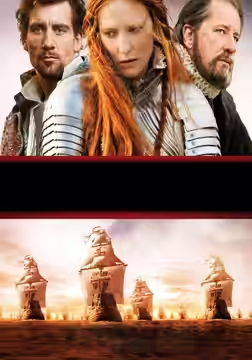
The Armada is where the money went, and for a few minutes it is good. The English fire ships drift out at night towards the Spanish line, Blanchett stands on the cliff in white with her hair down, and we sat forward, surprised to feel something like the dread the film had been promising. Then Kapur cuts underwater to drowning horses in slow motion, Raleigh swings across to a Spanish deck on a rope, and the dread went. The sea battle takes less screen time than the suitors.

The first film was about a girl finding out what the throne would cost her, and it ended with her paying. This one begins with the bill settled and finds she has nowhere further to go, so the writers give her a crush and a theme. The theme is faith and fear, and the film handles it by having people say the words. Philip gets most of them.

Most critics split down the middle, half entertained and half worn out, and so are we. See it for Blanchett and Byrne, who between them make a better film than the one around them. At home, turn the sound down a notch; the dialogue survives and the choir does not need the help.
Critical consensus AI synthesised

51
Positive
4
Mixed
5
Negative
6

The critics are split, and the spread tips towards disappointment. Almost every review agrees that Cate Blanchett is the reason to watch: her Elizabeth is called commanding, forceful and compelling even by critics who dislike the film around her. Most also agree the sequel falls short of the original, which several remember as darker and more surprising. The costumes and the scale of the Armada sequence are credited even where the drama is not.

The reservations cluster on Shekhar Kapur’s direction and on the music. Several reviews find the staging over-indulgent and melodramatic, and the score is repeatedly described as pounding and deafening, drowning what tension the script has. The spread is wide, from a four-star notice at Radio Times to two stars at Time Out and a D+ at The AV Club, which blames rushed storytelling for leaving Elizabeth underdeveloped. Slant Magazine stands apart in reserving its praise for Samantha Morton’s Mary rather than for Blanchett.

Radio Times
★★★★ · Stella Papamichael
80

Papamichael gives the film a positive review. She singles out Cate Blanchett as a compelling presence in her return to the role.

Read the full review →
The Guardian
4 November 2007 · Philip French
75*

French finds the sequel compelling, with Cate Blanchett carrying its allegorical and historical drama. He especially praises Blanchett’s forceful embodiment of Elizabeth’s intelligence and authority.

Read the full review →
The Hollywood Reporter
8 September 2007 · festival review · Kirk Honeycutt
75*

Honeycutt finds the film a robust, entertaining historical epic, though it lacks the original’s capacity to surprise. He especially praises Cate Blanchett’s commanding performance and the spectacle of the Spanish Armada sequence.

Read the full review →
Screen Daily
10 September 2007 · Allan Hunter
64*

Hunter opens by doubting that the sequel can match its predecessor's achievements. The excerpt praises the original's impact and Blanchett's star quality, but gives no specific verdict on this film.

Read the full review →
RogerEbert.com
12 October 2007 · ★★½/4 · Roger Ebert
62

Ebert finds the film visually lavish but dramatically unconvincing. He singles out Cate Blanchett’s performance as a strength amid the film’s excesses.

Read the full review →
Total Film
2 November 2007 · ★★★ · Total Film
60

The review calls the sequel lesser than its predecessor but still stirring and entertaining. It praises Cate Blanchett’s performance, while finding Shekhar Kapur’s flashy direction distracting.

Read the full review →

Straight answers AI written, from our review

Is Elizabeth: The Golden Age worth watching?
Elizabeth: The Golden Age is a mixed case, worth an evening for Cate Blanchett and Alexandra Byrne's costumes and not much else, and we scored it 54. Blanchett is as good as she was in the first film, but Clive Owen's Raleigh never convinces and the score drowns conversations that would be tense on their own. See it for the queen and the dresses.
How long is Elizabeth: The Golden Age, and what is it rated?
Elizabeth: The Golden Age runs 1h 54m. It is a drama and history film.
Where can I watch Elizabeth: The Golden Age in Czechia?
Elizabeth: The Golden Age is available to rent from Amazon Prime Video and Apple TV from Kč 59.00. Availability is checked daily; the links above go straight to each service.
How violent or frightening is Elizabeth: The Golden Age, and is it suitable for children?
Elizabeth: The Golden Age is a 12A, so it is a historical drama older children and teenagers can sit through, with plotting, executions in prospect and a sea battle rather than gore. The Armada sequence has fire ships at night and drowning horses in slow motion, which may upset younger or sensitive viewers. The romance stays at the level of looks and speeches.
How does Elizabeth: The Golden Age compare to Elizabeth?
Elizabeth: The Golden Age is the louder and weaker of Shekhar Kapur's two Elizabeth films, and the earlier Elizabeth is the one we recommend. The first is a darker political thriller about a young queen learning what the throne costs, and it knows when to be quiet. The sequel has finer costumes and bigger set pieces but thinner drama. Newcomers should start with the original.
What should I watch after Elizabeth: The Golden Age?
After Elizabeth: The Golden Age, try Elizabeth (1998, Fi1m 82): The first one: same queen, same director, darker, and it knows when to be quiet. Then The Lion in Winter (1968, Fi1m 81): Hepburn and O’Toole running a kingdom from the dinner table; the dialogue does the work; and Orlando (1992, Fi1m 81): Sally Potter’s Woolf adaptation, with Quentin Crisp as an old Elizabeth in its opening act.

Cast

Awards

Academy Awards, 2008

Nominated
Best Actress
Won
Best Costume Design

If you liked this, try…

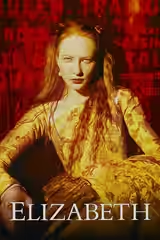
  1. Elizabeth (1998, Fi1m 82)The first one: same queen, same director, darker, and it knows when to be quiet.

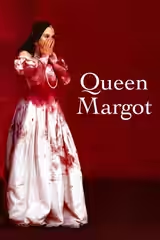
  2. La Reine Margot (1994) · not on Fi1m yetPatrice Chéreau’s French court of the same century, blood on the sheets and no choir.

  3. The Lion in Winter (1968, Fi1m 81)Hepburn and O’Toole running a kingdom from the dinner table; the dialogue does the work.

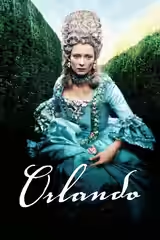
  4. Orlando (1992, Fi1m 81)Sally Potter’s Woolf adaptation, with Quentin Crisp as an old Elizabeth in its opening act.

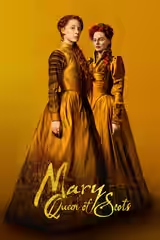
  5. Mary Queen of Scots (2018) · not on Fi1m yetThe cousin’s side of the story, with Saoirse Ronan and Margot Robbie and a quieter palette.