Jacques Audiard’s Spanish-language musical about a cartel boss who changes her body and her life is alive for an hour and then turns into the telenovela it had been mocking. Zoe Saldaña and Karla Sofía Gascón keep it watchable; the songs mostly do not.
Jacques Audiard has made a Spanish-language musical about a Mexican cartel boss who wants a new body and a new life, and hires a lawyer to arrange both. That is the pitch, and it is also the problem. For an hour Emilia Pérez is nervy, odd and alive; then it settles into the telenovela it had been winking at, and the wink goes. There is a great deal to look at, two performances worth the evening, and not enough underneath them.
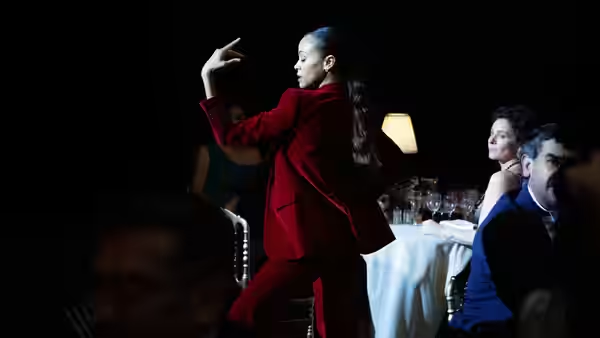
Zoe Saldaña carries the first act and a good deal of what follows. She plays Rita tired to the bone, and angry in a way she has trained herself to keep off her face. When the film gives her a number she does not sing it so much as spit it; the rest is in her shoulders and hands. A late black-tie dinner, in which she moves between the tables of men she despises and tells them what they are, is the one sequence where song, anger and camera all want the same thing.
Karla Sofía Gascón plays both Manitas and Emilia, and the double role is the film’s best idea. As Manitas she is hunched and heavy, with a voice like gravel and a threat in every pause; as Emilia she is warm, expansive, quick to laugh. The early scenes between her and Saldaña, two people negotiating over a body across a table, have a strangeness the rest of the film cannot match. Selena Gomez has the thinner part as Jessi and does what she can with it; she is at her best at a karaoke machine and at her worst when asked to hold a long dramatic scene in Spanish.
Paul Guilhaume shoots Mexico City in sodium orange and the clinics in surgical white, and the hospital number, in which surgeons and nurses sing the options for a new face and a new body, is the best staged sequence in the film. It arrives early. Emmanuelle Duplay’s sets are a shade too tidy, so the city looks like a stage even when nobody is singing, and Virginie Montel dresses Emilia in the reds and golds of a woman making up for lost time. Juliette Welfling cuts hard and often, and the first hour has the jolt of a thriller. The songs are the weak point. Clément Ducol and Camille write half-sung, half-spoken numbers that tell us what the characters are thinking and rarely find a melody to carry it, and by the third we were listening for a tune. There was not one.
We laughed at the clinic number, out loud and with pleasure, because the film had turned a medical consultation into a chorus line without sneering at the woman on the other end of it. About ninety minutes in, watching grief played at full volume with strings underneath, we realised we no longer believed anyone on screen, and that the film had stopped noticing the difference between a big feeling and a loud one.
What the film thinks about its subject is harder to say. Audiard, working from a novel by Boris Razon, treats transition mainly as a mechanism for the plot. A surgeon (Mark Ivanir) asks early on whether changing the body changes the soul, and the film never returns to the question. Cartel violence is wallpaper for most of the running time, and when the second half turns to the families of the disappeared, a real and continuing horror, it does so in the same key as the karaoke. We were uncomfortable, and not in the way the film intended.
Against Audiard’s own record this is the odd one. A Prophet (2009) built a criminal from the ground up and never once told us how to feel about him. Dheepan (2015) put a stranger somewhere he did not understand and let the discomfort do the work. Emilia Pérez is busier than both and thinks less.
Reviews have split down the middle, and we understand both halves. See it for Saldaña, for Gascón and for the first hour, and do not expect the rest to be about anything for long. It runs 132 minutes and carries a 15.