Chris Buck and Jennifer Lee make a musical about two sisters, and its first forty minutes are the best Disney has managed in years. The second half wanders in the snow. Worth your evening, especially with children.
Disney has been making films about princesses since 1937, and most of them end with a wedding. Frozen is the studio’s attempt to make one that does not need to. Chris Buck and Jennifer Lee take the bones of Hans Christian Andersen’s The Snow Queen, throw out the queen as villain, and make her a frightened elder sister instead. It is a warm, funny film with a first half as good as anything the studio has done since the early nineties, and a second half that gets lost on the way up the mountain. We recommend it, and we would not blame you for nodding off during the trolls.
The opening twenty minutes are the film’s case for itself. Two small girls build a snowman in a ballroom at night, the elder making snow from her hands; then there is an accident, and the doors close. Jeff Draheim cuts the years that follow to a single song, Anna singing through her sister’s bedroom door while both of them grow up on either side of it, and the door does the work a page of dialogue could not. We were moved more than we had expected to be by a cartoon about a door. It is the repetition that does it: a child asking to play, every year, and the answer always the same.
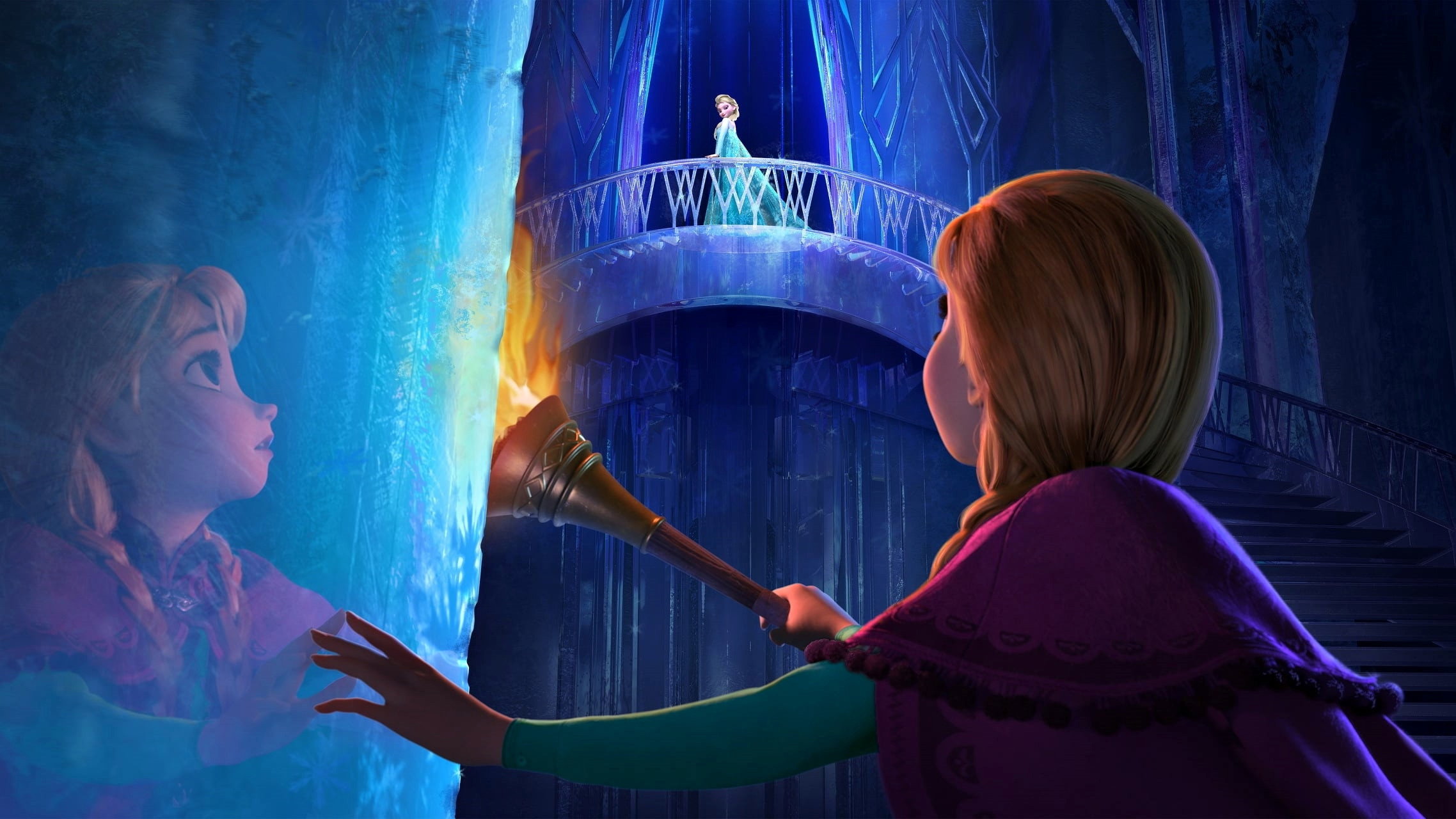
David Womersley’s production design puts Arendelle at the head of a fjord, with steep roofs, painted flowers on every hem and shutter, and mountains behind that look cold rather than decorative. When Elsa runs, the animators are let off the leash. Her palace goes up in one number, walls of blue ice growing out of a staircase and snowflake patterns spreading across the floor as she walks, and Idina Menzel sings “Let It Go” with a Broadway belt that turns a fairy tale about restraint into something closer to a coming-out. Christophe Beck’s score underneath, with its chanted Nordic voices, gives the first act a chill the songs then thaw.
The comedy is handed to the men and a snowman, and it mostly lands. Josh Gad’s Olaf, a snowman who dreams of lying on a beach in July, is the kind of sidekick the studio usually gets wrong and here gets right; he is sweet, and Gad’s timing keeps the jokes about melting funny past the point where they should have worn out. Jonathan Groff plays Kristoff, an ice harvester who supplies his own reindeer’s voice and is not sure he likes people, as the straight man, which suits him. Kristen Bell’s Anna talks too much, falls over and proposes to a man she has known for a day; Bell makes a proper heroine out of the clumsiness, and Santino Fontana’s Hans is smooth enough that we understand why.
Then the film goes up the mountain and slows down. Elsa, the most interesting person in it, is left in her palace for most of an hour while the others walk towards her, and the songs, so thick in the first forty minutes, thin to almost nothing. What remains is a number for the trolls, a family of rolling boulders who want Anna to marry Kristoff, and it stops the picture dead. We were bored, and then we were irritated, because the same writers had just shown they could do better. Alan Tudyk’s Duke, a nervous visiting nobleman, is set up as a comic threat and given nothing to threaten. Lee’s script is building towards an ending about two sisters, and for most of the middle hour one of them is offstage.
The character design is the other soft spot. Elsa’s face is the same doll’s face Disney has used for a decade; her powers are strange and her cheekbones are not. Anna has freckles, a crooked smile and a great deal more life. Set against the studio’s own musicals, this sits below Beauty and the Beast, which never lost its villain or its nerve, and clearly above most of what came between. The last act takes a turn we will not describe, and it is the turn that has made the film’s reputation. It is earned, mostly, and it arrives inside 102 minutes, which is about right.
Watch it with a child, if one is available, and watch the child during the door song. The big number will be in the house for a week afterwards. We are not sure that counts as a criticism.