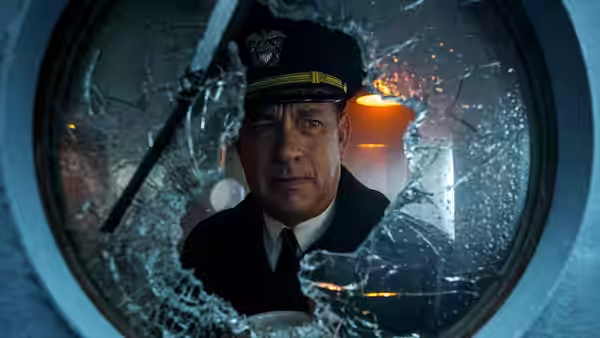
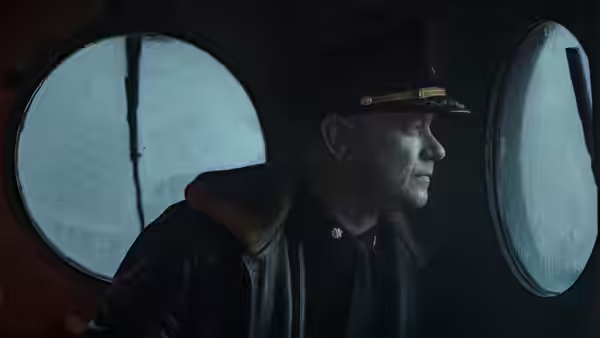
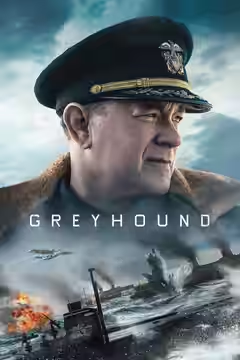
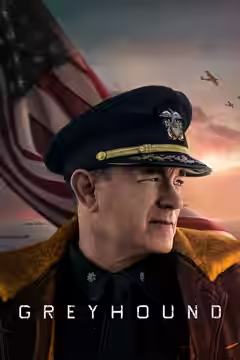
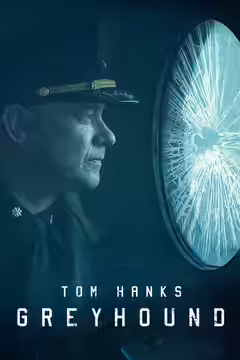
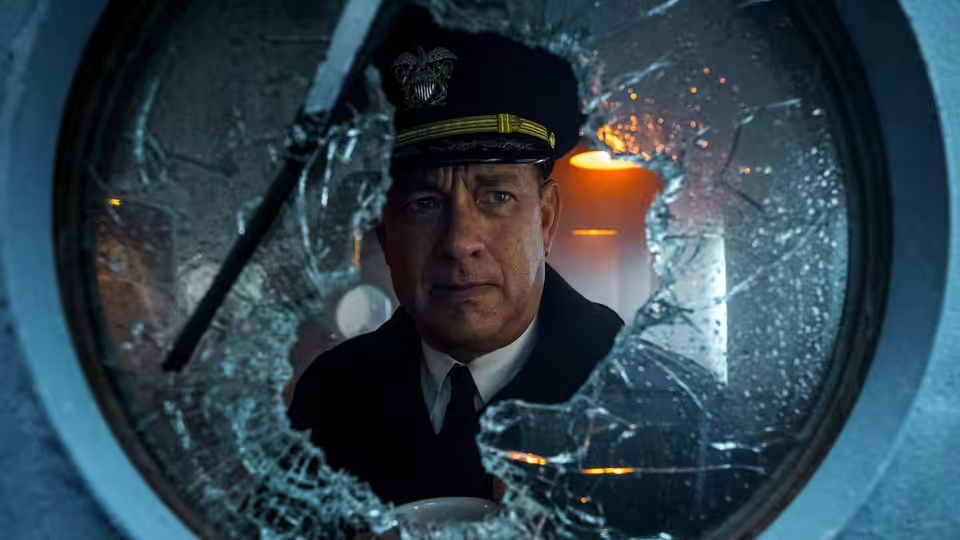
Commander Krause (Tom Hanks) peers through a rain-streaked window on the ship’s bridge
Film review

Greyhound

2020 · Directed by Aaron Schneider · 1h 32m · CH 12

In a sentenceTom Hanks refuses a sandwich for ninety minutes while the Atlantic tries to kill him

February 1942. Commander Krause (Tom Hanks), a career officer on his first command, takes the destroyer Greyhound into the North Atlantic at the head of an escort for a convoy of merchant ships. In the middle of the crossing lies a stretch of open water where a pack of U-boats is waiting. Krause has his executive officer, Charlie Cole (Stephen Graham); a mess attendant, Cleveland (Rob Morgan), who keeps bringing him meals he does not eat; and a bridge full of young talkers relaying his orders. One short flashback shows Evelyn (Elisabeth Shue), the woman he left behind. The first sonar contact comes soon after the air cover turns for home.

Plays from YouTube when you press play; nothing loads from them until then.

Fi1m review

Tom Hanks writes himself a destroyer and 92 minutes of orders, and Aaron Schneider makes that a tight, sometimes gripping crossing. It is precise about everything except the people, and it is over before that starts to cost it much.

Aaron Schneider’s film, from a screenplay by Tom Hanks after a novel by C. S. Forester, is about a destroyer taking a convoy across the Atlantic in February 1942, and it is about almost nothing else. There is no shore leave, no letters home, no back story beyond one short flashback. For 92 minutes we are on the bridge of the Greyhound with Commander Krause (Hanks) as he gives orders and hears them repeated back. It is a narrow film and it knows it, and within those limits it is tense and well made and, by the end, thin. Worth an evening if you like your war films procedural; there is not much to carry away afterwards.

The method is repetition. Krause says “right full rudder”, the helmsman says “right full rudder, aye”, a talker relays a bearing from sonar, the ship turns. Sidney Wolinsky and Markus Czyzewski cut these chains fast and clean, so that an order travels from Krause’s mouth to the rudder in four shots and we always know which way the ship is turning, even when we have lost hold of why. Hanks the writer has bet that watching a competent man do a hard job under strain is enough to fill a film. For the first hour he is right.

The first U-boat hunt is the best thing in it. Sonar gets a contact, the range closes, the boat passes beneath the hull and the whole bridge goes quiet to listen for it, and we found we had stopped breathing along with them. The depth charges go, the sea heaves, oil comes up, the crew cheers, and Krause says, almost to himself, “fifty souls”. It landed harder than we expected, because nothing before it had asked us to feel anything. Hanks has played decent men in authority often enough that we know the shape, and here he strips even that back: no speeches, hardly a smile, a man whose whole attention is on the next order.

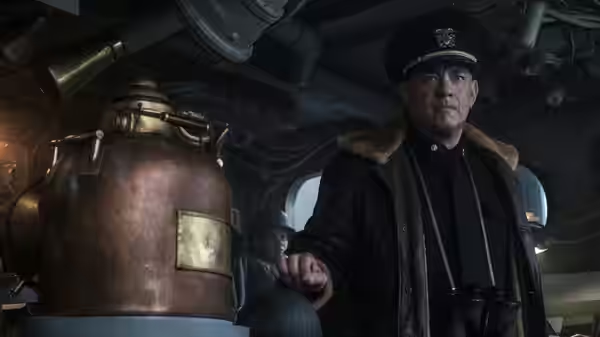
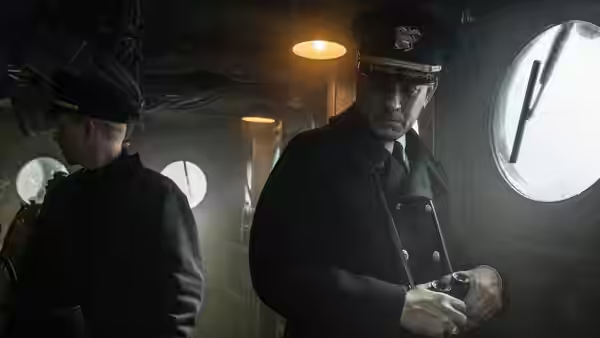
Shelly Johnson shoots nearly all of it from the bridge, through glass streaming with spray, and the war outside arrives as lookouts’ shouts and grey shapes on grey water. When the camera does go out over the convoy the sea has the smooth, weightless look of the computer, and those are the weakest images in the film. David Crank’s bridge is cramped and cold and crowded with brass and dials; there is always somebody’s elbow at the edge of the frame. Julie Weiss puts the crew in sheepskin and steel helmets over knitted caps and lets the frost sit on their collars. Blake Neely’s score is mostly drums and a low drone, and it knows when to stop, which is more than most war scores do. The night attacks are lit by flares and scored by the guns.

What is missing is the people. Stephen Graham’s Cole is loyal and worried, and that is the whole of him. Rob Morgan’s Cleveland brings Krause meals he does not eat and is the one man aboard the commander treats with anything like tenderness, and the film treats that as enough. Elisabeth Shue’s Evelyn gets one scene, a flashback, and is then gone from the film. Tom Brittney’s Watson, Manuel Garcia-Rulfo’s Lopez and Karl Glusman’s Eppstein are faces at stations. They are all well cast and none of them has more than a job to do.

By the third attack we noticed we were tired rather than tense. The later engagements are tracer and searchlight and shouting, and we could not have told you which merchant ship was burning or what it carried. The brevity that is the film’s great virtue starts to look like haste.

The submarine films it stands beside, Das Boot (1981) above all, understood that the waiting is the drama and the men are what you wait with. Greyhound has the waiting and the machinery. Hanks’s screenplay treats the ship’s log as the story, and his performance is the only thing on board that argues otherwise.

It runs 92 minutes and carries a 12. Watch it with the lights off and the sound up, because the bridge is where the film lives, and the bridge is good.

Critical consensus AI synthesised

60
Positive
11
Mixed
10
Negative
5
The AV Club
7 July 2020 · B · Ignatiy Vishnevetsky
77

The review finds Greyhound a compelling, gripping naval thriller, though its climactic stretch can feel visually monotonous. It praises the film’s grounded depiction of naval warfare and the suspense built from its limited point of view.

Read the full review →
The Hollywood Reporter
6 July 2020 · David Rooney
75*

Rooney finds Greyhound a taut, stirring action thriller that sustains its grip despite a slightly overdone sentimental ending. He particularly praises the immersive, nail-biting combat sequences and the convincing depiction of the perilous convoy crossing.

Read the full review →
Vulture
9 July 2020 · Bilge Ebiri
75*

Ebiri finds Greyhound surprisingly immersive and ultimately memorable despite some minor weaknesses. He especially praises its authentic naval detail and sound design, while noting that the focus on procedure leaves the crew underdeveloped.

Read the full review →
Los Angeles Times
6 July 2020 · Kevin Crust
70*

Crust finds the film an efficient, satisfying war drama, though its Black sailor subplot feels underdeveloped. He praises the taut direction, atmospheric visuals and understated performances, especially Hanks and Graham.

Read the full review →
The Guardian
6 July 2020 · Peter Bradshaw
70*

Bradshaw finds the film effective and watchable, though notably traditionalist and sombre. He praises its tense, claustrophobic naval action and old-school cat-and-mouse strategy.

Read the full review →
Variety
6 July 2020 · Owen Gleiberman
70*

Gleiberman finds the film a sturdy, tense account of the logistics of naval battle, though its characterizations are thin and the action sometimes sags. He praises Tom Hanks’s finely etched, minimalist performance and the scrupulous military detail.

Read the full review →

Straight answers AI written, from our review

Is Greyhound worth watching?
Greyhound is worth an evening if you like your war films procedural, and we scored it 66. It is tight, tense and well made for its first hour, with Tom Hanks stripped back to a man giving orders. The people around him never become more than faces at stations, and by the third attack we were tired rather than gripped.
How long is Greyhound, and what is it rated?
Greyhound runs 1h 32m and is rated 12 by the CH in Switzerland. It is a war and action film.
Where can I watch Greyhound in Switzerland?
Greyhound is streaming on Apple TV in Switzerland, and it is also available to rent from Apple TV from CHF 4.50. Availability is checked daily; the links above go straight to each service.
How violent or frightening is Greyhound, and is it suitable for children?
Greyhound carries a UK 12 certificate and is a war film of depth charges, tracer fire and burning ships rather than blood or gore. The tension is real and the night attacks are loud, so younger children may find it frightening, but there is little on screen to trouble a teenager or the squeamish. Its violence is mostly heard and glimpsed through spray-streaked glass.
How does Greyhound compare to Das Boot?
Greyhound sits on the other side of the same water as Das Boot, and the earlier film is the better of the two. Das Boot understands that the waiting is the drama and the men are what you wait with; Greyhound has the waiting and the machinery but hardly draws its crew. Choose Greyhound for a brisk 92 minutes, Das Boot if you can take the strain.
Is Greyhound based on a true story or a book?
Greyhound is adapted from a novel by C. S. Forester, with Tom Hanks writing the screenplay himself. It is set in February 1942 during the Atlantic convoy crossings, but it is a work of fiction rather than the story of one real ship. You need not know the book; the film treats the destroyer's log as the whole story and explains nothing beyond it.
What should I watch after Greyhound?
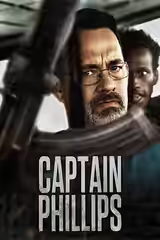
After Greyhound, try Das Boot (1981, Fi1m 89): The other side of the same water, with the men Greyhound never quite draws. Then Master and Commander: The Far Side of the World (2003, Fi1m 86): Command at sea done with weather, wood and a crew you could name by the end; and Captain Phillips (2013, Fi1m 83): Hanks on a bridge again, this time allowed to be frightened, and the difference shows.

Cast

Awards

Academy Awards, 2021

Nominated
Best Sound

If you liked this, try…

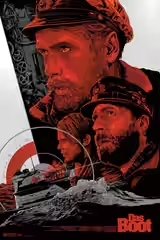
  1. Das Boot (1981, Fi1m 89)The other side of the same water, with the men Greyhound never quite draws.

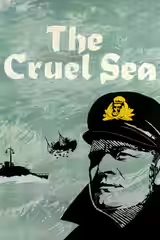
  2. The Cruel Sea (1953) · not on Fi1m yetA British corvette on convoy duty, and the cost counted in faces rather than tonnage.

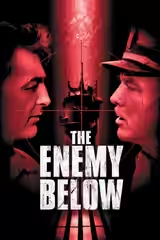
  3. The Enemy Below (1957) · not on Fi1m yetDestroyer captain against U-boat captain, played as a chess match with depth charges.

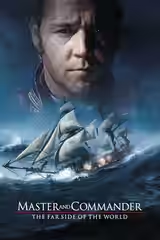
  4. Master and Commander: The Far Side of the World (2003, Fi1m 86)Command at sea done with weather, wood and a crew you could name by the end.

  5. Captain Phillips (2013, Fi1m 83)Hanks on a bridge again, this time allowed to be frightened, and the difference shows.

Greyhound (2020) review: tense, precise, and thin on people (Switzerland) | Fi1m