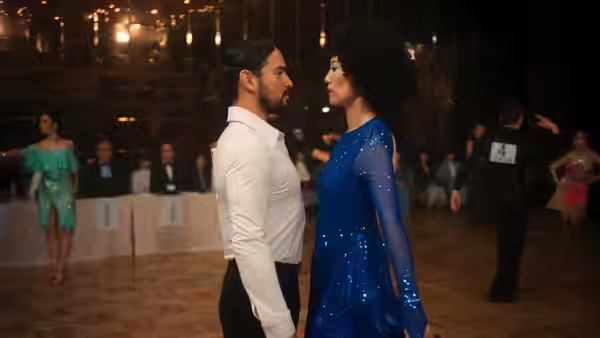
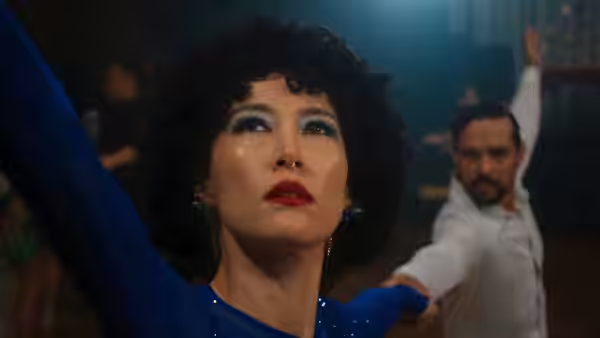
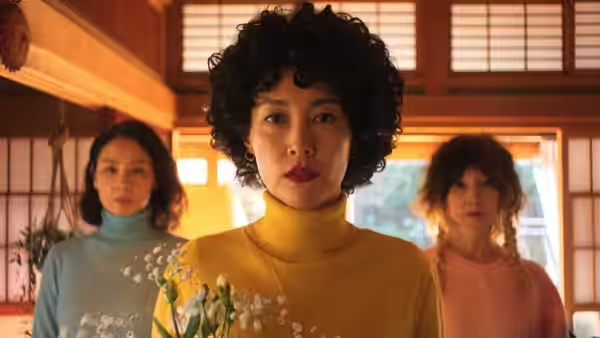
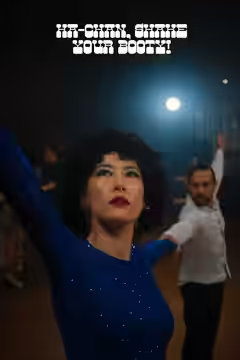
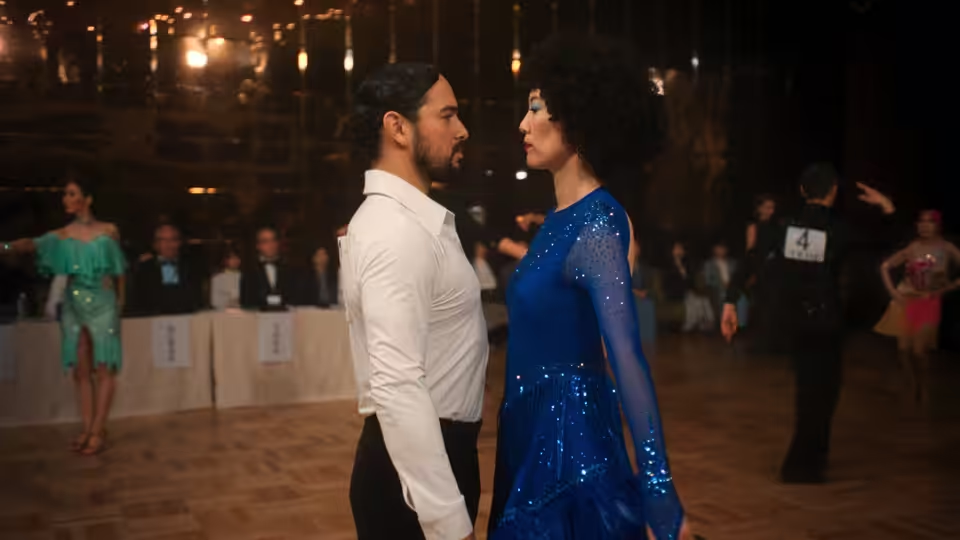
Haru (Rinko Kikuchi) and Fedir (Alberto Guerra) dancing closely on the floor
Film review

Ha-Chan, Shake Your Booty!

2026 · Directed by Josef Kubota Wladyka · 2h 02m

In a sentenceRinko Kikuchi makes ballroom dancing seem a sensible response to grief

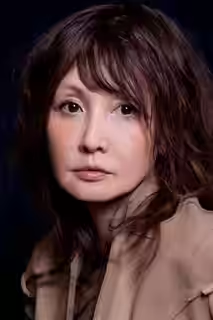
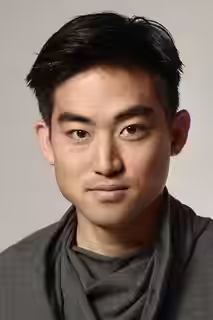
Haru (Rinko Kikuchi) is living with grief, with ballroom dancing offering a way to express feelings that complicate the possibility of starting again. Her story also includes Fedir (Alberto Guerra) and Luis (Alejandro Edda), alongside Hiromi (YOU) and Yuki (Yō Yoshida). Romance and renewed connection raise the question of how to move forward while her life remains marked by loss. The film follows Haru through comedy and sorrow, allowing its dance sequences to depart from everyday life and move into surreal fantasy.

Plays from YouTube when you press play; nothing loads from them until then.

Fi1m review

Rinko Kikuchi makes this uneven ballroom romance worth the evening, giving its grief and surreal dance sequences a warmth the plotting cannot always sustain. The comedy wanders, but Haru remains someone we want to stay with.

Josef Kubota Wladyka gives grief some company in this playful ballroom romance: comedy, the hope of renewed connection and dances that are allowed to become fantasies. It is a good fit for Rinko Kikuchi, whose Haru can be funny without making her sorrow seem like something the film has forgotten. We recommend it for her, and for the freedom of the dancing, with a reservation about a story that keeps interrupting its own progress. At 122 minutes, it has more room for eccentricity than it needs.

Haru could easily have become a collection of reactions to whatever odd development the writers produce next. Instead, her performance gives the character enough emotional consistency to prevent that, allowing the comedy and the hurt to belong to the same person. We warmed to Haru because her expressive dancing makes pleasure possible without suggesting that her grief has gone away. That matters in a film about beginning again, where optimism can so easily become an instruction to stop being sad.

The surreal dance sequences are the clearest reason to choose this over a more cautious romance. Daniel Satinoff’s cinematography and Masami Tanaka’s production design find their most persuasive use in these passages, which give Haru’s complicated feelings something to do beyond being discussed. Nathan Halpern supplies the music for a film whose most convincing emotional expression comes through dancing. The collective achievement is to make the fantasy feel like a natural part of Haru’s experience, even when the surrounding story struggles to connect its episodes.

The script, by Nicholas Huynh and Josef Kubota Wladyka, is less dependable. Its increasingly eccentric turns can make following Haru’s feelings harder than following its appetite for another surprise. The episodic storytelling also leaves the people around her less fully imagined, and a romance needs those other people to have some weight of their own. Rinko Kikuchi does much of the work of making these encounters matter, but a supporting character should offer more than another opportunity for the lead to be expressive.

Ben Rodriguez Jr. edits a film whose individual dance sequences are more satisfying than its movement from one episode to another. The sharper shifts into darker material sometimes feel punitive, placing fresh emphasis on pain when Haru’s emotional difficulties are already clear. That unevenness makes the running time harder to justify. A little less insistence on changing the mood would have allowed the film to stay with a feeling long enough for it to develop, rather than requiring another adjustment from us.

For a romantic comedy, its willingness to let grief remain untidy is welcome. There is something generous about allowing a character to be sorrowful, funny and open to pleasure without demanding that each feeling take its turn in an orderly fashion. The trouble comes when the storytelling mistakes that emotional messiness for permission to wander, and the thinner characterisation becomes harder to overlook. Even so, the performance and the dancing provide enough pleasure to make the patience worthwhile. Choose it for Rinko Kikuchi, with some tolerance for the diversions between dances.
Critical consensus AI synthesised

74
Positive
7
Mixed
3
Negative
0

Most critics respond warmly to the film’s playful treatment of grief and renewal, with seven positive reviews and three mixed. Praise centres on Rinko Kikuchi, whose funny, emotionally grounded performance gives the whimsy a human basis. The dance sequences are another point of agreement: the reviews repeatedly welcome their energy and expressive use of fantasy. Even the more reserved critics find charm and pleasure in the film’s willingness to be odd.

The disagreement concerns how well that oddness serves the story. Some reviews find the tonal shifts graceful; others say the increasingly wacky turns interrupt the emotion or make the darker passages feel punitive. Slant Magazine points to superficial characterisation, while Eye for Film finds that the episodic structure weakens the emotional payoff. Collider is considerably more enthusiastic, valuing the earnestness and simplicity that other reviews find less satisfying. The spread runs from qualified enjoyment to firm affection, with no outright rejection.

The Hollywood Reporter
23 January 2026 · festival review · Caryn James
80*

The critic calls the film a small delight and an unexpected charmer, with an optimistic story of grief and renewal. She praises Rinko Kikuchi’s affecting, funny performance and the graceful shifts into surreal fantasy.

Read the full review →
IndieWire
22 January 2026 · B · Kate Erbland
77

Erbland finds the film’s whimsical approach to grief mostly successful, though increasingly wacky plot turns sometimes disrupt its emotional flow. She praises Rinko Kikuchi’s performance and the film’s effervescent spirit, especially its fantastical dance sequences.

Read the full review →
Screen Daily
23 January 2026 · festival review · Wendy Ide
70*

The review presents the film as charming and playful. It singles out Rinko Kikuchi as a spark in the ballroom dance drama.

Read the full review →
Slant Magazine
19 September 2026 · ★★½/4 · Kenji Fujishima
62

The review finds the film charming but held back by superficial characterizations. It praises Kikuchi Rinko’s emotionally grounded performance amid the film’s playful surrealism.

Read the full review →
The New Yorker
31 January 2026 · festival review · Justin Chang
60*

Chang finds the comedy uneven but enjoyable, with its shifts into darker territory sometimes feeling unnecessarily punitive. He praises Kikuchi’s freewheeling performance and Wladyka’s loopy, expressive dance sequences.

Read the full review →
Collider
3 February 2026 · 9/10 · Taylor Gates
90

Gates calls it a charming, near-perfect surreal rom-com whose earnestness and simplicity make it special. She especially praises Rinko Kikuchi’s emotionally wide-ranging performance and the film’s energetic dance numbers.

Read the full review →

Straight answers AI written, from our review

How long is Ha-Chan, Shake Your Booty!, and what is it rated?
Ha-Chan, Shake Your Booty! runs 2h 02m. It is a comedy and drama film.
Where can I watch Ha-Chan, Shake Your Booty! in Canada?
Ha-Chan, Shake Your Booty! is not on any streaming or rental service in Canada at the moment. Availability is checked daily.
What should I watch after Ha-Chan, Shake Your Booty!?
After Ha-Chan, Shake Your Booty!, try Truly, Madly, Deeply (1990, Fi1m 80): For grief approached through fantasy, awkward humour and the difficulty of moving forward. Then The Farewell (2019, Fi1m 84): For family sorrow handled with humour and room for conflicting feelings; and Strictly Ballroom (1992, Fi1m 83): For romantic defiance expressed through dance, with considerably less restraint.

Cast

If you liked this, try…

  1. Shall We Dance? (1996) · not on Fi1m yetFor a Japanese story of private longing finding expression through ballroom dancing.

  2. Gloria (2013) · not on Fi1m yetFor adult romance that gives dancing and disappointment equal attention.

  3. Truly, Madly, Deeply (1990, Fi1m 80)For grief approached through fantasy, awkward humour and the difficulty of moving forward.

  4. The Farewell (2019, Fi1m 84)For family sorrow handled with humour and room for conflicting feelings.

  5. Strictly Ballroom (1992, Fi1m 83)For romantic defiance expressed through dance, with considerably less restraint.