A white car follows a winding road through dense green forest
Film review

Hillbilly Elegy

2020 · Directed by Ron Howard · 1h 57m

In a sentenceAmy Adams and Glenn Close could use a quiet scene, and so could we

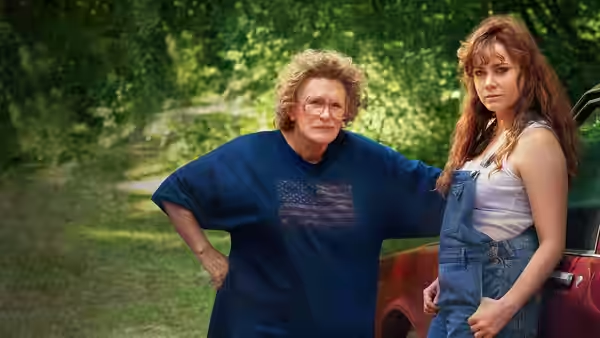
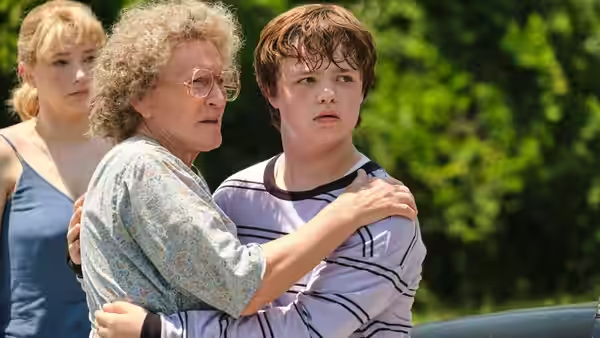
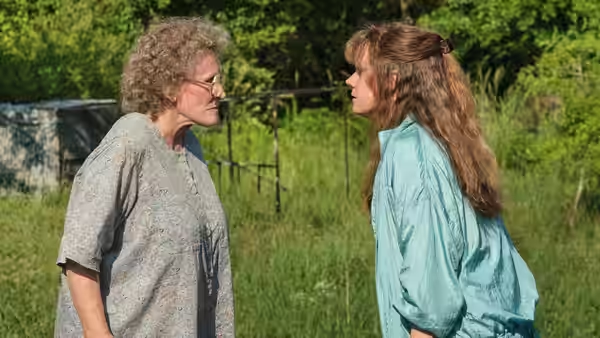
J.D. Vance (Gabriel Basso) is pursuing an Ivy League education while his family struggles with poverty and addiction. His mother, Bev (Amy Adams), and grandmother, Mamaw (Glenn Close), are at the centre of a childhood that continues to shape his adult life. The story returns to those years, with Owen Asztalos as Young J.D. Vance, and the turbulent relationship between the two women who help raise him. He wants to build a life beyond the family’s troubles, but those troubles keep drawing his attention back. Across three generations, the drama follows the demands of family alongside his efforts to get an education.

Plays from YouTube when you press play; nothing loads from them until then.

Fi1m review

Ron Howard’s family drama is earnest, repetitive and hard to care about. Amy Adams and Glenn Close work hard, but the writing gives their characters too few qualities beyond their troubles.

Hillbilly Elegy wants us to understand a troubled family before we judge it, which is a reasonable place for a drama to begin. Ron Howard directs with evident sympathy, yet the film keeps returning to scenes of distress without making its people more understandable. At 117 minutes, this is a poor, tiring drama with capable actors and too little interest in the lives they are playing. We get repeated demonstrations of how difficult this family can be to live with.

Vanessa Taylor’s screenplay moves between J.D. Vance’s childhood and his later Ivy League studies, placing his educational ambitions beside the family troubles that shaped him. Gabriel Basso plays J.D. Vance, with Owen Asztalos as Young J.D. Vance, and their relative restraint is welcome amid the surrounding agitation. The changes of period give James D. Wilcox, the editor, a useful way to connect the boy with the adult, and the transitions are more persuasive than much of the dialogue. Yet returning to the past keeps producing another crisis when we need an ordinary conversation.

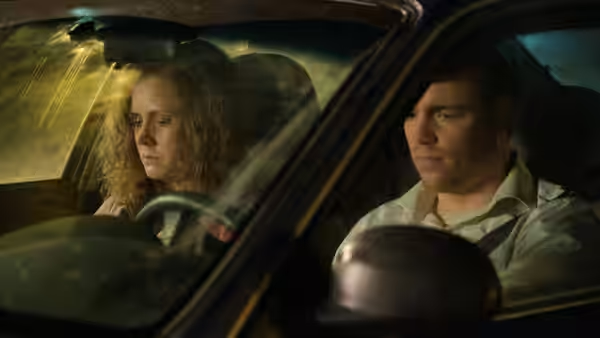
Amy Adams gives Bev a rawness that sometimes makes the pain register despite the writing’s insistence on another outburst. We were exhausted by the repeated eruptions between Bev and Mamaw, because their distress arrives at much the same volume each time. A family can argue like this, of course, but a drama still needs to show us what holds its members together when they stop. The performance gets too few opportunities to suggest anything beyond the immediate emergency.

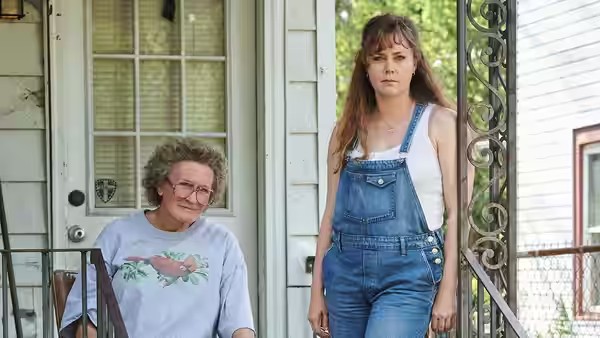
Glenn Close fares better as Mamaw, largely because her toughness occasionally suggests a person who exists when nobody is arguing. She can make a sentimental line sound like something this woman might actually say, and her flashes of warmth are welcome. That is a considerable service to the screenplay, which too often tells us what a character stands for before letting us know them. Even here, the emphasis on forcefulness leaves too little room for everyday company.

Maryse Alberti’s cinematography brings an assurance to the images that the storytelling lacks, and the film’s polish is not in doubt. Molly Hughes’s production design gives the family a credible setting, though we seldom get the sense of ordinary life continuing between the crises. The music by Hans Zimmer and David Fleming does little to vary the emotional pressure. These are capable contributions to a film whose basic dramatic rhythm remains confrontation, explanation and another confrontation.

A family melodrama need not offer a lecture on economics to tell us something about poverty. It does need to show enough of the wider world for the family’s choices to mean something. Here, hardship and addiction keep arriving as private emergencies, so that getting an education seems to answer questions the film has barely asked. We can follow the personal difficulties, but the film gives us little help in understanding the circumstances that surround them.

Viewers hoping for an intimate account of how a family lives with poverty should look elsewhere. The film’s insistence on distress makes it harder to spend time with people it plainly wants us to care about. If the attraction is the cast, we would still choose another film.


Critical consensus AI synthesised

31
Positive
0
Mixed
8
Negative
22

The consensus on Hillbilly Elegy is strongly negative, with praise concentrated on the cast rather than the adaptation. Glenn Close attracts the most approval: several critics find her grandmother convincing and affecting even when the surrounding drama feels generic. Amy Adams also earns credit for commitment and emotional force, though enthusiasm for both performances is far from universal. A few reviews acknowledge polished craft, but find little urgency or emotional depth.

The central objections concern repetitive melodrama, thin characterisation and a treatment of poverty that neglects wider social conditions. Many critics see stereotypes where the film needs curiosity about its characters. The spread runs from qualified approval to outright rejection: Den of Geek finds an absorbing family drama despite its shallow social context, while The Guardian finds even Close and Adams unconvincing. Acting is the clearest dividing point; reservations about the film’s narrow account of hardship extend into the more sympathetic reviews.

RogerEbert.com
64*

The review’s verdict cannot be verified because the page is blocked. Its specific praise or criticism is unavailable in the retrieved text.

Read the full review →
Screen Daily
10 November 2020 · Fionnuala Halligan
64*

The available text does not reveal the critic’s overall verdict. It singles out Glenn Close and Amy Adams for playing their roles to the hilt.

Read the full review →
Radio Times
★★★ · Trevor Johnston
60

The three-star rating suggests a mixed verdict. The review singles out Amy Adams’s showy performance and Glenn Close as a scene-stealer.

Read the full review →
Total Film
10 November 2020 · ★★★ · Jane Crowther
60

Crowther finds the film polished but pedestrian, criticizing its lack of bite and urgency. She singles out Glenn Close’s commanding performance as the film’s chief draw.

Read the full review →
The Hollywood Reporter
10 November 2020 · Sheri Linden
55*

Linden finds the film sympathetic but less affecting than its subject matter warrants, with its crises becoming repetitive. She praises Amy Adams and Glenn Close for making the turbulent mother-daughter relationship vivid and convincing.

Read the full review →
IndieWire
10 November 2020 · C- · David Ehrlich
50

Ehrlich finds the adaptation forgettable and politically evasive, with Vance’s self-serving story left dramatically unsatisfying. He praises Glenn Close for resisting caricature and giving the film its most affecting, grounded performance.

Read the full review →

Straight answers AI written, from our review

Is Hillbilly Elegy worth watching?
Hillbilly Elegy is difficult to recommend, even for admirers of Amy Adams and Glenn Close, and we score it 38 out of 100. Both work hard, and Close finds some welcome warmth, but the repeated family crises are exhausting without making the characters more understandable. Viewers seeking an intimate drama about poverty and addiction should look elsewhere.
How long is Hillbilly Elegy, and what is it rated?
Hillbilly Elegy runs 1h 57m. It is a drama film.
Where can I watch Hillbilly Elegy in Lithuania?
Hillbilly Elegy is streaming on Netflix in Lithuania. Availability is checked daily; the links above go straight to each service.
How violent or frightening is Hillbilly Elegy, and is it suitable for children?
Hillbilly Elegy has a US R certificate and centres on addiction, family distress and repeated confrontations, making it an unsuitable choice for children. We find the arguments emotionally exhausting rather than frightening; the concern for sensitive viewers is the sustained distress, though we cannot offer a specific assessment of violence from the material described.
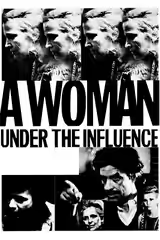
How does Hillbilly Elegy compare to A Woman Under the Influence?
Hillbilly Elegy is the weaker choice beside A Woman Under the Influence, which we recommend for its more recognisable family relationships and room for affection alongside distress. Both can become repetitive, but Gena Rowlands and Peter Falk make the demands on our patience worthwhile; Adams and Close have too few opportunities to show their characters beyond the crises.
What should I watch after Hillbilly Elegy?
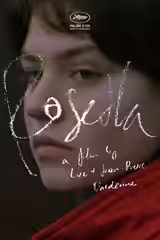
After Hillbilly Elegy, try A Woman Under the Influence (1974, Fi1m 86): A family under strain, with room for affection alongside the distress. Then Rosetta (1999, Fi1m 82): A young woman’s struggle for work, observed without reassuring explanations or easy blame; and Fish Tank (2009, Fi1m 85): A young woman’s ambitions emerge through performances that leave space for uncertainty.

Cast

Awards

Academy Awards, 2021

Nominated
Best Makeup and Hairstyling
Nominated
Best Supporting Actress

If you liked this, try…

  1. A Woman Under the Influence (1974, Fi1m 86)A family under strain, with room for affection alongside the distress.

  2. Rosetta (1999, Fi1m 82)A young woman’s struggle for work, observed without reassuring explanations or easy blame.

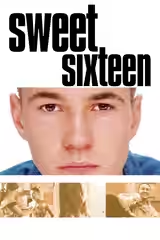
  3. Sweet Sixteen (2002) · not reviewed yetA teenager’s hopes for his mother make a sharper, less comfortable family drama.

  4. Fish Tank (2009, Fi1m 85)A young woman’s ambitions emerge through performances that leave space for uncertainty.

  5. Shoplifters (2018, Fi1m 89)Poverty and family loyalty examined through daily routines, with humour and patience.