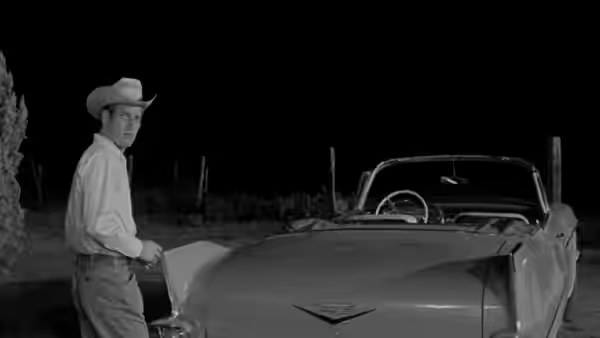
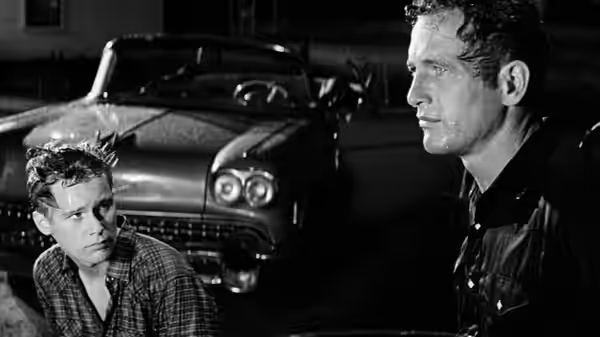
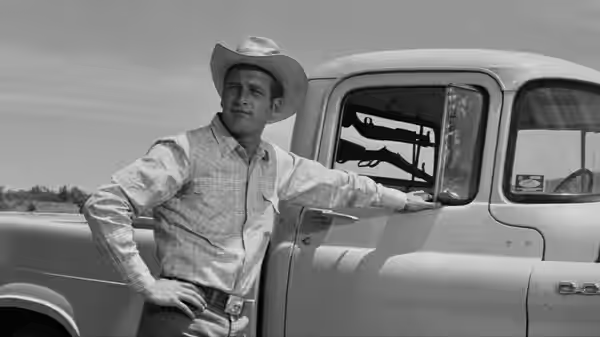
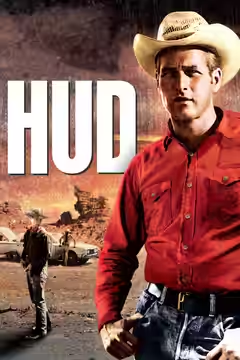
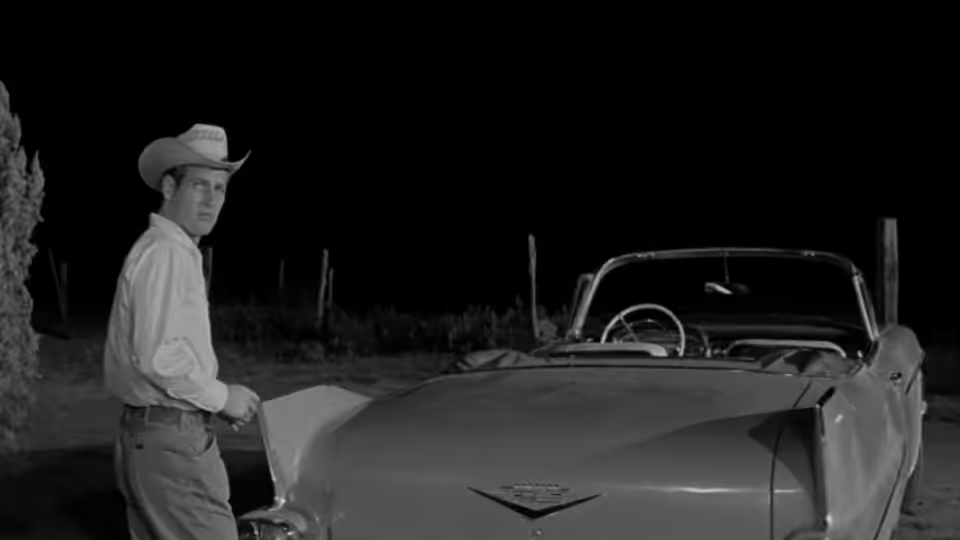
A cowboy stands beside a parked car at night
Film review

Hud

1963 · Directed by Martin Ritt · 1h 52m

In a sentencePaul Newman spends two hours proving he is no good and we kept wanting to buy him a drink

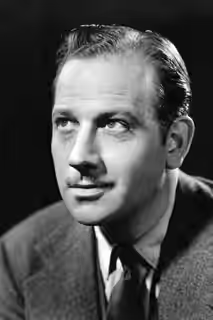
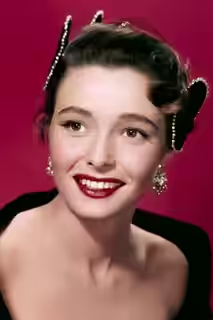
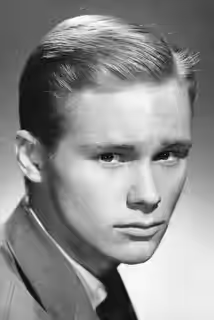
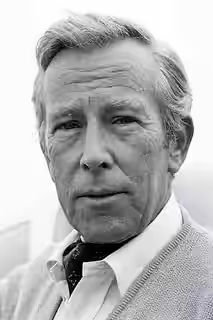
Texas, the early 1960s. Homer Bannon (Melvyn Douglas) runs a cattle ranch the old way and keeps a pair of longhorns for sentiment. His son Hud (Paul Newman) sleeps till noon, drives a Cadillac and comes home at dawn from another man’s wife. Homer’s grandson Lonnie (Brandon deWilde), whose father is dead, lives with them and cannot decide which of the two men he admires. Alma Brown (Patricia Neal), the housekeeper, fends off Hud across the kitchen table with a tired good humour. Then a heifer is found dead at the water tank, and the state vet, Mr Burris (Whit Bissell), wants the herd tested for foot-and-mouth disease before a single animal is sold. Hud wants the cattle moved and sold before the results come in. Homer will not hear of it.

Plays from YouTube when you press play; nothing loads from them until then.

Fi1m review

Martin Ritt’s Texas drama gives Paul Newman his most likeable louse and James Wong Howe a horizon to fill with sky, and neither wastes it. Only Melvyn Douglas’s upright rancher, right too often and too loudly, keeps it from the top rank.

Homer Bannon (Melvyn Douglas) has spent his life on a Texas cattle ranch building a herd and a set of rules, and his son Hud (Paul Newman) has spent his breaking them. Hud sleeps late, drives a Cadillac, and comes home in the morning from other men’s wives. Watching them both is Homer’s grandson Lonnie (Brandon deWilde), not yet grown and undecided about which of them he wants to turn into, and keeping house for all three is Alma Brown (Patricia Neal), a divorcee who has heard every line Hud has. Then a heifer is found dead by the water tank, and the state vet, Mr Burris (Whit Bissell), wants to run tests before anyone moves a cow. Hud’s idea is to sell the herd before the results come back. That is the film, and it is one of the best American films of its decade about a man who is no good.

The trick, and Martin Ritt knows it is a trick, is that Newman is so easy to watch. He plays Hud slack and grinning, never raising his voice, and he makes selfishness look like the only sane response to a hot afternoon. We came out liking him more than the film wanted us to, and we were uneasy about it, because Irving Ravetch and Harriet Frank Jr. keep handing him lines that ought to have cured us. It is the best kind of star performance: the actor’s charm and the character’s rot in the same shot, and no signal to tell you which one to trust.

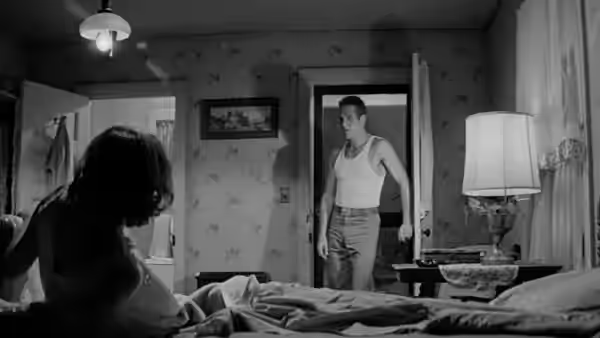
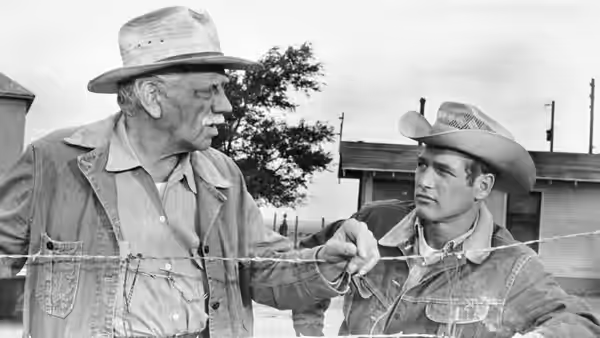
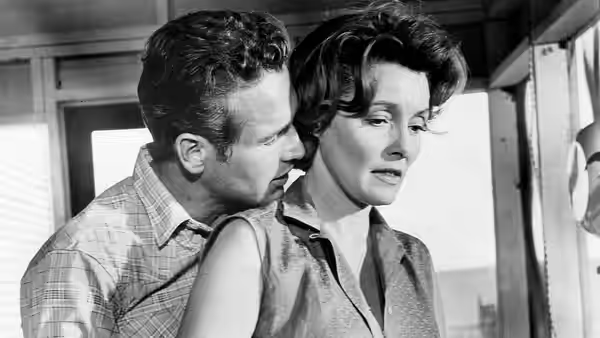
James Wong Howe shot it in black and white on a wide frame, and he puts the horizon low so that most of the picture is sky. The Bannon house sits on the flat like something that fell off a lorry. Indoors he lights from single sources, a lamp on a kitchen table, a bulb over a porch, so faces come out of the dark one at a time and the dark stays dark. Frank Bracht cuts slowly and lets conversations run to their end, which the script can bear. Elmer Bernstein’s score is a few bars of guitar and long stretches of nothing, and the nothing is right; the film’s sound is wind, screen doors and a car engine turning over at dawn.

Neal is the reason to see it a second time. Alma has a low, dry voice and a way of answering Hud’s advances that neither invites them nor shuts the door, and the kitchen scenes between them are the best-written in the film. Edith Head puts her in plain cotton dresses and Newman in shirts a size too tight, and the costumes tell you the terms of the argument before anyone speaks. deWilde has the harder job, since Lonnie mostly watches, and he does it with his face: the boy admires his uncle and knows he should not, and you can see both at once.

The weakness is Homer. Douglas plays him with great dignity, and the script rewards him by letting him make speeches, about the land, about the men a country chooses to admire, about the difference between what a man is and what he owns. Each speech is true and each one lowers the temperature, because Homer is never wrong, so he never has to fight for his side. The one hostile review we read complained that the film never clarifies its themes through the father and son. We think it clarifies them too much, and from the wrong side. Hud is also handed a late speech that states his philosophy in full, and we did not need it; Newman had shown us in the first ten minutes.

The second half takes turns we will not describe, except to say that one of them is the most upsetting thing in the film, that Howe shoots it without mercy, and that another changed how we felt about everything before it, which we take to be the point.

Ritt, Ravetch and Frank Jr. have made a western with a Cadillac in place of a horse, in which the range is fenced, the cattle may be diseased, and the handsome man in the tight shirt is the problem rather than the cure. At 112 minutes there is not a slack scene in it. Watch it and then ask yourself which Bannon you were on the side of. We are still not certain we gave the right answer.
Critical consensus AI synthesised

76
Positive
5
Mixed
0
Negative
1

Most critics admire Hud, and the praise gathers around two names. Paul Newman’s performance as the charming, venomous cattleman is singled out again and again, with more than one writer placing it among the best work of his career. James Wong Howe’s black-and-white photography is the other constant: crisp, stark, and, in the view of one reviewer of the recent restoration, well served by the transfer. More than one critic calls the film bleak, and means it kindly.

The spread is wide rather than narrow. Five reviews are positive, but Variety’s notice from the first release finds it a near miss, arguing that the father-son relationship never makes the film’s themes clear, while still praising all four leads and Patricia Neal in particular. One positive notice is a home-video review whose enthusiasm is partly for the disc, and the New York Times is favourable in its headline alone, with no text available to say why.

Radio Times
★★★★★ · Adrian Turner
100

Turner calls the film a powerhouse drama. He singles out Paul Newman’s performance as his finest on screen.

Read the full review →
Empire
1 January 2000 · Adam Smith
90*

Smith calls the film must-see and says Newman gives a standout performance. He especially praises James Wong Howe’s crisp black-and-white cinematography.

Read the full review →
The New York Times
9 June 1963
71*

The headline presents a favorable response to the film. The supplied page exposes no review text identifying what the critic praised.

Read the full review →
Slant Magazine
17 July 2026 · ★★★½ · Derek Smith
70

The review calls the Criterion release a must-own despite its sparse extras. It praises the top-notch audiovisual presentation, especially the restoration’s rendering of James Wong Howe’s cinematography.

Read the full review →
Variety
31 December 1962 · Variety Staff
40*

The review calls the film a near miss, faulting its failure to clarify its themes through the father-son relationship. It praises the four leading performances, especially Patricia Neal’s powerful turn.

Read the full review →
/Film
21 July 2026 · Chris Evangelista
90*

Evangelista calls the film a great, bleak work that ranks among Newman’s best. He praises Newman’s charming but venomous performance and the stark black-and-white cinematography, while noting the film’s profoundly depressing effect.

Read the full review →

Straight answers AI written, from our review

Is Hud worth watching?
Hud is worth watching for anyone who likes a western with no heroes in it, and we scored it 86. Paul Newman plays a lazy, grinning, selfish man so easily that we liked him more than we should have, and James Wong Howe's black-and-white Texas is nearly all sky. Only Melvyn Douglas's speech-making father, right too often, holds it back.
How long is Hud, and what is it rated?
Hud runs 1h 52m. It is a drama and western film.
Where can I watch Hud in the Philippines?
Hud is not on any streaming or rental service in the Philippines at the moment. It is available in 36 other countries; change your country at the top of the page to see where. Availability is checked daily.
Is Hud based on a true story or a book?
Hud is based on a novel by Larry McMurtry, not on a true story. Our review does not measure the film against the book, so we cannot say how faithful it is, but the film needs no help from it: the characters and the quarrel over the herd are complete on screen. You do not need to have read McMurtry to follow a word.
What should I watch after Hud?
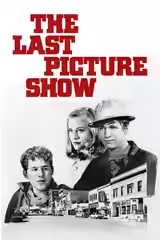
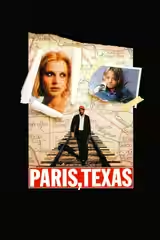
After Hud, try The Last Picture Show (1971, Fi1m 89): McMurtry’s Texas again, a decade on, with the town dying instead of the herd. Then Paris, Texas (1984, Fi1m 88): A German director finds the same flat horizon and puts a silent man against it; and Hell or High Water (2016, Fi1m 84): Two brothers, one decent and one not, and Texas ranch land nobody can afford to keep.

Cast

Awards

Academy Awards, 1964

Nominated
Best Actor
Nominated
Best Art Direction, Black and White
Nominated
Best Director
Nominated
Best Writing, Adapted Screenplay
Won
Best Actress
Won
Best Cinematography, Black-and-White
Won
Best Supporting Actor

If you liked this, try…

  1. The Last Picture Show (1971, Fi1m 89)McMurtry’s Texas again, a decade on, with the town dying instead of the herd.

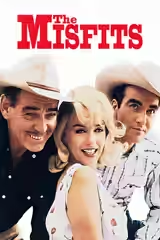
  2. The Misfits (1961) · not on Fi1m yetAnother black-and-white western about men who have outlived their own usefulness.

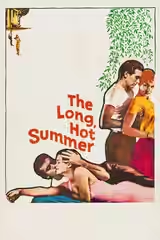
  3. The Long, Hot Summer (1958) · not on Fi1m yetRitt, Ravetch and Frank Jr. try Newman as a charming drifter first, with a happier outcome.

  4. Paris, Texas (1984, Fi1m 88)A German director finds the same flat horizon and puts a silent man against it.

  5. Hell or High Water (2016, Fi1m 84)Two brothers, one decent and one not, and Texas ranch land nobody can afford to keep.

Hud (1963) review: Newman’s charming louse, Howe’s endless sky (the Philippines) | Fi1m