Adam Sandler, playing it straight, carries a basketball drama that does nothing you have not seen before and does most of it well. The scouting and the court scenes are alive; the front office villains are cardboard.
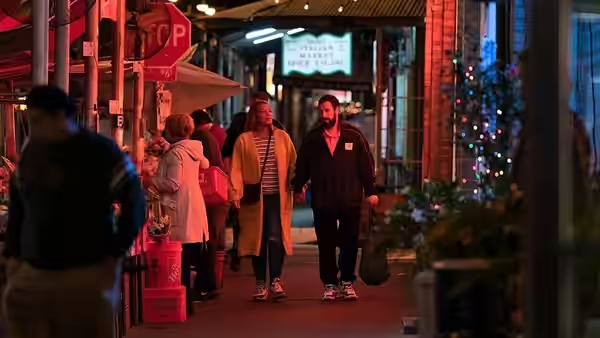
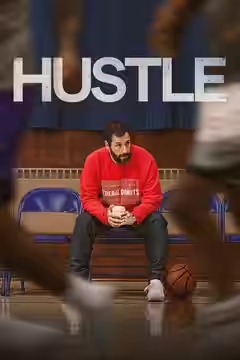
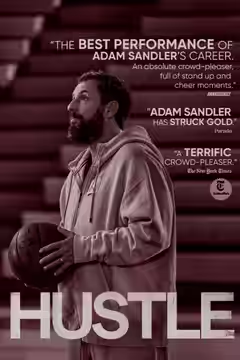
Hustle is the story of a scout who wants to be a coach and finds, on a concrete court in Spain, the player who might get him there. It is directed by Jeremiah Zagar, written by Will Fetters and Taylor Materne, and produced by, among others, LeBron James. You will know its shape from the first ten minutes. It is a good film anyway, because the people in it behave like people and the basketball looks like basketball, and those two things are rarer in the genre than they should be.
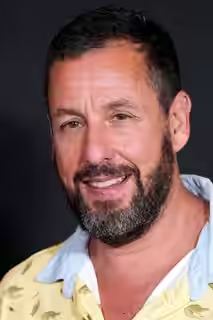
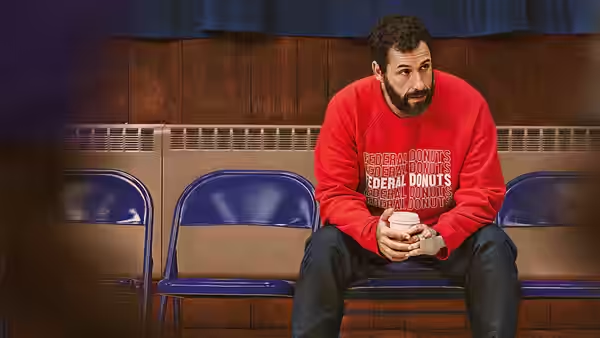
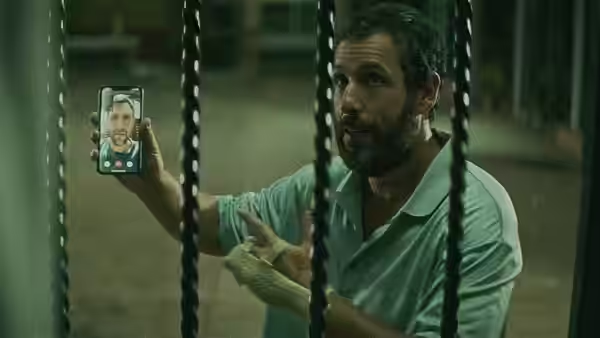
Since Uncut Gems (2019) nobody has needed convincing that Sandler can act when he chooses to. Here he chooses to play tired. Stanley Sugerman eats in airports, sleeps on planes, and wears the quarter-zips and slightly too tight polo shirts that Johnetta Boone has found for him, the uniform of a man who stopped dressing for anyone years ago. Sandler drops the voice, drops the shouting and keeps the timing, so that Stanley’s jokes come out sideways, as things he says to get through a room. When he talks to Bo about the game he sounds like a man who loves something that has never loved him back much. It is the most likeable he has been in a long while.
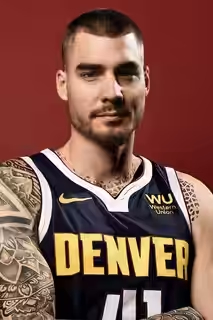
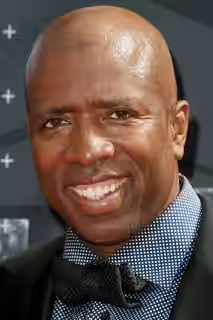
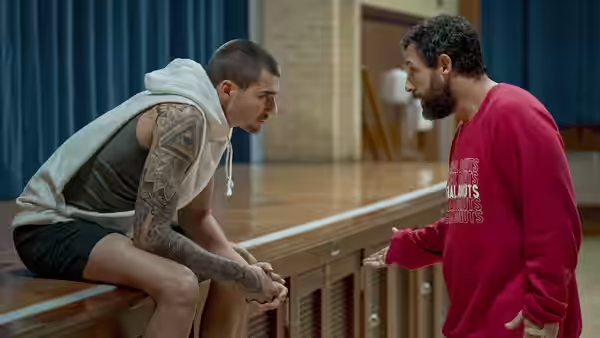
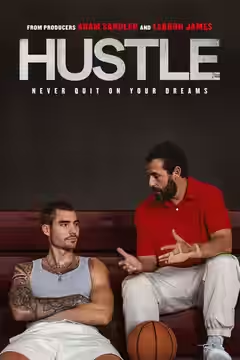
Hernangómez is a working professional player rather than an actor, as are Kenny Smith and Anthony Edwards, and the reviews so far have been rightly surprised by how well this works. Bo is shy, proud and quick to anger, and Hernangómez plays him with his shoulders, closing up when a stranger speaks to him and opening only on court. The two men are easy together from the first scene in Spain, Stanley in a rental car following a bus, Bo pretending not to notice. Most of what is good in the film is the two of them in a gym at six in the morning.
Zak Mulligan shoots the games from inside them, handheld at waist height, so the camera is a player who cannot keep up, and because the men on court are real players there is no cutting around anyone who cannot shoot. Perry Andelin Blake gives the Sugermans a small, cluttered house and the Merricks glass offices with nothing on the desks. Brian M. Robinson and Tom Costain cut the training so that the bounce of the ball sets the pace of the film, and under it Dan Deacon’s score, all short repeated synthesiser phrases and a pulse that keeps skipping, makes even a stretching drill feel like a countdown.
Here is what we felt. There is a montage of Bo running up a hill in the dark, day after day, with Stanley timing him from the car, and the film had told us in every possible way that this was coming. We were stirred by it anyway, properly and physically, and then slightly annoyed with ourselves. That is the sequence to judge the film by. Deacon’s music, the cutting and Hernangómez’s face doing nothing but hurt earn the feeling even though the script had already ordered it.
The front office is where it goes thin. Foster’s Vince has no reason to dislike Stanley beyond the plot needing someone to, and Foster, who can do a great deal, is given a sneer and a good coat. Queen Latifah is handed the wife at the kitchen table and makes more of it than is written; the film keeps leaving her there. Every setback arrives on the genre’s timetable, and a scrimmage in which Kermit Wilts starts talking to Bo and does not stop is the one place the script finds a cruelty of its own. A lot of real players and coaches pass through, and the film sometimes stops to look at them for a beat longer than it should.
Zagar knows he is making a film about a man running up things, and he does not hide from Rocky (1976) so much as nod at it and get on. Against the better basketball films, Hoop Dreams (1994) most of all, this has nothing to say about the business except that it is hard and some of the people in it are decent. That is enough for an evening. It runs 117 minutes, it carries a 15 for the language, and we would happily watch the two of them in that gym again.