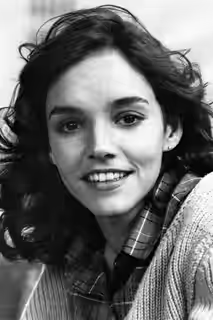
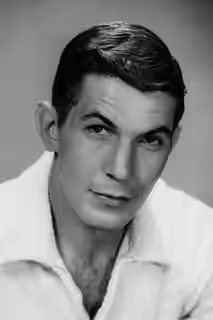
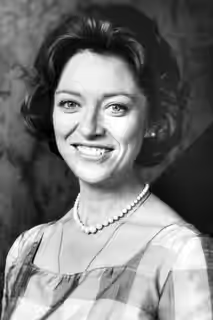
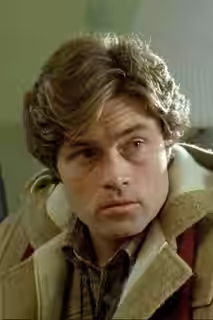
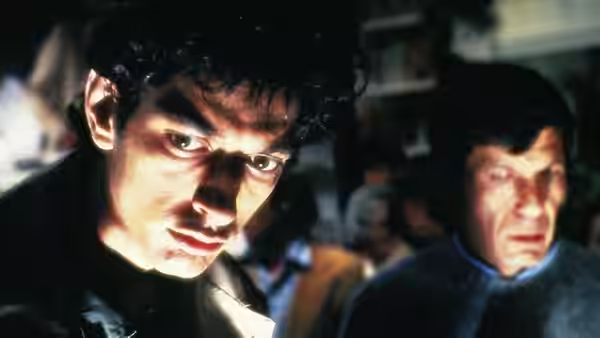
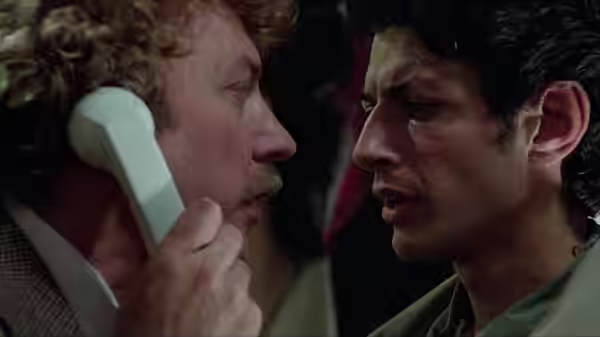
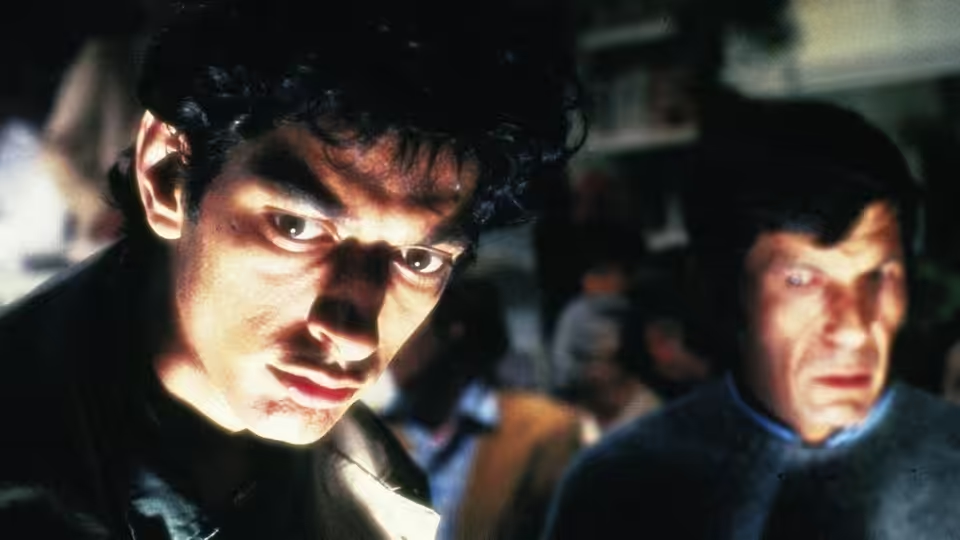
Jack Bellicec (Jeff Goldblum) staring ahead with a man behind him
Film review

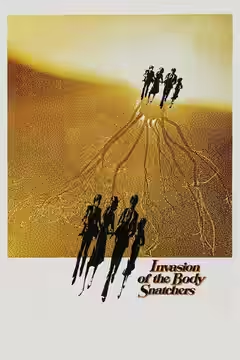
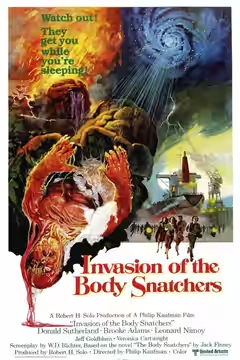
Invasion of the Body Snatchers

1978 · Directed by Philip Kaufman · 1h 56m · IFCO 15

In a sentenceThe talking cure finally works on San Francisco: nobody has a feeling left to discuss

Something drifts out of space and comes down on San Francisco as rain, and by morning small pink flowers are growing in the cracks of the pavements. Elizabeth Driscoll (Brooke Adams), who works at the city health department, picks one and takes it home. The next day her boyfriend Dr. Geoffrey Howell (Art Hindle) is up before her, dressed and tidy and cold, and he will not meet her eye. She tells her colleague Matthew Bennell (Donald Sutherland), a health inspector, who takes her to a book party for the pop psychiatrist Dr. David Kibner (Leonard Nimoy). Kibner tells her she is looking for an excuse to leave a man. Across town, Jack Bellicec (Jeff Goldblum), a writer, and his wife Nancy Bellicec (Veronica Cartwright) run a mud-bath spa, where something grey has begun to form on one of the tables.

Plays from YouTube when you press play; nothing loads from them until then.

Fi1m review

Philip Kaufman moves the pod people from a small town to late-seventies San Francisco, where nobody notices a neighbour changing because everybody is already paying to change. It is one of the few remakes that improves on its original, and it frightened us badly.

Philip Kaufman’s film is a remake of Don Siegel’s 1956 Invasion of the Body Snatchers, and it keeps the plot of Jack Finney’s novel: pods from space grow copies of sleeping people, the copies wake without feeling, and the few who notice cannot get anyone to believe them. What Kaufman and his screenwriter W.D. Richter change is the address. Siegel’s story happened in a small town. This one happens in San Francisco in the late seventies, a city full of people paying to be told they have changed, so nobody looks twice when a neighbour does. It is a better film than the original, and we did not sleep well after it.

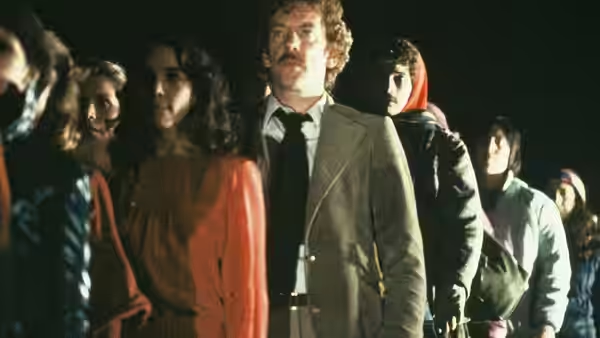
The first hour has no monster in it. Michael Chapman, who shot Taxi Driver two years earlier, films the city at street level, and Kaufman fills the back of the frame with small wrongnesses: a priest on a children’s swing, a schoolteacher gathering flowers with her class, a crowd on a corner that has stopped moving. Elizabeth watches Dr. Geoffrey Howell hand a parcel to strangers without a word, and Brooke Adams plays it as the ordinary hurt of a woman whose partner has gone off her overnight. We were more frightened by Art Hindle sitting downstairs before dawn, dressed and shaved, staring at a television, than by anything the film does later with fibre and foam. He is only sitting there.

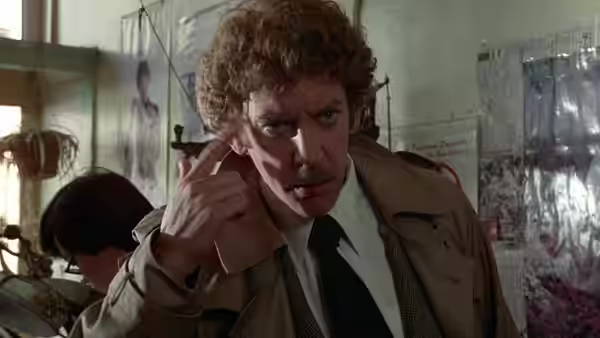
Donald Sutherland’s Matthew is a health inspector, introduced fishing a rat dropping out of a restaurant sauce while the chef insists it is a caper. Aggie Guerard Rodgers puts him in a long leather coat, and Sutherland gives him a perm and a slow, reasonable manner; the character’s trouble is that he stays reasonable for too long. Leonard Nimoy’s Dr. David Kibner is the pop psychiatrist whose book everyone at the party is holding, and Nimoy plays him as a man with an explanation for everything and a hand on your shoulder while he gives it. He tells Elizabeth that people invent conspiracies because they cannot admit a relationship is over. In this city that passes for wisdom.

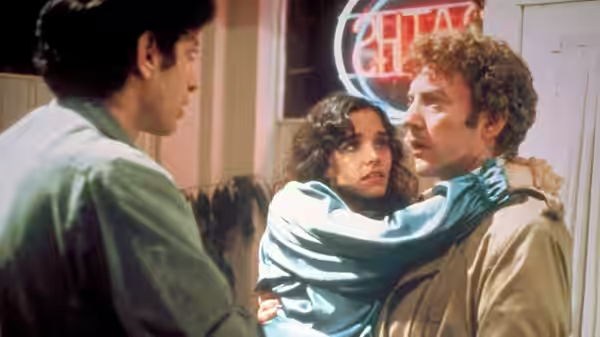
Jeff Goldblum’s Jack Bellicec is a writer nobody reads, twitching with grievance at a party for a man everybody reads, and Veronica Cartwright’s Nancy Bellicec, who runs their mud-bath spa with him, believes first and is believed least. Cartwright is the best thing in the film. When she finds the grey, unfinished body on a table in the spa she does not scream; she talks, fast, and keeps talking, and Kaufman holds on her until the chatter is the fear.

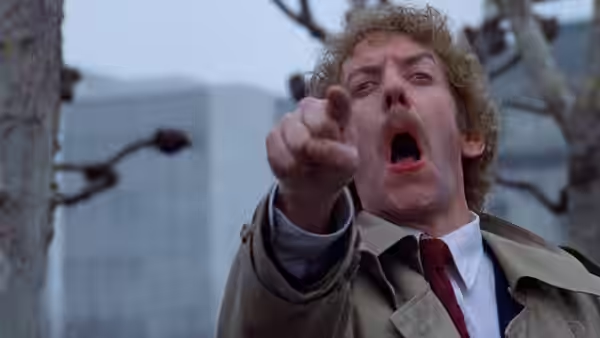
Charles Rosen’s production design and Chapman’s lighting make the city a place of stairwells and back alleys, shot from low down and often at a tilt, with faces half in shadow. It is showy, and now and then we noticed the angle before we noticed the scene. Denny Zeitlin’s score sets a small piano theme against low brass and electronic groans, and the sound department gives the pod people a signal: when they spot one of the unchanged they point and let out a raw, open-mouthed shriek. The film also keeps showing refuse lorries at dawn loaded with grey dust, and you work out what the dust is before the characters do.

The pods themselves are wet, practical work, fibres reaching for skin and pink froth peeling back, and Kaufman shows them in daylight in a garden so there is nothing to hide behind. Douglas Stewart’s editing carries the second half through a run of pursuits across the city, and this is the one stretch that resembles other films: people run, hide, are found. At 116 minutes it is longer than Siegel’s version and does not feel it.

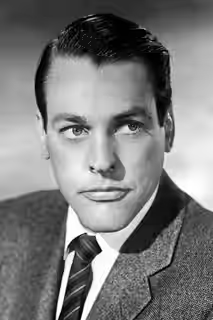
Kaufman is open about the debt. Kevin McCarthy, the lead of the 1956 film, throws himself across a windscreen shouting that they are coming, and Siegel himself drives a taxi. It is a fond touch and it quietly makes this a sequel: the man who ran out of the last film has been running ever since. The ending, which we will not describe, is the best-known thing about the film, and the reason to read nothing else before you watch it.

Watch it in the dark with the sound up, and keep an eye on the extras. The film teaches you to look at strangers the way Elizabeth learns to, and it takes about a day to wear off.
Critical consensus AI synthesised

85
Positive
11
Mixed
0
Negative
0

Eleven reviews, all positive, and unusually united for a remake. Most critics say Kaufman’s 1978 version matches or improves on the 1956 original; a few call it as much a sequel as a rerun. The praise clusters on the move to San Francisco and what it lets the film say about post-Watergate distrust and Sixties idealism curdling into complacency. Denny Zeitlin’s layered score, the sound design, restrained effects and an ensemble led by Sutherland are all singled out, and several reviews rank it among the most frightening American films of its decade.

The spread is narrow; nobody dislikes it, and the cooler notices simply admire it a little less. The New York Times finds it dazzling but showy, closer to an affectionate joke on the material than straight horror, and Time Out reads it as a knowing Movie Brat exercise toying with psychology and ecology. The rest take the fear at face value.

Empire
1 January 2000 · Kim Newman
90*

The critic praises Kaufman's 1978 remake as an intelligent upgrade and even a sequel to the 1956 original, highlighting its subtle effects, layered soundtrack by Denny Zeitlin, and depiction of post-Summer of Love alienation in San Francisco. It singles out the eerie open-mouthed pod yell and the film's standing among the most intelligent and frightening American sci-fi films of the decade.

Read the full review →
Slant Magazine
16 August 2016 · Chuck Bowen
90*

The review praises Philip Kaufman's film as a funny and terrifyingly sensual portrait of conformity, highlighting its textured, tactile scenes rich in emotional detail and subtle social commentary on the shift from 1960s/70s idealism to corporate culture and complacency.

Read the full review →
The AV Club
29 August 2007 · A- · Keith Phipps
90

The review commends the film's blend of post-Vietnam paranoia and Me Decade introspection, noting how it alternates sharp social commentary with impeccably crafted scares while updating the original's formula effectively.

Read the full review →
The New Yorker
18 December 1978 · Pauline Kael
90*

The film is sheer fun and a new classic, a full-scale realization of the story's potential with confident direction and witty script. Kael praises the sumptuous production, sound design, San Francisco setting, and the way it captures the fear of losing individuality.

Read the full review →
Variety
31 December 1977 · Variety Staff
90*

The remake validates the concept of remakes by matching and exceeding the original in tone, conception, and execution. The critic highlights the strong ensemble cast led by Sutherland and the methodical ominousness of the later pursuit scenes.

Read the full review →
The New York Times
22 December 1978 · Vincent Canby
70*

Kaufman's remake is a dazzling, showy update of the horror classic that operates as both a valentine and a good-hearted joke on the material. The critic singles out the director's inventive visual style and attention to beautiful minutiae for praise.

Read the full review →

Straight answers AI written, from our review

Is Invasion of the Body Snatchers worth watching?
Invasion of the Body Snatchers is worth watching for its patient, unsettling science-fiction horror, and we score it 86 out of 100. We were badly frightened by the ordinary coldness of people who no longer seem themselves. The later pursuits are more familiar, but the performances and the small wrongnesses in the background keep the fear close.
How long is Invasion of the Body Snatchers, and what is it rated?
Invasion of the Body Snatchers runs 1h 56m and is rated 15 by the IFCO in Ireland. It is a science fiction and horror film.
Where can I watch Invasion of the Body Snatchers in Ireland?
Invasion of the Body Snatchers is streaming on Amazon Prime Video in Ireland, and it is also available to rent from Amazon Prime Video and Apple TV from €3.99. Availability is checked daily; the links above go straight to each service.
How violent or frightening is Invasion of the Body Snatchers, and is it suitable for children?
Invasion of the Body Snatchers has a UK 15 certificate and is too frightening for children, with sustained paranoia and wet, fibrous body horror. We find a familiar person behaving coldly more disturbing here than the physical effects. Older teenagers who enjoy horror are its likely audience; the squeamish should take the bodily transformations seriously.
How does Invasion of the Body Snatchers compare to The Thing?
Invasion of the Body Snatchers offers stronger character work than The Thing, while both make the possibility of a human copy deeply frightening. We favour the San Francisco film for its ordinary relationships turning quietly wrong; Carpenter’s Antarctic horror suits those drawn to strange physical effects. We recommend both, though The Thing has thinner characters and a sagging middle.
Is Invasion of the Body Snatchers based on a true story or a book?
Invasion of the Body Snatchers is based on Jack Finney’s novel, not a true story, and remakes Don Siegel’s earlier film. It keeps the novel’s central premise of alien pods replacing sleeping people with unfeeling copies, while moving the action to late-seventies San Francisco. No knowledge of the book or the earlier film is needed to follow it.

Cast

If you liked this, try…

Invasion of the Body Snatchers poster

Invasion of the Body Snatchers

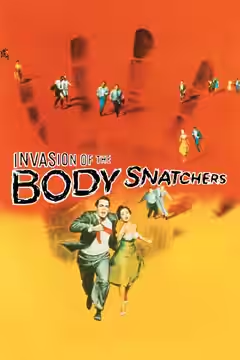
1956 · Siegel’s original, leaner and cheaper, with Kevin McCarthy running for his life.

The Thing poster88

The Thing

1982 · Carpenter’s Antarctic version of the same fear, where the copy could be sitting beside you.

The Wicker Man poster90

The Wicker Man

1973 · A policeman on a Scottish island where everyone is polite and nobody will help.

Cure poster

Cure

1997 · Kiyoshi Kurosawa’s Tokyo detective story, in which ordinary people quietly stop being themselves.

Under the Skin poster81

Under the Skin

2013 · Glasgow, a van, and Scarlett Johansson learning what human beings are for.