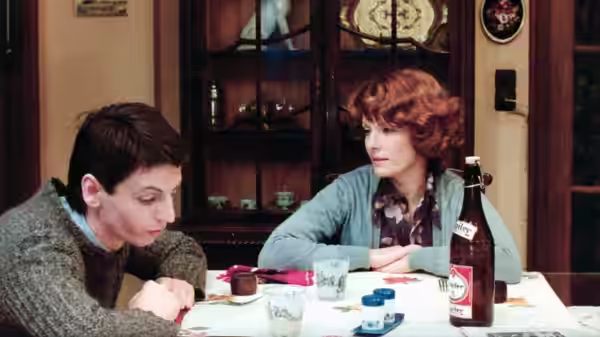
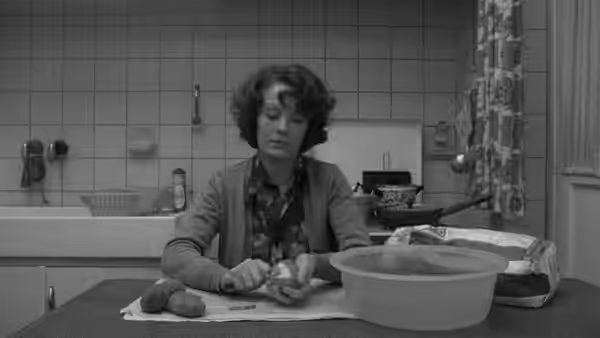
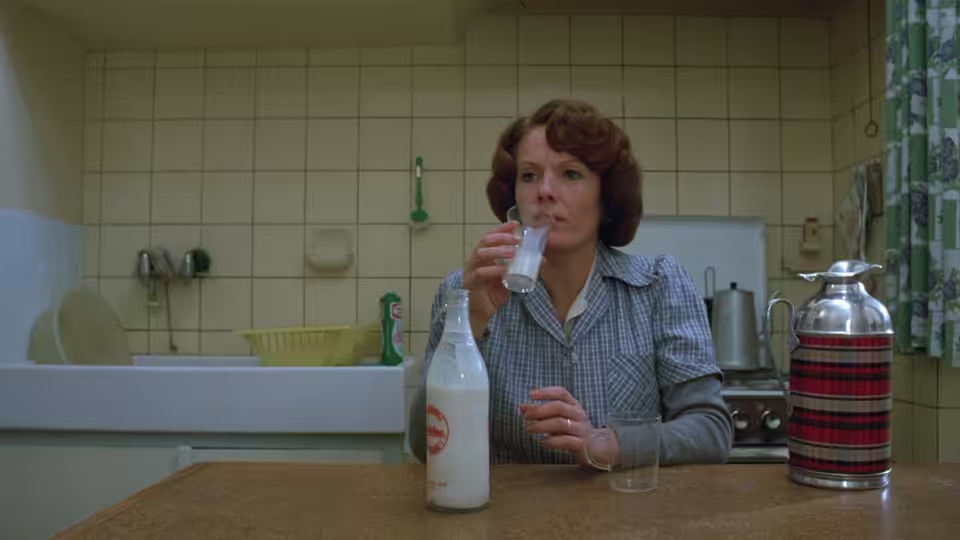
Jeanne Dielman (Delphine Seyrig) drinks from a glass in her tiled kitchen
Film review

Jeanne Dielman, 23, quai du Commerce, 1080 Bruxelles

1976 · Directed by Chantal Akerman · 3h 22m

In a sentenceDelphine Seyrig makes the housework worth watching, which is no small achievement over 202 minutes

Jeanne Dielman (Delphine Seyrig) attends to the routines of domestic life at the address named in the title, 23, quai du Commerce, 1080 Bruxelles. Around her are Sylvain Dielman (Jan Decorte) and the 1st Caller (Henri Storck). Household work occupies her time, and each familiar task belongs to a pattern that has to be maintained. Across 202 minutes, the drama stays with Jeanne and these repeated activities, observing the effort involved in keeping daily life in order rather than skipping ahead to the next event.

Plays from YouTube when you press play; nothing loads from them until then.

Fi1m review

Chantal Akerman makes domestic routine worth close attention, helped by Delphine Seyrig’s absorbing performance. The 202 minutes occasionally test patience beyond their purpose, but this is a demanding drama we recommend making time for.

Chantal Akerman’s Jeanne Dielman, 23, quai du Commerce, 1080 Bruxelles is demanding, absorbing drama whose length has a purpose, though not every minute feels necessary. It asks us to look at domestic routines with a degree of attention that films seldom give them. At 202 minutes, that is a substantial request. We recommend it for the seriousness with which it watches Jeanne and for Delphine Seyrig’s ability to make such attention worthwhile.

The performance is restrained without making Jeanne seem inaccessible. She does not advertise what we ought to feel, which leaves room for tenderness and irritation to arrive together. We were moved more than we expected. Watching her give the household routines such concentration made us think about the time they consume and how readily that effort goes unnoticed. The feeling develops through watching her work, without needing a conspicuously expressive moment to announce it.

Babette Mangolte’s cinematography gives that performance room to be watched. The observational style allows household activity sustained attention, so we have a chance to study the person doing it. That sounds a modest achievement until we notice how accustomed we are to seeing such work hurried past. The approach gives us time to recognise the concentration involved, and to wonder why watching it should make us impatient.

Patricia Canino’s editing accepts the risk that a viewer will become restless. Keeping domestic routines at the centre of a film this long means that repetition begins to affect the way we watch. We start to feel how much time these activities consume. An edit that hurried us through them would make the film easier to sit through, and weaken a considerable part of what it achieves. The duration is doing useful work, even when it becomes uncomfortable.

Chantal Akerman treats the labour involved as worthy of attention even when it is repetitive or unrewarding. The film’s feminist concerns become clear through that decision, without requiring Jeanne to stand for every woman. Delphine Seyrig remains essential here: her performance keeps the domestic activity attached to a particular person. That matters over this duration, when a less persuasive performance could leave us feeling that we were being given a demonstration of the director’s convictions.

There are stretches when we feel we have noticed all we can and are simply waiting. By then the film has established how much time routine consumes, and further observation adds little to our understanding. The director’s commitment can make the experience feel needlessly severe. Admiration for the method does not prevent impatience, and the film cannot always make that impatience worth our while.

The film makes an unusually sustained challenge to the idea that drama should keep supplying new incidents. The household routines have enough human interest to justify the experiment, though the running time remains a serious condition of our recommendation. It needs attention, and there is little point starting it in the hope that it will hurry up. Choose an evening when the housework can wait.

Critical consensus AI synthesised

3 of 6
Positive
2
Mixed
0
Negative
1
Time Out
22 September 2024 · ★★★★★ · TR
100

The available description presents the film as compelling both aesthetically and politically. It singles out the way its feminist concerns are matched by aesthetic interest.

Read the full review →
Empire
6 April 2006 · David Parkinson
90*

Parkinson praises the film as a mesmerizing, courageously experimental work. He singles out Delphine Seyrig’s performance and the observational style that makes domestic routines compelling.

Read the full review →
HeyUGuys
10*

The critic strongly rejects the film, arguing that its excessive runtime drains it of meaning and pathos. They single out its 202-minute length as the overriding flaw, and also criticize the climax’s choreography.

Read the full review →

Straight answers AI written, from our review

Is Jeanne Dielman, 23, quai du Commerce, 1080 Bruxelles worth watching?
Jeanne Dielman, 23, quai du Commerce, 1080 Bruxelles is worth watching for patient viewers drawn to closely observed domestic drama, and we score it 72 out of 100. Delphine Seyrig makes household routines absorbing and unexpectedly moving, though stretches of its 202 minutes test our patience without adding much to our understanding.
How long is Jeanne Dielman, 23, quai du Commerce, 1080 Bruxelles, and what is it rated?
Jeanne Dielman, 23, quai du Commerce, 1080 Bruxelles runs 3h 22m. It is a drama film.
Where can I watch Jeanne Dielman, 23, quai du Commerce, 1080 Bruxelles in Norway?
Jeanne Dielman, 23, quai du Commerce, 1080 Bruxelles is not on any streaming or rental service in Norway at the moment. It is available in 5 other countries; change your country at the top of the page to see where. Availability is checked daily.
How violent or frightening is Jeanne Dielman, 23, quai du Commerce, 1080 Bruxelles, and is it suitable for children?
Jeanne Dielman, 23, quai du Commerce, 1080 Bruxelles carries a UK 15 certificate and is not suitable for children under 15. We cannot specify its level of violence or fright from the information available, and its focus on household routines should not be taken as reassurance about content. Its 202-minute duration also demands considerable patience.
How does Jeanne Dielman, 23, quai du Commerce, 1080 Bruxelles compare to Late Spring?
Jeanne Dielman, 23, quai du Commerce, 1080 Bruxelles is the more demanding recommendation beside Late Spring, which we recommend more strongly for its deeply moving father-and-daughter drama. Both find pressure in quiet household rituals, but Akerman gives repeated domestic work sustained attention across 202 minutes. We favour Late Spring for family relationships and Jeanne Dielman for its close examination of routine and labour.
What should I watch after Jeanne Dielman, 23, quai du Commerce, 1080 Bruxelles?
After Jeanne Dielman, 23, quai du Commerce, 1080 Bruxelles, try Late Spring (1949, Fi1m 92): Quiet household rituals reveal pressures that nobody quite wants to name. Then The Mother and the Whore (1973, Fi1m 86): An extended study of intimacy for anyone willing to sit with difficult company; and Distant Voices, Still Lives (1988, Fi1m 90): Family routine, memory and domestic unease, compressed into a much shorter evening.

Cast

If you liked this, try…

  1. Late Spring (1949, Fi1m 92)Quiet household rituals reveal pressures that nobody quite wants to name.

  2. The Mother and the Whore (1973, Fi1m 86)An extended study of intimacy for anyone willing to sit with difficult company.

  3. Distant Voices, Still Lives (1988, Fi1m 90)Family routine, memory and domestic unease, compressed into a much shorter evening.

  4. The Headless Woman (2008) · not on Fi1m yetFor another closely watched woman whose ordinary surroundings become hard to trust.

  5. The Assistant (2019) · not on Fi1m yetRepetitive work and small gestures expose what an institution expects women to tolerate.