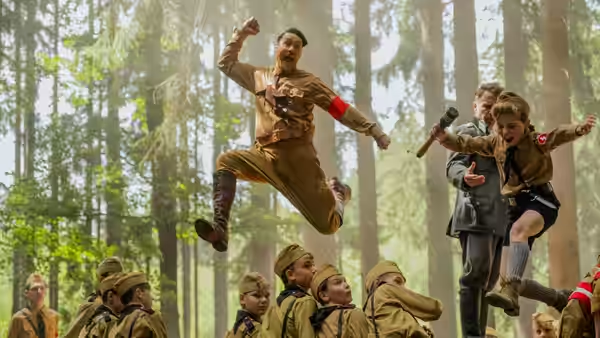
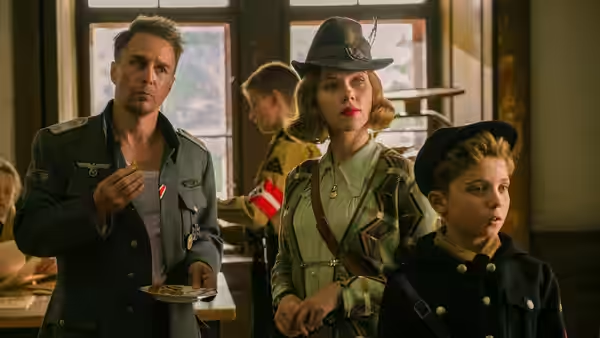
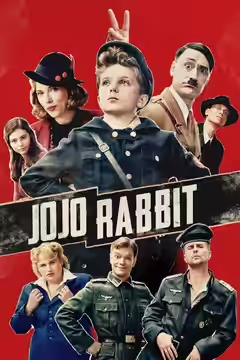
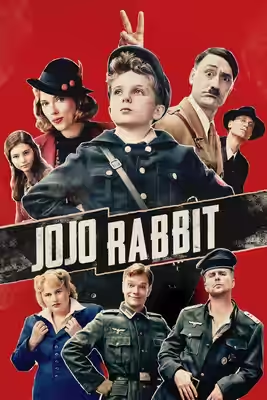
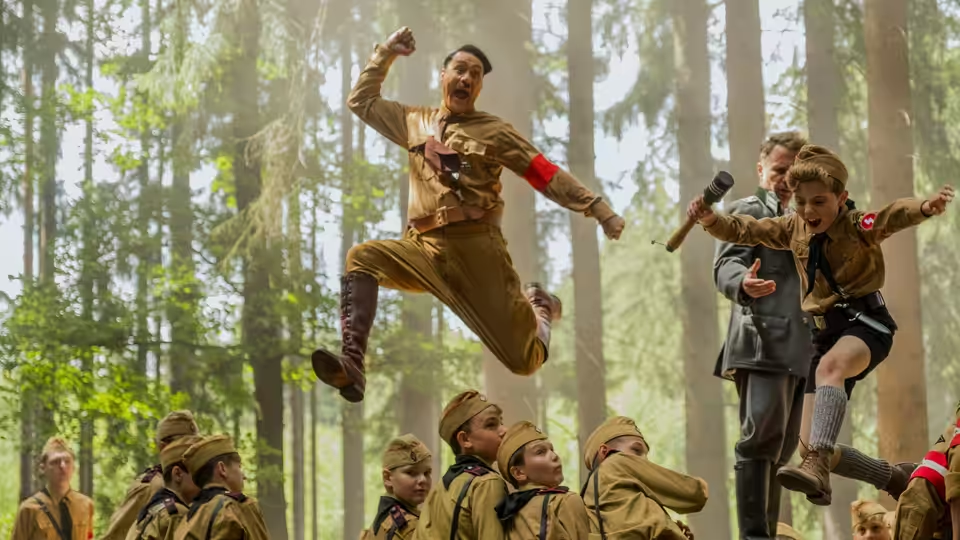
Adolf (Taika Waititi) and Jojo (Roman Griffin Davis) leap among children at a forest youth camp
Film review

Jojo Rabbit

2019 · Directed by Taika Waititi · 1h 48m · ClassInd 14

In a sentenceThe children are so good that even an imaginary Hitler has to wait his turn

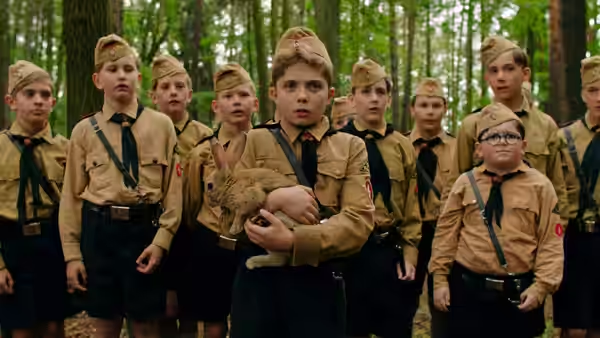
Under the Third Reich during the Second World War, Jojo (Roman Griffin Davis) is a boy whose imaginary friend is Adolf (Taika Waititi), his own version of Hitler. Yorki (Archie Yates) is Jojo’s friend. Jojo tries to understand the world through the Nazi beliefs around him, with an imaginary dictator available to join the conversation. His relationship with Elsa (Thomasin McKenzie) puts those beliefs under pressure. Between the adults teaching him what to think and the people he gets to know, Jojo has to work out whose account to believe.

Plays from YouTube when you press play; nothing loads from them until then.

Fi1m review

Roman Griffin Davis and Scarlett Johansson give Jojo Rabbit the warmth that makes its account of indoctrination so moving. Taika Waititi occasionally overplays the imaginary Hitler, but this funny, compassionate film earns its faith in a child’s ability to change.

Jojo Rabbit is a funny, deeply affecting coming-of-age comedy that understands how seriously a child can take nonsense. Taika Waititi, who writes and directs, wants to make indoctrination comprehensible through a boy who treats Hitler as an imaginary friend. There is a useful idea here: a child can attach himself to something monstrous without understanding what it means. The film makes that attachment plausible, then gives the boy room to question it without pretending the beliefs themselves are harmless.

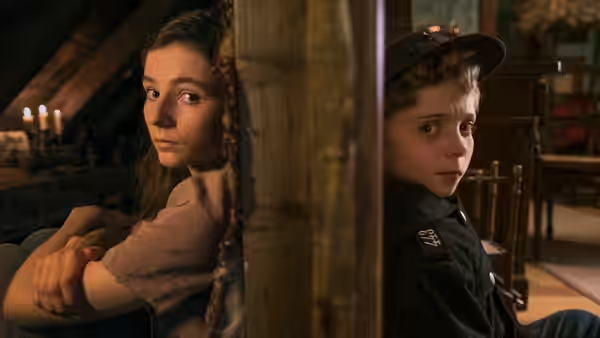
Roman Griffin Davis gives Jojo enough uncertainty to keep him from becoming simply a child delivering grown-up jokes. The performance makes it possible to care about this boy without endorsing the rubbish he believes. Thomasin McKenzie, as Elsa, is equally persuasive, bringing a wariness that keeps their scenes from becoming easy lessons in tolerance. She makes Elsa’s vulnerability matter independently of what Jojo might learn from her. Their exchanges give the difficult business of questioning a belief enough tension to hold our attention without the broader comedy.

Taika Waititi also plays Adolf, the imaginary Hitler, and the silliness has a clear purpose. We laughed at this dictator reduced to a boy’s imaginary companion, because the performance makes his authority look childish. A few routines go on too long, and once the absurdity is established, further clowning brings diminishing returns. Even so, the imaginary friend makes sense as someone this boy would invent, and the performance makes Jojo’s need for approval uncomfortably easy to recognise.

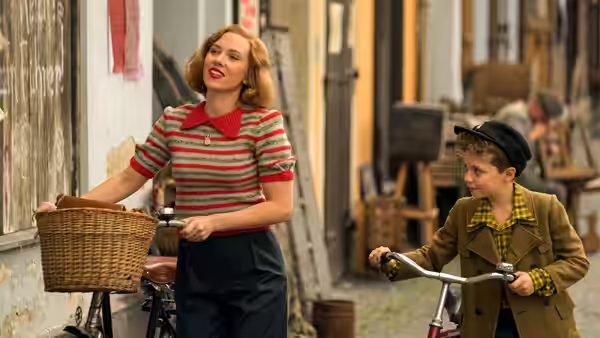
Scarlett Johansson gives Rosie a warmth that does not need the imaginary friend’s antics, and the film benefits from that quieter approach. We were moved by her scenes with Jojo because their affection gives him something believable to value beyond the beliefs he has been taught. Sam Rockwell’s Captain Klenzendorf supplies a more knowing kind of comedy. Both performances suggest lives beyond the boy’s understanding, without requiring the film to abandon his point of view.

Cinematographer Mihai Malaimare Jr. and production designer Ra Vincent make the setting attractive enough to support the fantasy. We can see why a child’s imagined world should look inviting. That appeal matters because Jojo has to discover what is wrong with surroundings and people he already likes. Presenting everything as sinister would make that discovery much easier, and much less interesting to watch.

Editor Tom Eagles has the awkward job of fitting broad farce beside scenes that ask for serious feeling. He gives the actors enough space for the serious moments to develop, so the film can change its tone without losing the people we care about. Michael Giacchino’s music contributes to the sweetness, and supports feelings the performances have already earned. At 108 minutes, the film has enough time for its story, and allows Jojo’s doubts to develop without turning every exchange into a lesson.

The consensus is far less enthusiastic than we are, particularly about the sentiment and the broad treatment of Nazis. We think the film’s affection for Jojo makes his indoctrination more troubling, because it insists that a child we like can still believe something hateful. As coming-of-age comedy, this is unusually willing to let its child be wrong. We recommend it warmly, with the warning that the imaginary dictator occasionally needs a firmer editor.

Critical consensus AI synthesised

56
Positive
13
Mixed
13
Negative
10

The reviews are sharply divided on Jojo Rabbit, with praise and qualified approval together outweighing outright rejection, but little agreement on whether its satire works. Praise clusters around the performances: Roman Griffin Davis’s comic timing and emotional range, Scarlett Johansson’s warmth, and Thomasin McKenzie’s scenes with Davis draw approval even from several sceptics. Supporters find the mixture of slapstick and tenderness funny and affecting, and see its gentleness as a useful way into the subject of indoctrination.

The central dispute is whether that gentleness makes hatred comprehensible or makes Nazism look harmless. Reservations repeatedly concern jarring tonal shifts, broad caricature and sentimentality that softens the history; even some favourable reviews find the comedy and drama unevenly joined. The spread is wide: Eye for Film explicitly rejects the charge of trivialising the Holocaust, while The New Yorker argues that the film’s sentimental treatment invites sympathy for Nazis.

Time Out
29 November 2019 · ★★★★ · Joshua Rothkopf
80

The review presents the film as an audacious comedy that finds a tricky way into a difficult subject. It singles out the film’s unusual premise of a Nazi boy befriending an imaginary Führer.

Read the full review →
Sight and Sound
10 September 2019 · Ella Kemp
70*

Kemp finds the film a witty, playful, well-intentioned satire, while acknowledging that its Holocaust comedy may alienate viewers. She especially praises Roman Griffin Davies’s convincing performance as Jojo.

Read the full review →
Screen Daily
17 September 2019 · Tim Grierson
68*

The available text characterizes the film as a gentle satire. It singles out the boy’s imaginary friendship with Hitler as its central premise.

Read the full review →
The New York Times
65*

The page could not be read, so the critic’s verdict cannot be determined. No specific praise or criticism is available in the supplied text.

Read the full review →
The AV Club
17 October 2019 · C+ · A.A. Dowd
63

Dowd finds the film a sentimental, thin crowd-pleaser rather than the provocative satire it promises. He particularly criticizes its gooey humanism and portrayal of Nazis as buffoons, which he says softens the horror of the Holocaust.

Read the full review →
Empire
26 December 2019 · Ben Travis
60*

The review finds the film daring but uneven, with tonal clashes that are partly redeemed by its humane second half. It singles out Thomasin McKenzie and Roman Griffin Davis for bringing tension and vulnerability to the story.

Read the full review →

Straight answers AI written, from our review

Is Jojo Rabbit worth watching?
Jojo Rabbit is well worth watching for its funny, compassionate account of childhood indoctrination, and we score it 88 out of 100. We recommend it warmly to anyone who enjoys coming-of-age comedy with difficult feelings beneath the jokes, though Waititi’s imaginary Hitler routines sometimes outstay their welcome.
How long is Jojo Rabbit, and what is it rated?
Jojo Rabbit runs 1h 48m and is rated 14 by the ClassInd in Brazil. It is a comedy and war film.
Where can I watch Jojo Rabbit in Brazil?
Jojo Rabbit is streaming on Disney+ in Brazil. Availability is checked daily; the links above go straight to each service.
How violent or frightening is Jojo Rabbit, and is it suitable for children?
Jojo Rabbit has a UK 12A certificate, so children under 12 need an accompanying adult at the cinema. Its Nazi beliefs and wartime setting warrant thought before watching with younger children; we would not treat the broad comedy as evidence that it is harmless family viewing. The certificate alone does not establish how graphic or frightening individual scenes are.
How does Jojo Rabbit compare to Hunt for the Wilderpeople?
Jojo Rabbit shares Hunt for the Wilderpeople’s broad comedy and tenderness towards a stubborn child, but puts hateful beliefs at the centre of its coming-of-age story. We favour Jojo Rabbit for the difficult questions its young characters face, and recommend Hunt for the Wilderpeople when a wilderness friendship sounds more appealing; both earn their sweetness despite some overworked comedy.
Is Jojo Rabbit based on a true story or a book?
Jojo Rabbit is adapted from a novel by Christine Leunens, rather than presented as a true story. We would approach it as a fictional coming-of-age tale set under the Third Reich, not a factual account of one boy’s life. Reading the novel is not necessary to follow Jojo’s growing doubts about the beliefs he has been taught.
What should I watch after Jojo Rabbit?
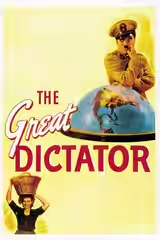
After Jojo Rabbit, try Hunt for the Wilderpeople (2016, Fi1m 82): Another stubborn child gives broad comedy a surprisingly tender centre. Then Good Bye, Lenin! (2003, Fi1m 78): Family affection and political fantasy collide, with consequences the jokes cannot contain; and The Great Dictator (1940, Fi1m 80): Dictatorial vanity gets a thorough dressing-down, with room for an earnest appeal.

Cast

Awards

Academy Awards, 2020

Nominated
Best Picture
Won
Best Writing, Adapted Screenplay

If you liked this, try…

  1. Hunt for the Wilderpeople (2016, Fi1m 82)Another stubborn child gives broad comedy a surprisingly tender centre.

  2. Good Bye, Lenin! (2003, Fi1m 78)Family affection and political fantasy collide, with consequences the jokes cannot contain.

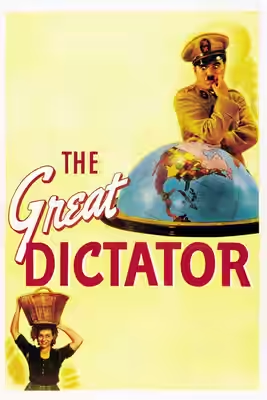
  3. The Great Dictator (1940, Fi1m 80)Dictatorial vanity gets a thorough dressing-down, with room for an earnest appeal.

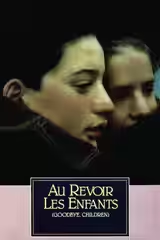
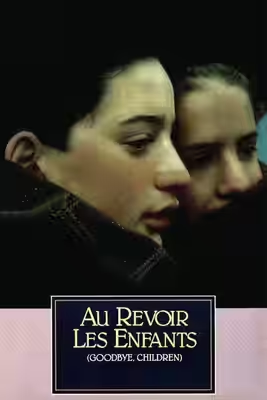
  4. Au revoir les enfants (1987, Fi1m 90)Childhood friendship under Nazi persecution, treated with a restraint that makes it hurt.

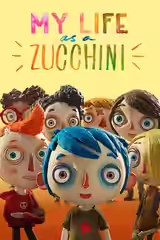
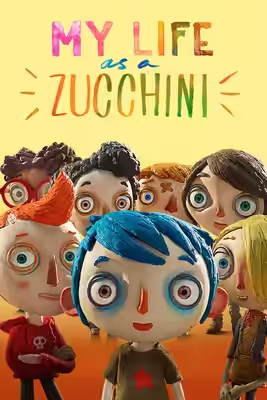
  5. My Life as a Courgette (2016, Fi1m 84)Children carry difficult histories through a funny, carefully judged story of belonging.

Free account

Know what to watch tonight

Two lists that know where things are streaming, collections you can share, your own score beside ours, and Discover that remembers what you have seen.

  • Want to see, sorted by what is streaming now
  • Seen, with your score out of ten
  • No adverts, ever