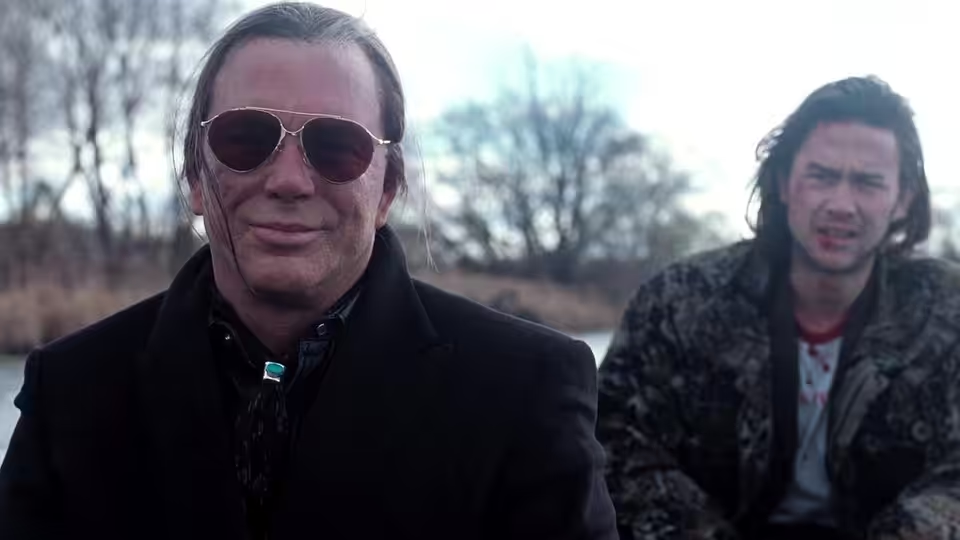
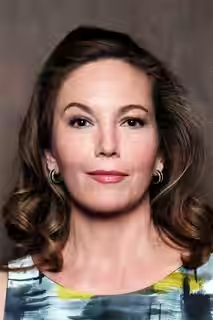
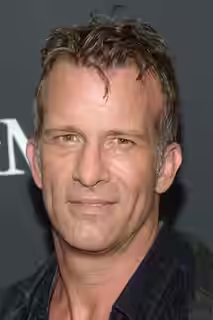
Mickey Rourke gives John Madden’s Elmore Leonard adaptation a slow, sorrowful centre, and Diane Lane and Thomas Jane make a believable marriage under threat. Around them the film has been cut to 95 minutes and plays like the outline of a better one.
Elmore Leonard’s Killshot is one of his plainer books: two criminals, one witness couple, a long wait for the knock on the door. Hossein Amini’s screenplay keeps that shape. The Blackbird kills a man, picks up a partner he does not want, and ends up hunting a husband and wife across the American Midwest because they saw his face. John Madden directs it as a quiet, cold, serious thriller. That is a legitimate way to do Leonard. It is not the way most people like him, and the film knows it.
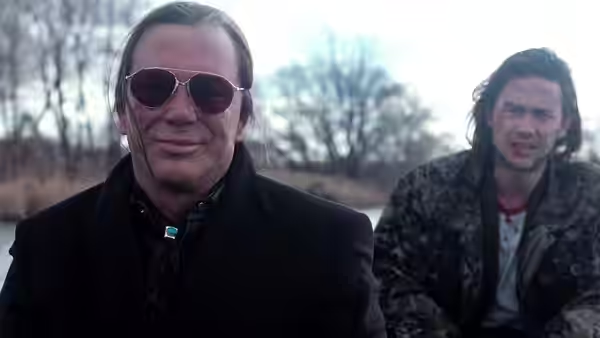
Rourke is the reason to watch. Beth Pasternak dresses him in a long dark coat and a braid down his back, and he moves through the film at half the speed of everyone else, speaking in a low rasp as if each sentence costs him something. There is a scene early on where he sits with his brothers and says almost nothing, and another in a motel where he watches Richie sleep, and in both he looks like a man who has already decided how this ends. We felt sadder watching him than the film seemed to intend, and it is the only strong feeling the film gave us. Rourke supplies grief; the picture around him does not always know what to do with it.
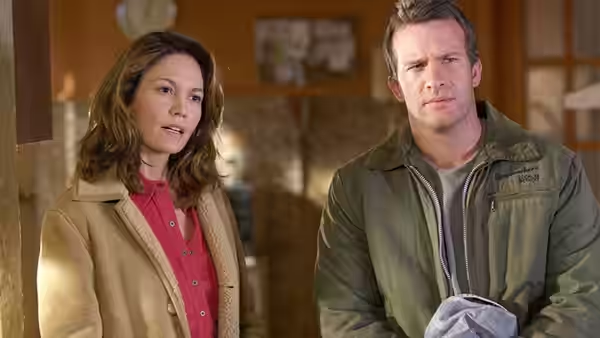
Lane and Jane do the other good work. Carmen and Wayne are separated when we meet them, living in the same small town and avoiding each other, and the film is at its best when it lets them be an ordinary couple with an ordinary grievance who happen to have killers after them. Jane plays Wayne as a big man who settles everything with his hands and is slowly learning that this will not do. Lane gives Carmen a tired patience that turns, over the running time, into something harder. Their scenes in the rented house, arguing over a kitchen table about whose fault any of this is, are the ones that stay.
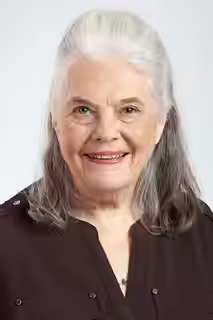
Gordon-Levitt is the problem on screen. His Richie shouts, flails, grins and threatens, and he is working at a volume the rest of the cast has not agreed to. We understand the idea, a boy who thinks he is in a film about a famous outlaw while the man beside him is in a film about dying, but the gap is so wide that the two never seem to be in the same room. Rosario Dawson’s Donna is introduced with some care, talks about Elvis, and then more or less vanishes. Lois Smith has one scene as Carmen’s mother and is, as usual, better than the scene.
The craft is sober and well-judged for a film that lasts 95 minutes and has two credited editors. Caleb Deschanel shoots a grey, low winter, flat fields and bare trees and motel rooms lit by a single lamp, and the colour is drained down to browns and steel blues so that even the blood looks cold. Andrew Jackness gives the Colsons a rented bungalow that is just a little too tidy to feel like anyone’s home, which is right. Klaus Badelt’s score sits on low strings and does nothing wrong and nothing memorable. Mick Audsley and Lisa Gunning, between them, have cut a film in which scenes end a beat before they land and characters leave without having arrived. The reviews so far mention a troubled edit, and we can see the seams.
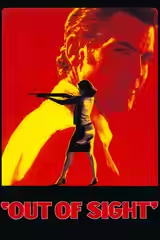
We were bored through the middle half hour, and then puzzled by our own boredom, because every scene has a good actor in it. The explanation is the dialogue. Leonard’s criminals talk, at length, about nothing, and the talk is where the pleasure lives; Out of Sight and Jackie Brown understood that and let the camera sit. Here the talk has been trimmed to plot, and what is left is people telling each other where to go next. The two reviews we have read split cleanly, one finding it solid and one finding it lifeless, and we sit between them: it is solid and it is lifeless, in about equal measure.
See it for Rourke if his sad, slow mid-career work interests you, and for a marriage that is written and played with more honesty than the thriller around it deserves. Do not come for the pulp. The pulp is on the cutting-room floor, with Rosario Dawson.