Caleb Deschanel gives images time to tell the story, an instinct we value more confidently in his cinematography than in his directing. Twin Peaks earns our warm recommendation, though its success is shared by many hands.
Fi1m perspective
Deschanel often keeps the camera at eye level, using long lenses to stay back from performers while allowing action within a carefully arranged frame. He gives us time to look. His preference for telling stories through pictures is clearest in his cinematography, which remains the larger part of his work. We value that patience, but it does not by itself tell us how well he directs.
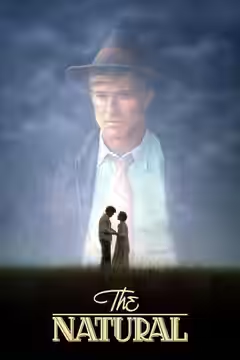
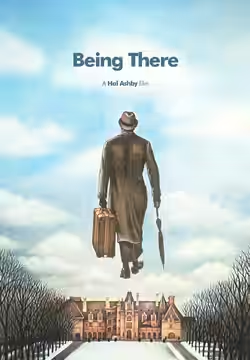
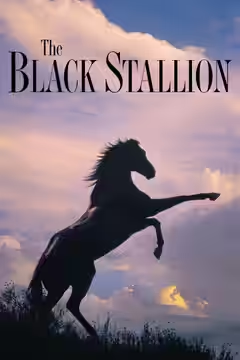
The Black Stallion and Being There (both 1979) established him as a cinematographer; The Escape Artist (1982) was his feature directing debut, followed by Crusoe (1988). His repeated collaborations with directors Carroll Ballard, Hal Ashby and William Friedkin suggest a willingness to adjust his habits to somebody else's film. The light in The Natural (1984) has an almost magical quality, while The Lion King (2019) takes his live-action experience into virtual production. His work has continued to change technically without abandoning the attempt to make an image feel natural.
The substantial pleasure for us is Twin Peaks (1990), for which he directed three episodes. We were unexpectedly saddened by its soap-opera jealousy, because the series takes those feelings seriously even while making them funny and frightening. Kyle MacLachlan provides a steady centre, giving us someone dependable amid the strangeness. Deschanel's willingness to adapt to the series' established style is valuable here, though our praise belongs to the series and should not be mistaken for a separate verdict on his three instalments. It is work within an existing programme, where fitting in matters.
Crusoe supplies a caution: its storytelling drew criticism for being obvious and slow to develop. We would not dismiss the directing on that basis, but nor would we assume that his command of lighting settles the matter. The useful distinction is between giving a scene time and leaving it waiting for something to happen. Start with Twin Peaks for the directing, with some tolerance for the stretches when its patience becomes drift.
Biography
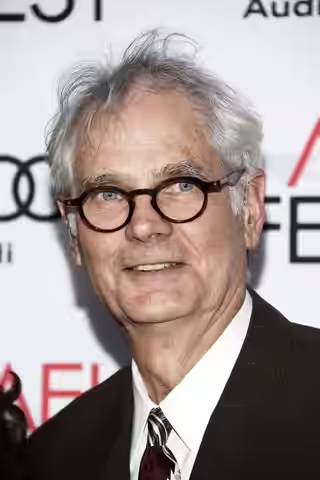
Caleb Deschanel, also credited as Joseph Caleb Deschanel, is an American cinematographer and occasional director of film and television. Born on 21 September 1944 in Philadelphia, Pennsylvania, he studied at Johns Hopkins University, the University of Southern California School of Cinematic Arts and the AFI Conservatory.
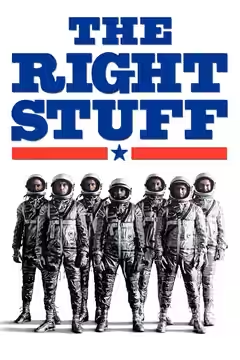
He has served as director of photography on films including The Right Stuff (1983), The Natural (1984), Fly Away Home (1996), The Patriot (2000), The Passion of the Christ (2004) and Never Look Away (2018). Deschanel has received six Academy Award nominations for cinematography. He has also directed episodes of the television series Twin Peaks (1990–91).
Deschanel has been married to actress Mary Jo Deschanel since 1972. They are the parents of actresses Emily Deschanel and Zooey Deschanel.