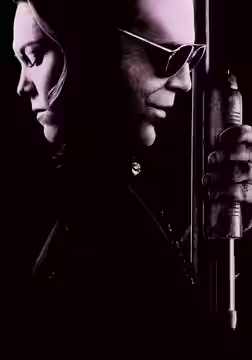
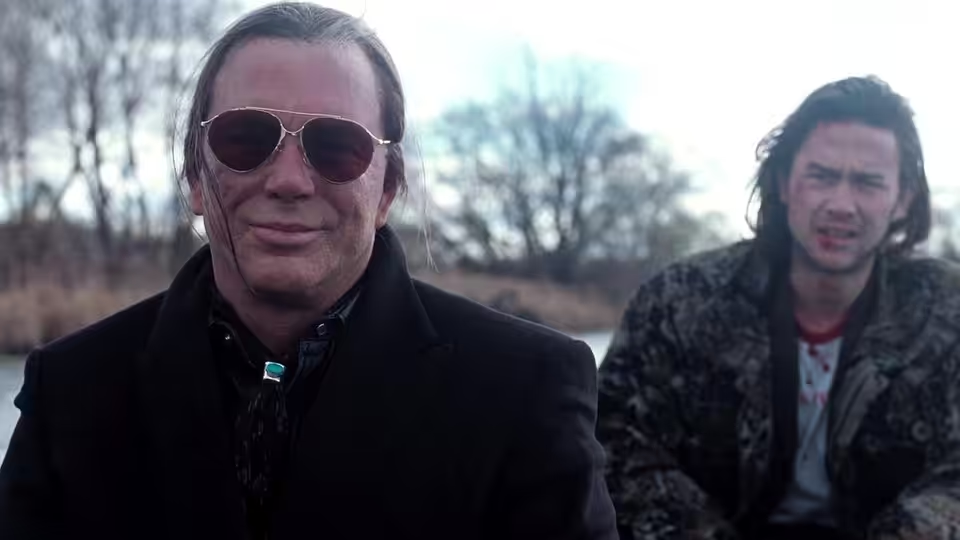
Armand Degas (Mickey Rourke) stands outdoors with Richie Nix (Joseph Gordon-Levitt) behind him
Film review

Killshot

2008 · Directed by John Madden · 1h 35m

In a sentenceElmore Leonard with the jokes cut out and the winter left in

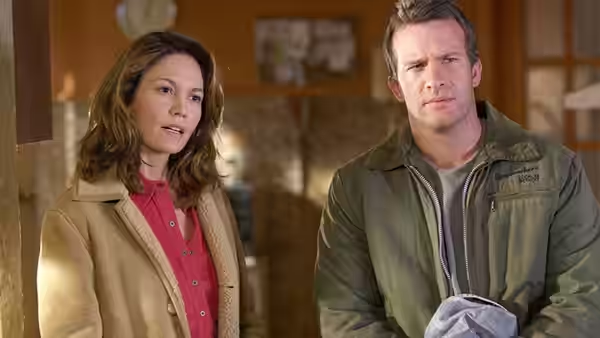
Armand Degas (Mickey Rourke), a hitman known as the Blackbird, shoots an ageing mob boss called Papa (Hal Holbrook) in a hotel room and knows the people who paid him will want him gone as well. Drifting south over the border, he falls in with Richie Nix (Joseph Gordon-Levitt), a loud young armed robber with an Elvis-loving girlfriend, Donna (Rosario Dawson), and a plan to shake down an estate agent, Nelson Davies (Don McManus). At the agent’s office they run into Carmen Colson (Diane Lane), who sells the houses, and her husband Wayne (Thomas Jane), who takes Richie’s gun off him and puts him on the floor. The Colsons have now seen two faces they should not have. The marshals move them to a rented house in another state, and the two men come looking.

Fi1m review

Mickey Rourke gives John Madden’s Elmore Leonard adaptation a slow, sorrowful centre, and Diane Lane and Thomas Jane make a believable marriage under threat. Around them the film has been cut to 95 minutes and plays like the outline of a better one.

Elmore Leonard’s Killshot is one of his plainer books: two criminals, one witness couple, a long wait for the knock on the door. Hossein Amini’s screenplay keeps that shape. The Blackbird kills a man, picks up a partner he does not want, and ends up hunting a husband and wife across the American Midwest because they saw his face. John Madden directs it as a quiet, cold, serious thriller. That is a legitimate way to do Leonard. It is not the way most people like him, and the film knows it.

Rourke is the reason to watch. Beth Pasternak dresses him in a long dark coat and a braid down his back, and he moves through the film at half the speed of everyone else, speaking in a low rasp as if each sentence costs him something. There is a scene early on where he sits with his brothers and says almost nothing, and another in a motel where he watches Richie sleep, and in both he looks like a man who has already decided how this ends. We felt sadder watching him than the film seemed to intend, and it is the only strong feeling the film gave us. Rourke supplies grief; the picture around him does not always know what to do with it.

Lane and Jane do the other good work. Carmen and Wayne are separated when we meet them, living in the same small town and avoiding each other, and the film is at its best when it lets them be an ordinary couple with an ordinary grievance who happen to have killers after them. Jane plays Wayne as a big man who settles everything with his hands and is slowly learning that this will not do. Lane gives Carmen a tired patience that turns, over the running time, into something harder. Their scenes in the rented house, arguing over a kitchen table about whose fault any of this is, are the ones that stay.

Gordon-Levitt is the problem on screen. His Richie shouts, flails, grins and threatens, and he is working at a volume the rest of the cast has not agreed to. We understand the idea, a boy who thinks he is in a film about a famous outlaw while the man beside him is in a film about dying, but the gap is so wide that the two never seem to be in the same room. Rosario Dawson’s Donna is introduced with some care, talks about Elvis, and then more or less vanishes. Lois Smith has one scene as Carmen’s mother and is, as usual, better than the scene.

The craft is sober and well-judged for a film that lasts 95 minutes and has two credited editors. Caleb Deschanel shoots a grey, low winter, flat fields and bare trees and motel rooms lit by a single lamp, and the colour is drained down to browns and steel blues so that even the blood looks cold. Andrew Jackness gives the Colsons a rented bungalow that is just a little too tidy to feel like anyone’s home, which is right. Klaus Badelt’s score sits on low strings and does nothing wrong and nothing memorable. Mick Audsley and Lisa Gunning, between them, have cut a film in which scenes end a beat before they land and characters leave without having arrived. The reviews so far mention a troubled edit, and we can see the seams.

We were bored through the middle half hour, and then puzzled by our own boredom, because every scene has a good actor in it. The explanation is the dialogue. Leonard’s criminals talk, at length, about nothing, and the talk is where the pleasure lives; Out of Sight and Jackie Brown understood that and let the camera sit. Here the talk has been trimmed to plot, and what is left is people telling each other where to go next. The two reviews we have read split cleanly, one finding it solid and one finding it lifeless, and we sit between them: it is solid and it is lifeless, in about equal measure.

See it for Rourke if his sad, slow mid-career work interests you, and for a marriage that is written and played with more honesty than the thriller around it deserves. Do not come for the pulp. The pulp is on the cutting-room floor, with Rosario Dawson.

Critical consensus AI synthesised

2 of 6
Positive
1
Mixed
0
Negative
1
Variety
10 June 2009 · Joe Leydon
70*

Leydon finds the delayed crime drama surprisingly solid and mostly satisfying despite signs of disruptive editing. He especially praises the involving, well-played relationship between Diane Lane and Thomas Jane’s characters.

Read the full review →
The AV Club
3 June 2009 · D · Nathan Rabin
37

Rabin finds the film lifeless and boring, saying it fails to deliver the pulpy energy of Elmore Leonard’s work. He praises Mickey Rourke’s sad gravity but singles out the dull clichés and drained, joyless tone as central flaws.

Read the full review →

Straight answers AI written, from our review

Is Killshot worth watching?
Killshot is worth watching only for Mickey Rourke, and we scored it 55. He gives the hitman a slow, sorrowful weight, and Diane Lane and Thomas Jane play a separated couple with more honesty than the thriller around them deserves. Cut to 95 minutes, the film plays like the outline of a better one, and anyone coming for Elmore Leonard's pulp will find most of it missing.
How long is Killshot, and what is it rated?
Killshot runs 1h 35m. It is a crime and drama film.
Where can I watch Killshot in Norway?
Killshot is not on any streaming or rental service in Norway at the moment. It is available in 18 other countries; change your country at the top of the page to see where. Availability is checked daily.
How violent or frightening is Killshot, and is it suitable for children?
Killshot is a cold, serious crime thriller rated R in the United States and uncertificated in the UK, and it is not for children. It opens with a hitman shooting an ageing mob boss and follows two killers hunting a married couple who saw their faces; the violence is sober rather than gleeful, and the blood looks cold. Older teenagers would be fine with it, but it is adult in tone throughout.
How does Killshot compare to Out of Sight?
Killshot is the colder and much lesser of the two Elmore Leonard adaptations, and Out of Sight is the one to choose. Soderbergh keeps the talk, the warmth and the patience that make Leonard a pleasure; John Madden trims the dialogue to plot and leaves a quiet, grey thriller. Watch Killshot if Rourke's sad mid-career work interests you, and Out of Sight for almost any other reason.
Is Killshot based on a true story or a book?
Killshot is based on Elmore Leonard's novel of the same name, not on a true story. Hossein Amini's screenplay keeps the book's plain shape, two criminals, one witness couple and a long wait for the knock on the door, but cuts away most of the talk that makes Leonard's criminals enjoyable. You need not have read the book, though readers who have will miss the jokes.
What should I watch after Killshot?
After Killshot, try Out of Sight (1998, Fi1m 86): The Leonard adaptation that keeps the talk, the warmth and the patience. Then Le Samouraï (1967, Fi1m 88): A hitman who barely speaks and a city that barely notices him; Rourke’s model; and A History of Violence (2005, Fi1m 88): An ordinary marriage, a diner, and criminals who will not go away.

Cast

If you liked this, try…

  1. Out of Sight (1998, Fi1m 86)The Leonard adaptation that keeps the talk, the warmth and the patience.

  2. The Friends of Eddie Coyle (1973) · not reviewed yetSmall-time Boston crooks, grey weather and a weary lead; the sadness done properly.

  3. Le Samouraï (1967, Fi1m 88)A hitman who barely speaks and a city that barely notices him; Rourke’s model.

  4. A History of Violence (2005, Fi1m 88)An ordinary marriage, a diner, and criminals who will not go away.

  5. Justified (2010, Fi1m 87)Leonard on television, with the jokes left in and the pace he intended.