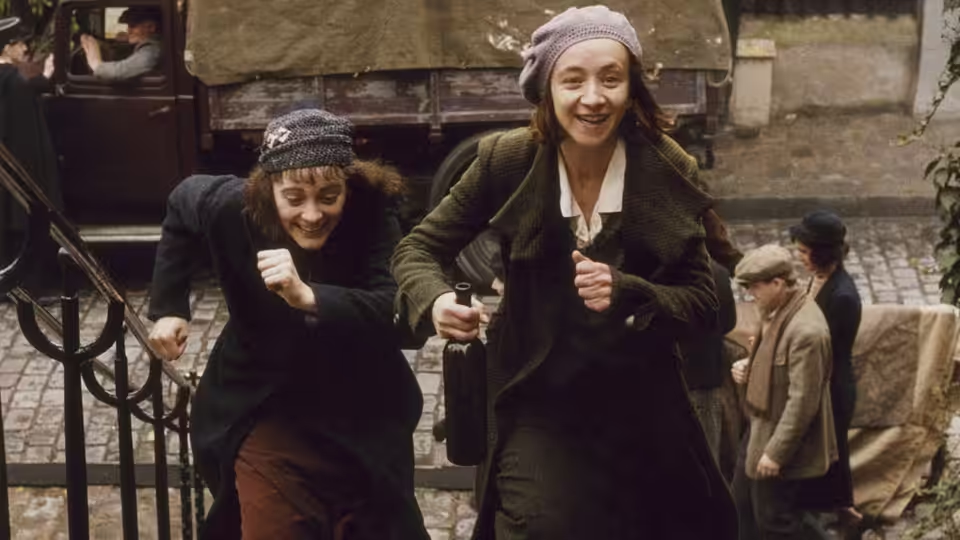
Marion Cotillard’s Edith Piaf is as complete an impersonation as we have seen, from the plucked eyebrows to the shuffle. Olivier Dahan’s film around her leaps across forty years with no clear reason for any leap, and 140 minutes is too many.
Olivier Dahan has not made a life of Edith Piaf in order. He has made one as it might be remembered by a woman lying in a bed on the Riviera, drifting: a Belleville street, a brothel, a New York club, a hospital corridor, a stage, none of them arriving when you expect. The idea is sound and the execution is not. La Vie en Rose contains one of the great screen performances and it keeps interrupting it to check the time.
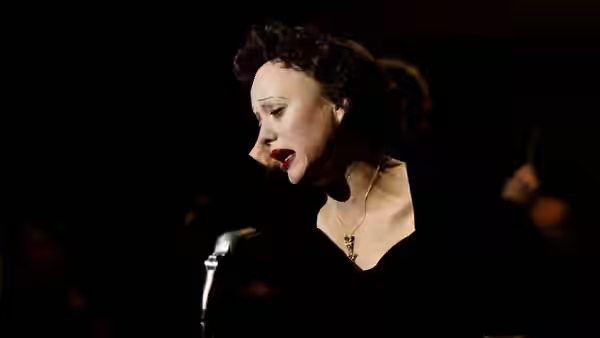
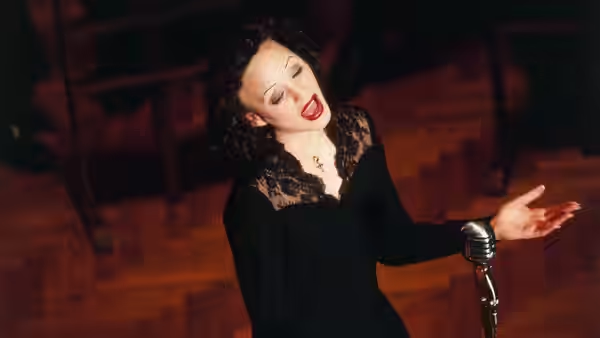
Start with Cotillard, because everyone will. Her eyebrows are plucked to nothing and her hairline shaved back, her shoulders hunch, her hands rise and fall in front of her as if they belong to a taller woman, and her laugh is the raw bark of a girl who grew up shouting over traffic. As the older Piaf she walks like a woman of seventy in a body not yet fifty, and the prosthetics do less of the work than the neck and the knees. She does not sing; the voice on the soundtrack is not hers, and the miming is exact down to the breath before a note. It is the kind of performance that biopics are usually built to display, and this one keeps cutting away from it.
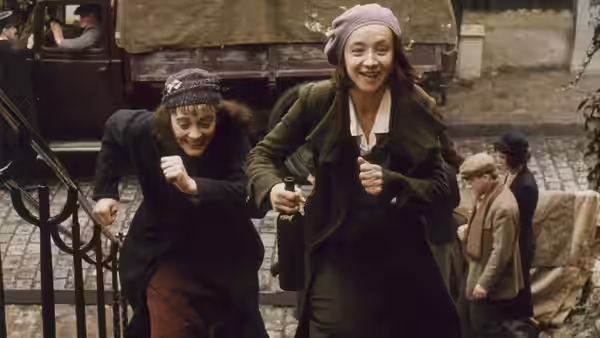
The childhood is the best-made stretch, and the most simply told. Olivier Raoux gives the Normandy brothel dark wood, red lamps and a staircase the child watches from, and Tetsuo Nagata lights it with the lamps alone, so faces come and go in brown shadow. Manon Chevallier, as the five-year-old, has a stillness that makes the women fuss round her, and Emmanuelle Seigner’s Titine fusses most. When the father comes back for the girl and she is pulled out of Titine’s arms, we were properly upset, more than we expected to be by a scene we had seen coming for ten minutes, and it is because Seigner plays it as a woman losing the only thing she was allowed to keep.
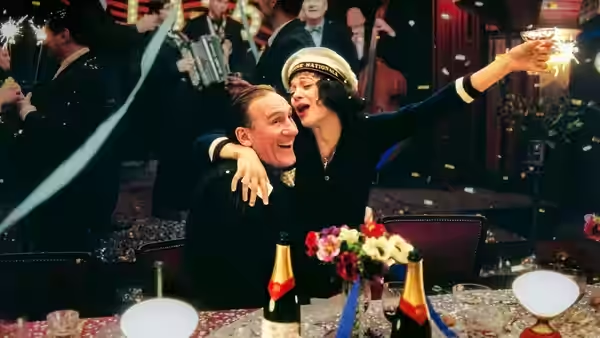
The adult supporting cast do well in little space. Gérard Depardieu has perhaps a quarter of an hour as Louis Leplée, the club owner who hears her on a Pigalle corner, and he plays him as a large, gentle man who knows what he has found and is slightly afraid for it. Marc Barbé’s Raymond Asso teaches her to stand still and use her hands, and the lesson is the one scene where the film shows us how a singer is made rather than that she was. Sylvie Testud’s Mômone drinks, sulks and stays, and Pascal Greggory’s Louis Barrier manages her with the patience of a man who has stopped expecting thanks. Jean-Pierre Martins, as the boxer Marcel Cerdan, is shy and courteous, and the New York scenes between him and Cotillard are the tenderest thing in the film.
Then there is the structure. Dahan and Isabelle Sobelman’s script hops from decade to decade, and Richard Marizy’s editing hops with it, so that a scene in 1935 is cut off for a scene in 1959 that is cut off for one in 1963, and none of them is allowed to finish. The war years disappear entirely. Around the ninety-minute mark we realised we had stopped feeling anything and had started doing arithmetic, working out how old she was in this room and which husband this was, and we were irritated, because the film had just spent ten minutes making us care. It happens more than once.
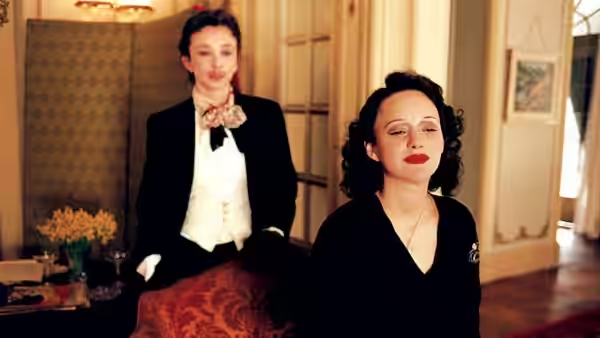
The craft is handsome and a little insistent. Nagata gives Paris a sodium yellow and the Riviera a bruised blue, and his camera prowls the clubs handheld, which suits the early years and tires by the later ones. Marit Allen dresses Piaf in the plain black that became her uniform and lets the childhood clothes look bought second-hand. Christopher Gunning’s orchestral score swells under Piaf’s own recordings, and there are moments when the two are competing and hers is losing, which is the wrong way round.
Biopics that scramble the chronology usually do it to avoid the cradle-to-grave march. This one takes the march and shuffles the cards, and the result is the same march with the map torn up. See it for Cotillard, for Depardieu, and for the brothel. Watch it at home if you can, where you can pause to work out the year, which is a convenience and not a compliment. It runs 140 minutes and carries a 12 certificate.