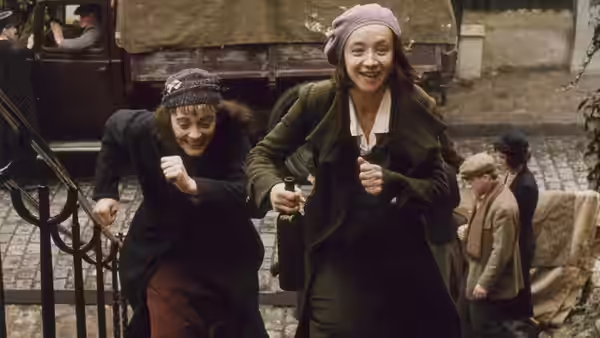
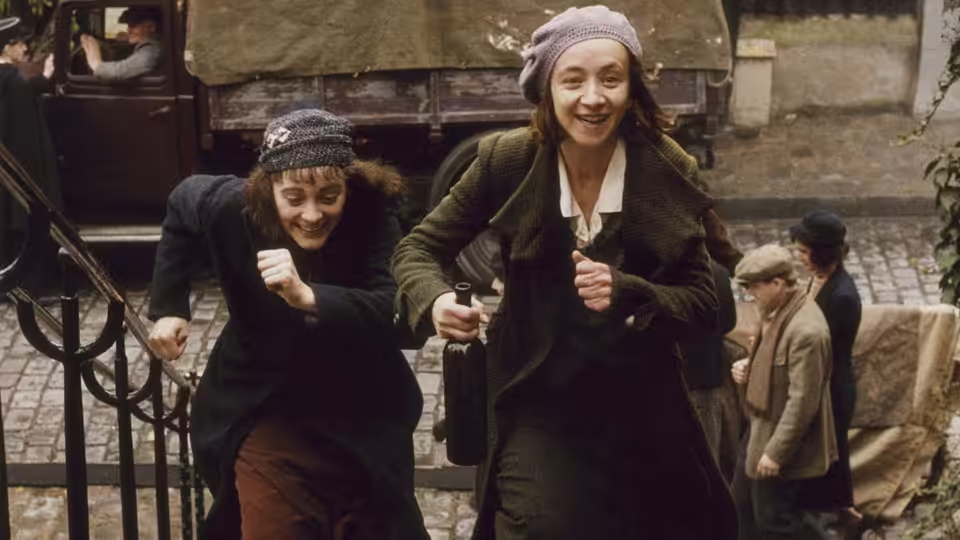
Two young women run up a cobbled street past a horse-drawn carriage
Film review

La Vie en Rose

2007 · Directed by Olivier Dahan · 2h 20m

In a sentenceCotillard disappears so completely you forgive the film for never quite deciding what year it is

New York, 1959: Edith Piaf (Marion Cotillard) collapses on stage in the middle of a song. From there the film cuts to Belleville, Paris, in 1918, where the five-year-old Edith (Manon Chevallier) is left by her mother Annetta Gassion (Clotilde Courau), a street singer, and taken by her father Louis Gassion (Jean-Paul Rouve), a street acrobat, to the Normandy brothel run by his mother Louise (Catherine Allégret). A prostitute called Titine (Emmanuelle Seigner) mothers her there. In 1935 the club owner Louis Leplée (Gérard Depardieu) hears her singing on a Pigalle pavement beside her friend Mômone (Sylvie Testud), gives her a stage and a name, La Môme Piaf, and the story leaps forward and back from there through Paris, New York and her last years on the Riviera.

Fi1m review

Marion Cotillard’s Edith Piaf is as complete an impersonation as we have seen, from the plucked eyebrows to the shuffle. Olivier Dahan’s film around her leaps across forty years with no clear reason for any leap, and 140 minutes is too many.

Olivier Dahan has not made a life of Edith Piaf in order. He has made one as it might be remembered by a woman lying in a bed on the Riviera, drifting: a Belleville street, a brothel, a New York club, a hospital corridor, a stage, none of them arriving when you expect. The idea is sound and the execution is not. La Vie en Rose contains one of the great screen performances and it keeps interrupting it to check the time.

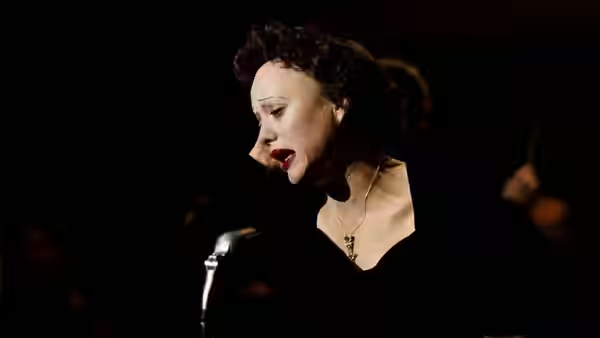
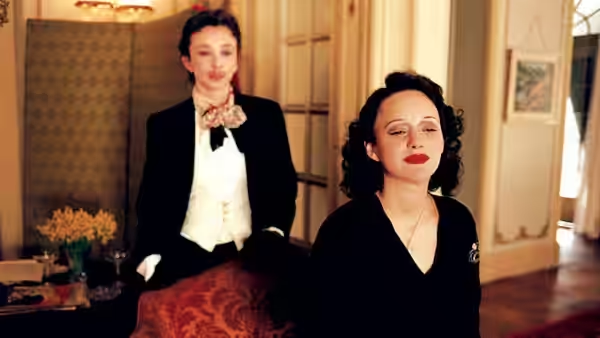
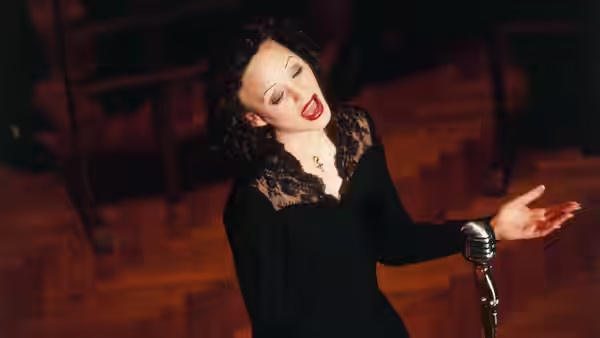
Start with Cotillard, because everyone will. Her eyebrows are plucked to nothing and her hairline shaved back, her shoulders hunch, her hands rise and fall in front of her as if they belong to a taller woman, and her laugh is the raw bark of a girl who grew up shouting over traffic. As the older Piaf she walks like a woman of seventy in a body not yet fifty, and the prosthetics do less of the work than the neck and the knees. She does not sing; the voice on the soundtrack is not hers, and the miming is exact down to the breath before a note. It is the kind of performance that biopics are usually built to display, and this one keeps cutting away from it.

The childhood is the best-made stretch, and the most simply told. Olivier Raoux gives the Normandy brothel dark wood, red lamps and a staircase the child watches from, and Tetsuo Nagata lights it with the lamps alone, so faces come and go in brown shadow. Manon Chevallier, as the five-year-old, has a stillness that makes the women fuss round her, and Emmanuelle Seigner’s Titine fusses most. When the father comes back for the girl and she is pulled out of Titine’s arms, we were properly upset, more than we expected to be by a scene we had seen coming for ten minutes, and it is because Seigner plays it as a woman losing the only thing she was allowed to keep.

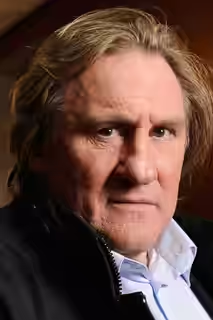
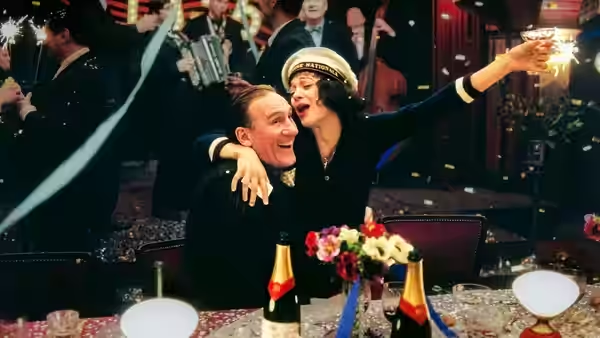
The adult supporting cast do well in little space. Gérard Depardieu has perhaps a quarter of an hour as Louis Leplée, the club owner who hears her on a Pigalle corner, and he plays him as a large, gentle man who knows what he has found and is slightly afraid for it. Marc Barbé’s Raymond Asso teaches her to stand still and use her hands, and the lesson is the one scene where the film shows us how a singer is made rather than that she was. Sylvie Testud’s Mômone drinks, sulks and stays, and Pascal Greggory’s Louis Barrier manages her with the patience of a man who has stopped expecting thanks. Jean-Pierre Martins, as the boxer Marcel Cerdan, is shy and courteous, and the New York scenes between him and Cotillard are the tenderest thing in the film.

Then there is the structure. Dahan and Isabelle Sobelman’s script hops from decade to decade, and Richard Marizy’s editing hops with it, so that a scene in 1935 is cut off for a scene in 1959 that is cut off for one in 1963, and none of them is allowed to finish. The war years disappear entirely. Around the ninety-minute mark we realised we had stopped feeling anything and had started doing arithmetic, working out how old she was in this room and which husband this was, and we were irritated, because the film had just spent ten minutes making us care. It happens more than once.

The craft is handsome and a little insistent. Nagata gives Paris a sodium yellow and the Riviera a bruised blue, and his camera prowls the clubs handheld, which suits the early years and tires by the later ones. Marit Allen dresses Piaf in the plain black that became her uniform and lets the childhood clothes look bought second-hand. Christopher Gunning’s orchestral score swells under Piaf’s own recordings, and there are moments when the two are competing and hers is losing, which is the wrong way round.

Biopics that scramble the chronology usually do it to avoid the cradle-to-grave march. This one takes the march and shuffles the cards, and the result is the same march with the map torn up. See it for Cotillard, for Depardieu, and for the brothel. Watch it at home if you can, where you can pause to work out the year, which is a convenience and not a compliment. It runs 140 minutes and carries a 12 certificate.

Critical consensus AI synthesised

65
Positive
6
Mixed
6
Negative
2

Most critics agree on one thing: Marion Cotillard. Nearly every review, whether favourable or not, singles out her performance as the reason to watch, and several say she stops seeming like an actress playing Piaf at all. The positive reviews also credit the lavish production and the film’s willingness to match its subject’s excess with a theatrical energy of its own.

The reservations gather around structure. The film moves back and forth across Piaf’s life, and many critics find the result muddled, overstuffed and short on insight into who she was. The spread is wide: some call it moving and compassionate, others pedestrian or shapeless, and the mixed verdicts equal the positive ones. The New Yorker’s Judith Thurman finds a pedestrian saga around a strong central performance, and Time Out’s Trevor Johnston goes further, suggesting a life this dramatic never needed a biopic in the first place.

Variety
8 February 2007 · festival review · Lisa Nesselson
90*

Nesselson recommends the involving, impressively mounted biopic and finds its portrait of Piaf rich and emotionally compelling. She especially praises Marion Cotillard’s transformative, affecting performance.

Read the full review →
Slant Magazine
1 May 2007 · ★★★½/4 · Dan Callahan
88

Callahan praises the film as an intuitive, theatrical biopic that captures Piaf’s tumultuous life with gusto. He singles out Marion Cotillard’s extravagant, convincingly embodied performance as its chief strength.

Read the full review →
IndieWire
6 June 2007 · Kristi Mitsuda
85*

Mitsuda finds the film an enlivening, unconventional portrait of Piaf. She especially praises Marion Cotillard’s performance for making the film’s shifting periods feel cohesive.

Read the full review →
The Guardian
30 November 2007 · Rob Mackie
70*

Mackie finds the film emotionally excessive and poorly structured, but ultimately feels it does justice to Piaf. He singles out Marion Cotillard’s charismatic performance and the film’s lavish production values for praise.

Read the full review →
The New York Times
8 June 2007 · A.O. Scott
70*

The review is broadly positive about the film. It singles out Marion Cotillard’s performance as its central strength.

Read the full review →
RogerEbert.com
65*

The page appears to be a review of the specified film, but its verdict cannot be determined from the blocked content. No praise or complaint is visible to summarize.

Read the full review →

Straight answers AI written, from our review

Is La Vie en Rose worth watching?
La Vie en Rose is worth watching for Marion Cotillard's Edith Piaf, which is as complete an impersonation as we have seen, and we scored it 66. Olivier Dahan's film around her leaps across forty years with no clear reason for any leap, and at 140 minutes it stops making us feel and starts making us count.
How long is La Vie en Rose, and what is it rated?
La Vie en Rose runs 2h 20m. It is a music and drama film.
Where can I watch La Vie en Rose in Serbia?
La Vie en Rose is not on any streaming or rental service in Serbia at the moment. It is available in 9 other countries; change your country at the top of the page to see where. Availability is checked daily.
How violent or frightening is La Vie en Rose, and is it suitable for children?
La Vie en Rose carries a 12 certificate and is a drama of poverty, drink and illness rather than violence. Part of the childhood is spent in a Normandy brothel, and a small child is pulled from the arms of the woman who has mothered her, a scene that upset us more than we expected. It is not frightening, but it is too slow and too adult in its concerns for younger children.
How does La Vie en Rose compare to Judy?
La Vie en Rose and Judy are both built around a small woman with a large voice near the end of her life, and both are carried by their lead. Cotillard's Piaf is the more complete transformation, but Rupert Goold's film is the tidier and easier to follow, while Dahan's scrambles four decades until you lose track of the year. Choose Piaf for the performance and Garland for the storytelling.
What should I watch after La Vie en Rose?
After La Vie en Rose, try Judy (2019, Fi1m 65): Renée Zellweger’s Garland, another small woman with a large voice, near the end. Then Amy (2015, Fi1m 81): A documentary about Amy Winehouse that lets the songs carry the story, unsentimentally.

Cast

Awards

Academy Awards, 2008

Nominated
Best Costume Design
Won
Best Actress
Won
Best Makeup and Hairstyling

César Award for Best Actress, 2008

Nominated
César Award for Best Actress

European Film Academy Prix d'Excellence, 2007

Nominated
European Film Academy Prix d'Excellence

European Film Award for Best Actress, 2007

Nominated
European Film Award for Best Actress

European Film Award for Best Film, 2007

Nominated
European Film Award for Best Film

European Film Award – People's Choice Award for Best European Film, 2007

Nominated
European Film Award – People's Choice Award for Best European Film

If you liked this, try…

  1. Love Me or Leave Me (1955) · not on Fi1m yetDoris Day as Ruth Etting; a singer’s life told straight, with James Cagney as the trouble.

  2. Bird (1988) · not on Fi1m yetEastwood’s Charlie Parker film also breaks up time, and knows why it is doing so.

  3. I'm Not There (2007) · not on Fi1m yetSix actors as Dylan; the fragmented biopic taken to its logical and stranger end.

  4. Judy (2019, Fi1m 65)Renée Zellweger’s Garland, another small woman with a large voice, near the end.

  5. Amy (2015, Fi1m 81)A documentary about Amy Winehouse that lets the songs carry the story, unsentimentally.

La Vie en Rose (2007) review: Cotillard superb, the film sprawls (Serbia) | Fi1m