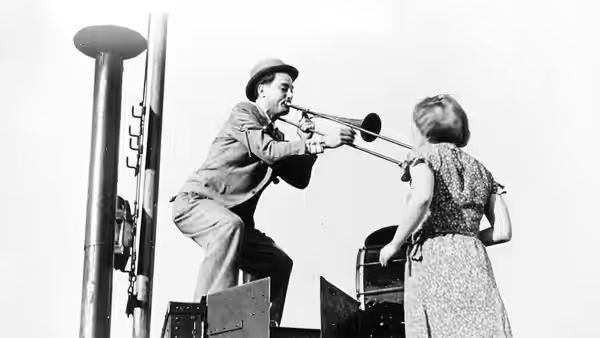
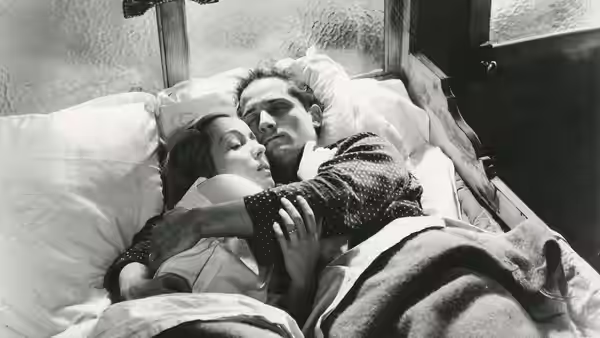
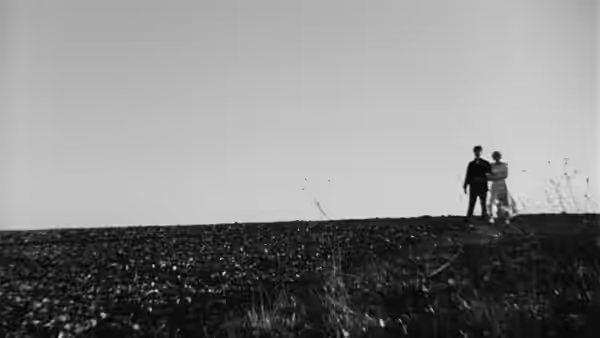
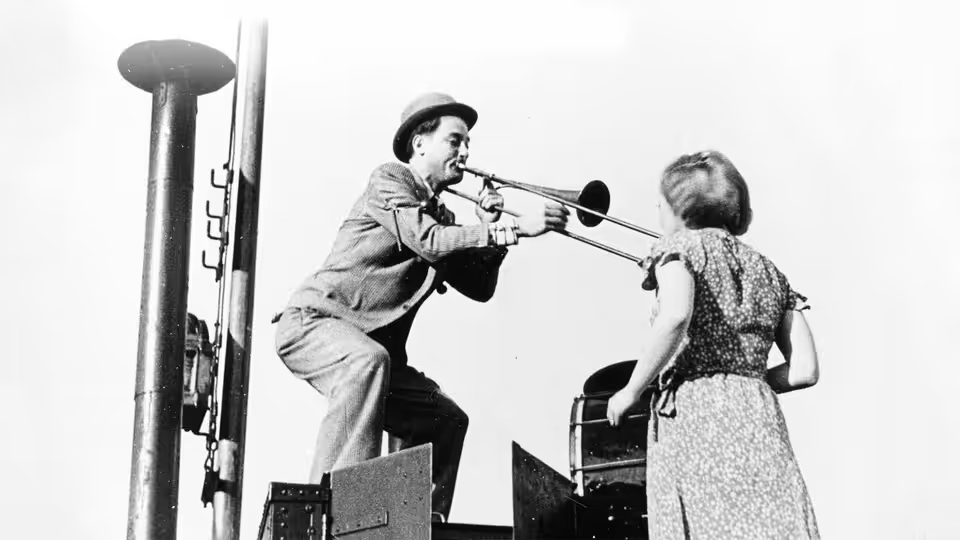
Jean (Jean Dasté) leans across the barge deck toward Juliette (Dita Parlo)
Film review

L'Atalante

1934 · Directed by Jean Vigo · 1h 28m

In a sentenceA barge is a perfectly good place for romance, provided nobody expects Michel Simon to make himself scarce

Jean (Jean Dasté) and Juliette (Dita Parlo) begin married life aboard a barge, where their relationship must fit around the work of keeping the boat going. Père Jules (Michel Simon) and the Cabin Boy (Louis Lefebvre) are part of the life they share. The couple want to be together, but marriage means adjusting to each other’s wishes as well as the demands of the boat. Everyday work and physical desire accompany their attempts to make a home in a place that is also a workplace.

Plays from YouTube when you press play; nothing loads from them until then.

Fi1m review

Jean Vigo’s L’Atalante is a funny, sensual romance we recommend warmly. The storytelling has rough joins, but Dita Parlo, Jean Dasté and Michel Simon make the life aboard its barge matter.

Jean Vigo’s L’Atalante is a romance we recommend warmly, including to anyone who suspects that an old film about marriage will be improving rather than enjoyable. It is funny, frank about desire and interested in the work people do when they have to live together. The barge matters because it makes that work visible: the couple’s home is also a place with jobs to be done. Vigo does not tidy up the people for our approval.

Dita Parlo’s Juliette and Jean Dasté’s Jean are allowed to be awkward company. Parlo gives Juliette a directness that keeps her from becoming a decorative young bride, while Dasté allows Jean to seem difficult without making him merely a problem to be solved. We can feel the attraction without being asked to believe that it makes sharing a life easy. Their physical performances give the relationship a persuasive intimacy, and Vigo leaves them room to be funny without treating their desires as a joke.

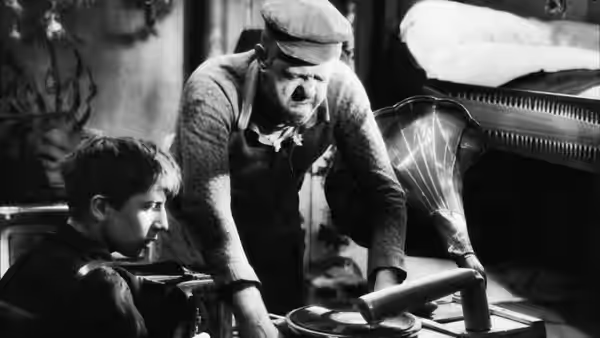
Michel Simon’s Père Jules could easily commandeer the film, and there are stretches when we are content to let him. Simon makes the character’s untidiness and self-possession funny without appearing to wait for a laugh. We laughed, then found ourselves unexpectedly fond of him, because that ungainly physical presence gives the barge someone who seems thoroughly at home there. He also prevents the couple’s troubles from becoming the only thing we are allowed to notice.

Boris Kaufman’s cinematography keeps the barge recognisably workaday even when the images turn strange and sensual. There is roughness in the photography, and we would not pretend every image is equally clear or controlled. The movement from ordinary boat life into fantasy feels persuasive because we remain interested in the people experiencing it. Kaufman’s dreamlike passages draw their force from the plain physical life around them, so we never feel that the film has stopped to demonstrate how beautifully it can photograph desire.

Louis Chavance’s editing is less consistently persuasive. Continuity can be ragged, and some transitions ask us to do a little more work than the scene warrants. That matters in a film whose pleasures depend on taking an interest in small changes between people: an awkward join can briefly make their behaviour harder to read. It is a real qualification to the recommendation, though the looseness never made us stop caring about Jean and Juliette.

Maurice Jaubert’s music is more sure-footed. It works with the surrounding sounds rather than trying to smother them, so the romance can grow without cutting us off from the place where these people live. Jaubert can give a scene a lift without making every small exchange sound momentous. His score helps the stranger images feel close to the ordinary ones, and gives the film a steadiness that the cutting sometimes lacks.

At 88 minutes, this is not a romance that requires an evening of dutiful patience. It does ask us to accept that love can be comic, inconvenient and physically urgent within the same relationship. The rough edges will trouble anyone who wants each scene to lead neatly into the next. Watch it with someone who will forgive you for preferring Père Jules.

Critical consensus AI synthesised

84
Positive
11
Mixed
1
Negative
0

Most critics respond warmly to L’Atalante, with praise clustering around its blend of ordinary working life, dreamlike imagery and sensual romance. The reviews repeatedly single out Boris Kaufman’s cinematography and Vigo’s handling of love and marriage, finding tenderness and strangeness in small moments without forced whimsy. Michel Simon’s Père Jules draws particular affection, while the Los Angeles Times highlights Maurice Jaubert’s score and the way it works with images and ambient sound.

The reservations are limited rather than shared across the reviews: Sight and Sound notes rough photography and continuity, but still finds the mixture of realism and psychological fantasy persuasive. The ratings span a wider range than the accessible commentary suggests, with eleven positive assessments and one mixed. Several lower-scoring entries lack enough accessible text to establish their objections, so there is no clear, documented counterargument to the prevailing enthusiasm.

Slant Magazine
22 April 2003 · ★★★★/4 · Eric Henderson
100

Henderson presents the film as a beautiful, rich celebration of human connection. He singles out its frank, sensual portrayal of sexual freedom and the dreamlike imagery aboard the barge.

Read the full review →
The Guardian
19 January 2012 · Peter Bradshaw
95*

Bradshaw calls Vigo’s film a mature masterpiece, praising its blend of delicacy, sophistication and human feeling. He singles out Boris Kaufman’s unforgettable, dreamlike cinematography.

Read the full review →
The New Yorker
18 April 2012 · Richard Brody
95*

Brody calls the film one of cinema’s greatest and celebrates its unusual blend of ecstasy and realism. He singles out its portrayal of physical and emotional labor, as well as Michel Simon’s seemingly timeless character.

Read the full review →
Los Angeles Times
4 October 2018 · Robert Abele
90*

Abele calls the film an enchanting, versatile masterpiece that rewards repeated viewings. He especially praises Maurice Jaubert’s score and its powerful interplay with the film’s images and ambient sounds.

Read the full review →
Sight and Sound
90*

The critic finds the film an enduring, imaginative achievement despite rough photography and continuity. They especially praise how Vigo blends ordinary realism with surreal, psychological fantasy.

Read the full review →
Evening Standard
10 April 2012 · Derek Malcolm
85*

Malcolm presents L'Atalante as a cherished, poetic work by a cinematic genius. He particularly praises Boris Kaufman's dreamlike cinematography.

Read the full review →

Straight answers AI written, from our review

Is L'Atalante worth watching?
L'Atalante is warmly worth watching for its funny, sensual account of married life aboard a working barge; we score it 90 out of 100. We recommend it especially for the awkward intimacy between Dita Parlo and Jean Dasté, and Michel Simon’s ungainly charm, though ragged continuity occasionally makes the couple’s behaviour harder to follow.
How long is L'Atalante, and what is it rated?
L'Atalante runs 1h 28m. It is a comedy and drama film.
Where can I watch L'Atalante in Bulgaria?
L'Atalante is not on any streaming or rental service in Bulgaria at the moment. It is available in 4 other countries; change your country at the top of the page to see where. Availability is checked daily.
How does L'Atalante compare to Paterson?
L'Atalante is the more sensual, dreamlike romance, while Paterson finds quiet comfort in a working couple’s daily routines. We prefer L'Atalante for giving both partners fuller lives, though its editing is rough; Paterson suits those drawn to an absorbing working week and Adam Driver’s quiet performance, with the reservation that Laura remains too lightly sketched.

Cast

If you liked this, try…

  1. People on Sunday (1930) · not on Fi1m yetOrdinary leisure, unhurried observation and the pleasure of watching people forget themselves.

  2. The River (1951) · not on Fi1m yetAnother riverside romance that lets daily routines matter as much as longing.

  3. A Swedish Love Story (1970) · not on Fi1m yetYoung desire receives patient attention, while the adults remain awkwardly, comically human.

  4. The Lunchbox (2013) · not on Fi1m yetWork and routine make room for an intimacy neither participant was expecting.

  5. Paterson (2016, Fi1m 84)A working couple’s daily routines are watched with humour, patience and affection.