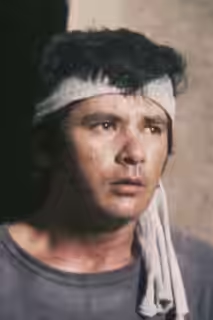
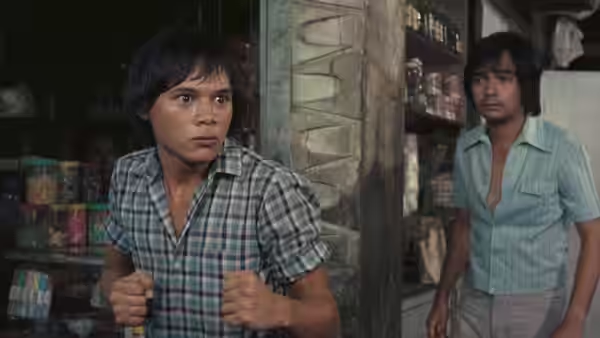
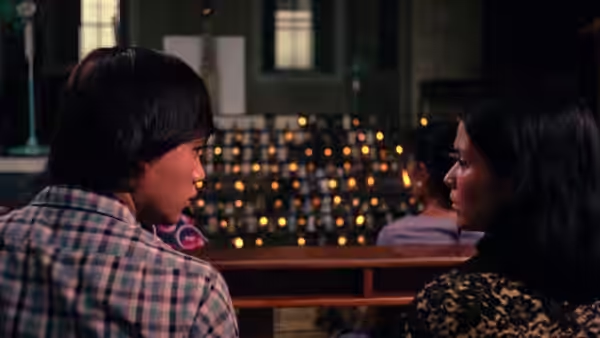
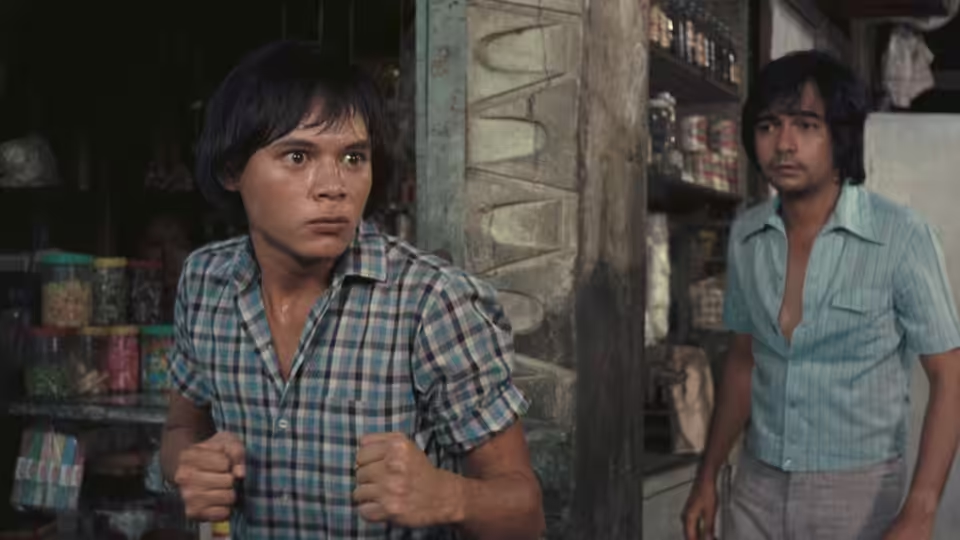
A young man clutches his shirt in a shop while another man watches from the doorway
Film review

Manila in the Claws of Light

1975 · Directed by Lino Brocka · 2h 07m

In a sentenceEveryone in Manila is owed money, and the man who owes it has just left

Julio Madiaga (Bembol Roco), a young fisherman from the provinces, has come to Manila to find Ligaya Paraiso (Hilda Koronel), the girl he meant to marry. A woman arrived in their village promising her work and schooling in the city; Ligaya went, wrote once, and then stopped. Months later Julio is still looking, sleeping rough and taking day labour on a construction site where the foreman, Mr. Balajadia (Pancho Pelagio), pays less than the posted rate and keeps the difference. A workmate, Atong (Lou Salvador Jr.), gives him a corner of his family’s shack in the slum; another, Pol (Tommy Abuel), explains how the city works. Between shifts Julio walks the streets, watching one particular doorway, and remembers the beach he came from.

Plays from YouTube when you press play; nothing loads from them until then.

Fi1m review

Lino Brocka’s film about a provincial boy searching Manila for a lost girl is angry, exact about wages and rent, and still sharp. The mystery plot dawdles and the villain is a broad type, but the city itself has rarely been filmed with this much bad temper.

Julio Madiaga (Bembol Roco) has come from a fishing village to Manila to find Ligaya Paraiso (Hilda Koronel), who left with a woman promising work and schooling and then stopped writing. When we meet him he has been searching for months and has run out of money, so he takes a labouring job on a building site. Lino Brocka’s film, adapted by Clodualdo del Mundo Jr. from Edgardo Reyes’s novel, has the outline of a mystery: a missing girl, a man asking questions, a doorway he keeps returning to. It is not much interested in solving anything. It wants to show what the city does to people who arrive with nothing, and it does that with a ledger in its hand.

The site sequences are the best thing in it. The foreman, Mr. Balajadia (Pancho Pelagio), hires men at one rate and pays them another, and nobody argues because the men waiting at the gate will take less. Atong (Lou Salvador Jr.) takes Julio home to a shack built over a drain. Pol (Tommy Abuel) has been in the city longer and has worked out the rules, which is not the same as having beaten them. A man falls from the scaffolding and Brocka does not cut away; we flinched, and then noticed that within a few minutes the site is working again and the wage is still what it was. That is the film’s method throughout. Something terrible happens, and then somebody counts the money.

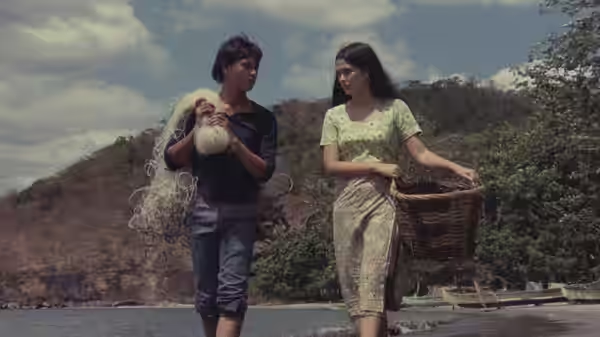
The camera is credited to Mike de Leon and Clodualdo del Mundo Jr., and most of the film is shot on the streets in daylight, following Julio as he walks. Jeepneys, hoardings, food stalls, the neon at night, faces that look at the lens because they are not extras. Julio is small in these frames and the city is not. The flashbacks to the province are done the other way, soft focus, sea, Koronel with her hair in the wind, and Max Jocson’s score turns sweet for them and hard and jangling for the city. The contrast is deliberate and a little crude; the beach looks like an advertisement for something. We found we wanted it back every time it went, which we suspect is the point. Julio does too.

Ike Jarlego Jr. and Edgardo Jarlego cut between the two worlds without warning, often off Roco’s face in the middle of a shot, so memory arrives the way it does when you are tired and hungry. The present tense is slow, and meant to be. Julio waits at the gate, waits for his pay, waits across the road from a door. Roco plays him as someone who does not understand the rules and is learning them at full price. He is passive for long stretches and the film does not apologise for that. A man with no money in a strange city is passive; he has to be.

Koronel is mostly a memory until late on, when she gets one long scene we will not describe. What we can say is that the last twenty minutes left us shaken in a way the first two hours had not prepared us for, and that Brocka holds on a face for longer than is comfortable when most directors would have cut. We sat through the credits without speaking.

The flaws are real. The mystery dawdles in its middle third, and a detour into a different kind of work for Julio is filmed with less confidence than the building site. The man he eventually comes to suspect is a broad type, drawn with a thick pencil, and a film that is so precise about a foreman’s arithmetic goes vague when it needs a villain. Some of the supporting playing in the slum scenes is pitched for the back row.

City films about country boys go back a long way, and most of them soften somewhere before the end. This one does not, and at 127 minutes it has the time to make its case without hurrying. See it in a cinema if one near you is showing it; the streets need the size, and so does that last face.

Critical consensus AI synthesised

3 of 6
Positive
3
Mixed
0
Negative
0
The New Yorker
85*

The capsule presents the film as a fierce, compelling portrayal of urban poverty and exploitation. It especially praises Brocka’s sharp-edged imagery and the film’s combative energy.

Read the full review →
Slant Magazine
14 June 2018 · ★★★★ · Alan Jones
80

The review praises Brocka’s film as a stunning, subversive portrait of poverty and violence. It particularly commends the Criterion transfer for preserving the film’s visual texture despite damaged source materials.

Read the full review →
Time Out
4 February 2014 · ★★★★ · Keith Uhlich
80

Uhlich presents the restored melodrama as a devastating work and a pinnacle of Filipino cinema. The available description highlights the film’s recently restored presentation, but the full review text is unavailable.

Read the full review →

Straight answers AI written, from our review

Is Manila in the Claws of Light worth watching?
Manila in the Claws of Light is worth watching for anyone with patience for a slow, angry film about poverty, and we scored it 87. Lino Brocka is exact about wages, rent and what a building site does to the men on it, and the last twenty minutes shook us. The mystery plot dawdles in the middle and the villain is a broad type.
How long is Manila in the Claws of Light, and what is it rated?
Manila in the Claws of Light runs 2h 07m. It is a drama and mystery film.
Where can I watch Manila in the Claws of Light in Singapore?
Manila in the Claws of Light is not on any streaming or rental service in Singapore at the moment. It is available in 2 other countries; change your country at the top of the page to see where. Availability is checked daily.
How does Manila in the Claws of Light compare to Bicycle Thieves?
Manila in the Claws of Light is the angrier and harsher of the two films; Bicycle Thieves is the warmer and the more moving. Both follow a poor man walking a city that will not help him, but De Sica has a father and son to soften the blows, while Brocka gives Julio nothing but a doorway to watch. Choose De Sica for tenderness, Brocka for fury.
Is Manila in the Claws of Light based on a true story or a book?
Manila in the Claws of Light is based on a novel by Edgardo Reyes, adapted for the screen by Clodualdo del Mundo Jr. It is fiction, not a true story, though its detail about day labour and a foreman skimming wages is drawn from how the city actually worked. You do not need to have read the book.
What should I watch after Manila in the Claws of Light?
After Manila in the Claws of Light, try Bicycle Thieves (1948, Fi1m 93): The template for a poor man walking a city that will not help him. Then Killer of Sheep (1978, Fi1m 90): Los Angeles, a slaughterhouse job and a family, filmed with the same patience.

Cast

If you liked this, try…

  1. Insiang (1976) · not on Fi1m yetBrocka again, one slum, one household, and a daughter who has had enough.

  2. Bicycle Thieves (1948, Fi1m 93)The template for a poor man walking a city that will not help him.

  3. Killer of Sheep (1978, Fi1m 90)Los Angeles, a slaughterhouse job and a family, filmed with the same patience.

  4. Norte, the End of History (2013) · not on Fi1m yetFour hours of Philippine injustice from Lav Diaz, for when you want the longer argument.

  5. Wanda (1970) · not on Fi1m yetA woman drifting through Pennsylvania coal country with nothing; plain, unhurried, unforgiving.