Godard’s study of a boy who talks and a girl who does not listen is funny, cold and still sharp, though it holds its young people at arm’s length for so long that the film catches their chill.
Jean-Luc Godard announces Masculin Féminin as fifteen precise facts, and then delivers something closer to fifteen conversations in cafés. Paul, just demobbed and full of opinions, meets Madeleine, who is making a pop record and would rather talk about that. Over 105 minutes in a grey Paris winter he pursues her, polls strangers for a magazine, argues with his friend Robert about Vietnam and de Gaulle, and learns almost nothing. The film calls its subjects the children of Marx and Coca-Cola. It is funny, it is cold, and it is still worth an evening, with the caveat that its coldness is a decision rather than a lapse.
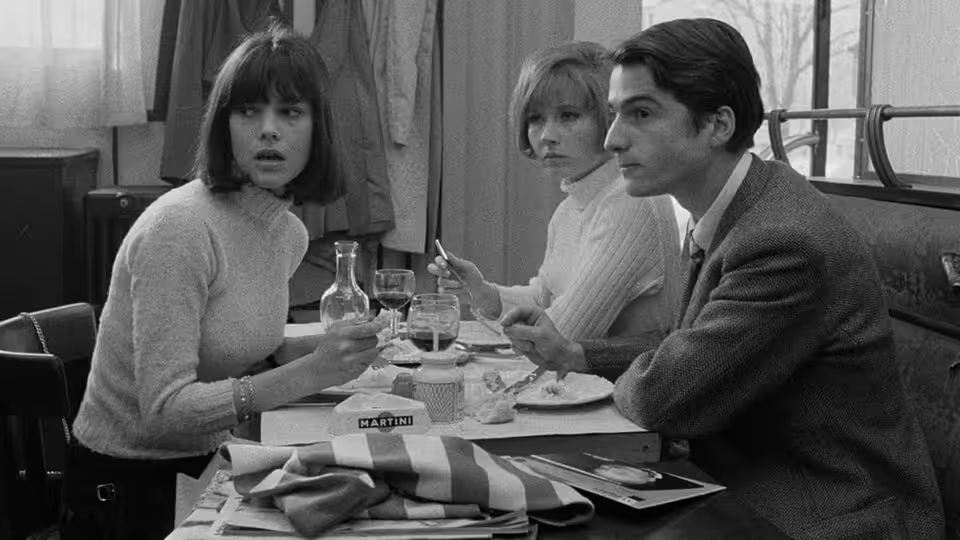
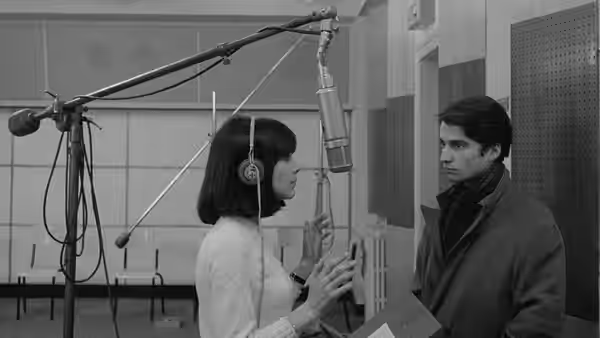
Jean-Pierre Léaud is the reason to watch. He was Truffaut’s Antoine Doinel as a boy, and here he is the same boy a few years on, having read some pamphlets and learned nothing about girls. He talks the way other actors fidget. He asks Madeleine whether she thinks about the war and, when she says no, asks whether she thinks about anything at all, and Léaud plays the cruelty as though it were tenderness. Chantal Goya, a pop singer playing a pop singer, gives him almost nothing back: a polite smile, a glance at the clock, an answer about her hair. It is easy to read her as blank. We think she is bored, and that the film knows it.
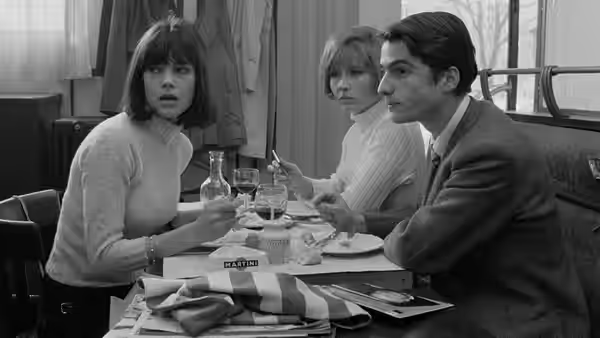
Willy Kurant shoots Paris in the black and white of a wet pavement. Cafés, laundrettes, a record booth, a cinema, the inside of a taxi: the light is flat and the walls are pale and everyone keeps their coat on. He holds long takes in booths and at tables so that two faces in profile have to carry a scene without help. Agnès Guillemot and Marguerite Renoir cut those takes off with intertitles, a gunshot on the soundtrack and a line of text on black, so the film keeps interrupting itself just as we settle. Jean-Jacques Debout’s songs for Goya, bright and light and sung as if nothing had ever gone wrong for anyone, are the only warm thing in the picture, which is the joke, and it lands.
The scene we have not shaken is the long interview. Paul, on magazine business, questions a young woman about contraception, socialism and the American presence in Vietnam, and she answers each question as best she can while a man off screen waits for her to be stupid. We were embarrassed for her, then ashamed of ourselves, because we had been waiting too. Godard keeps the camera on her face and lets the questions do the damage. It is the one stretch where the film’s method, the poll as seduction and the seduction as poll, is fully in view, and it is uncomfortable to watch, which we take to be the point.
What does not work is the politics, or rather the amount of it. Robert Packard paints slogans on a car; Paul reads the paper aloud; a Swedish film, with Birger Malmsten and Evabritt Strandberg undressing in silence, plays in a cinema the couples have gone to for warmth. These are gestures, and Godard makes them and moves on. He has contempt for how little his young people care, and after an hour that contempt is hard to tell apart from the indifference he is describing. Brigitte Bardot wanders through one café rehearsing lines with a director, and the film shrugs at her too.
By the standards of Godard’s own decade this sits in the middle. Vivre sa vie (1962) took one woman and looked at her properly. Bande à part (1964) let its three fools be liked. Masculin Féminin has a wider cast and a narrower sympathy, and there is a stretch of café talk in the second half where we found we had stopped listening to Paul as surely as Madeleine had.
The last quarter of an hour goes somewhere we will not describe, and the way it is told, at second hand and without fuss, is the coldest thing in a cold film. Watch it at home, where the intertitles can be paused and the gunshots make you jump a little less, and where Léaud’s face fills the frame the way Godard wanted. Bring someone who was once nineteen and insufferable. Most of us qualify.