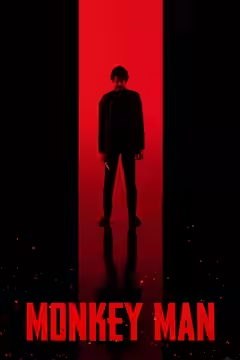
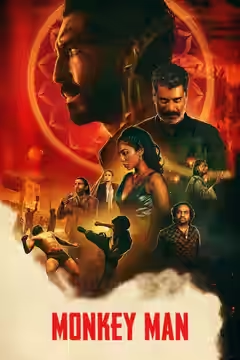
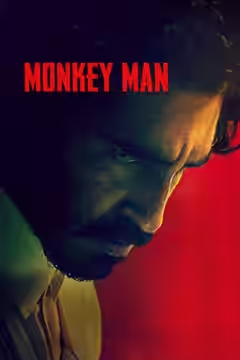
Dev Patel’s first film as director is angry, bloody and made with real feeling for the city it invents. The fights land hard; the story around them wanders and repeats itself. Worth your evening if a revenge film is what you are after.
Dev Patel has spent most of his career playing decent, anxious young men, and Monkey Man, his first film as director, is his answer to that. He wrote the story, shares the screenplay with Paul Angunawela and John Collee, and plays Kid, who spends the first half hour being hit in the face for money. It is a revenge film in the old shape, the wronged son and the men who wronged him, with the legend of Hanuman told over the top. It is good, it is scrappy, and at 122 minutes it is a quarter of an hour too long.
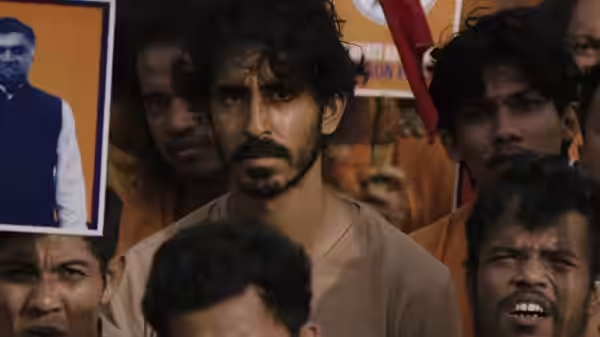
Patel is not built like an action star and does not fight like one. Kid is lean and quick and used to losing, and in the early bouts he is hit far more than he hits, hunched behind the gorilla mask that gives the film its title. He barely speaks. Patel plays him with his eyes and his shoulders, a man who has spent years making himself small so as to get close to the people he means to hurt. When he finally stands up straight, the change is in his posture before it is in his fists.
Sharone Meir shoots handheld, close and low, in the reds and sick greens of neon on wet concrete, and for the first hour the fights are as hard to read as they would be from inside them. That is deliberate. Kid does not know what he is doing yet, and neither does the camera. As he improves the shots get longer and steadier, until by the end you can follow a knife across a room. Four editors are credited, Dávid Jancsó, Kasra Rassoulzadegan, Tim Murrell and Chris Gill, and the cutting is fast, sometimes too fast. We winced more than once, and it was the sound that did it rather than the picture: the cuts land so close on the blows that you hear each one before you have seen it.
Jed Kurzel’s score is a low, ugly throb, and the film’s best musical idea is to set it aside. Zakir Hussain appears as a tabla player, and a long training sequence is cut to his hands, the drum speeding up as Kid’s punches do. Pawas Sawatchaiyamet’s production design gives the city a top and a bottom: the club where the powerful drink is mirror and gold, and the kitchen beneath it is steam and grease. Kid carries trays between the two, and nobody upstairs looks at him.
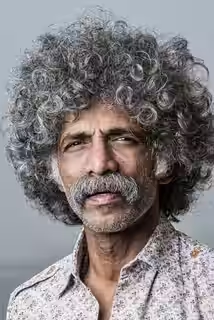
The supporting cast is broad by design. Sharlto Copley’s Tiger, the fight promoter, bellows at the crowd and enjoys every second. Sikandar Kher’s Rana, the police chief Kid is hunting, is a big, heavy man who hurts people the way other people yawn. Makrand Deshpande gives the guru Baba Shakti a soft voice and a gentle smile. Pitobash, as the fixer Alphonso, supplies most of the jokes. Sobhita Dhulipala’s Sita gets less to do than the film seems to think, and Vipin Sharma’s Alpha arrives in the middle stretch and brings a calm the film badly needs by then.
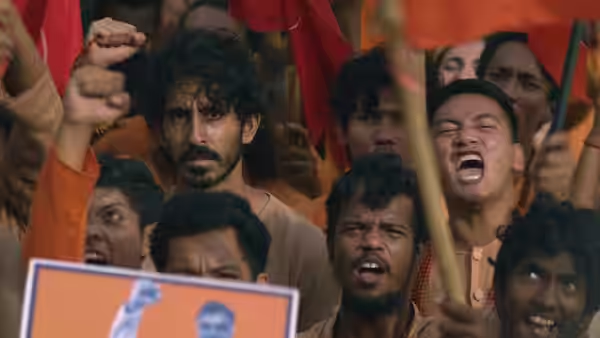
The flaws are those of a first film that wants to say everything. The script keeps returning to the same childhood memory, Jatin Malik as the young Kid and Adithi Kalkunte as his mother Neela, and each time it stays longer. We had understood by the second visit; by the fifth we were checking our watch. The politics are there, in the guru and in the men who drink upstairs while Kid carries trays, but the script never says what it thinks about any of it, and the film is angrier than it is clear. The stretch between the first fights and the last is the slackest, and that is where the fifteen minutes could go.
Most critics have reached for The Raid and John Wick, and the comparison is fair as far as the choreography goes. What sets Monkey Man apart is that its anger is pointed at a city and the men who run it, even when it cannot find the words. That is more than most revenge films manage, and it is why this one’s failures nag more than they would in something emptier. See it loud, with someone who does not mind knives.