Michael Jackson’s performances offer relief in a poorly joined collection of music and fantasy. The colour and sets deserve attention, but the writing makes 93 minutes feel like a considerable commitment.
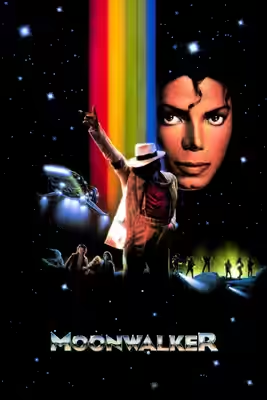
Moonwalker is a poor film, though its musical performances give us reasons to keep watching. Its problem is not simply that it strings together separate episodes; a collection can work perfectly well when each piece earns its place. Across 93 minutes, however, the performance passages establish an energy that the fantasy cannot maintain. Michael Jackson is persuasive enough performing without a story so determined to make him admirable.
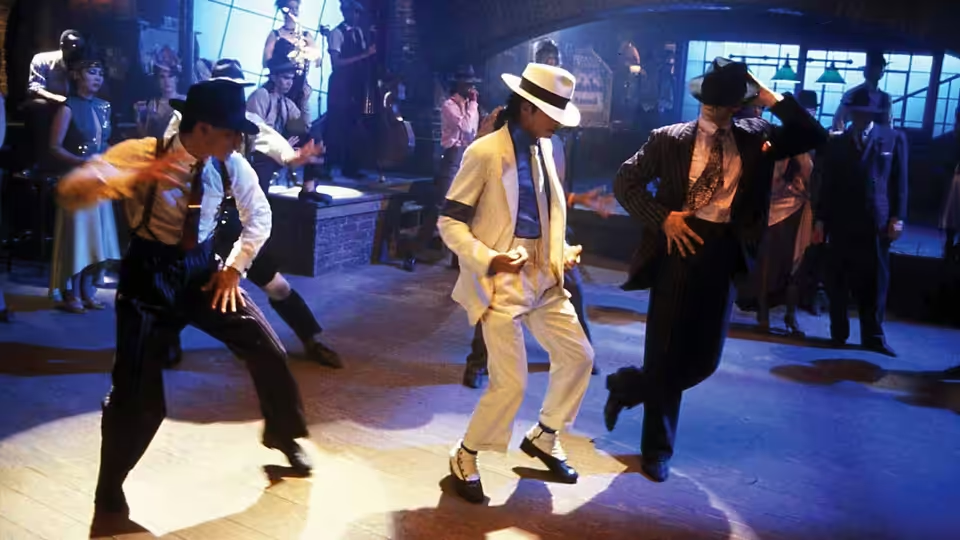
The concert-style opening gives us the clearest reason to stay: a performer with enough presence to command attention without an elaborate fictional excuse. We enjoyed these passages, because the music gives them a pace and purpose missing from the acted material. The film does not need much explanation when it lets him perform. Unfortunately, it keeps deciding that performance alone is insufficient, then offering something less interesting in its place.
Directors Will Vinton, Colin Chilvers, Jerry Kramer and Jim Blashfield contribute to a film whose different approaches never quite belong together. Editors David Blewitt, Mitchell Sinoway and Dale Beldin have the difficult task of making a feature from material that often feels self-contained. Individual passages have movement, but the transitions repeatedly lose it, leaving us to get interested all over again. A change of style can be refreshing in a musical; here, the changes too often feel like interruptions, and the running time begins to weigh on even the livelier sections.
The cinematography is credited to Crescenzo G.P. Notarile, John Hora, Thomas E. Ackerman, Robert E. Collins and Frederick Elmes. The colourful images supply some welcome variety, and Mike Ploog’s production design gives the fantasy settings more interest than the people occupying them. There is enough care in the visual work to make the weak storytelling frustrating rather than merely forgettable. But attractive sets can only hold attention for so long when the film gives us so little reason to care about what happens in them.
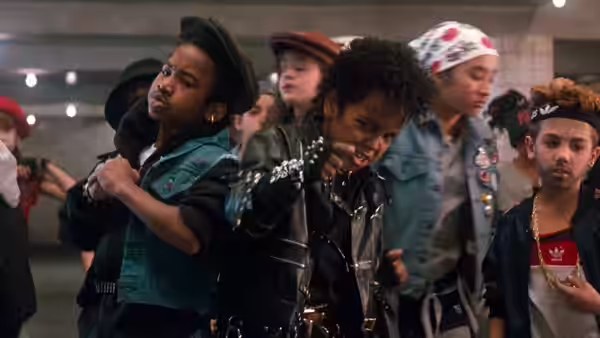
David Newman’s screenplay, from a story credited to Michael Jackson, is weakest when it asks us to accept the star’s importance as sufficient drama. The fairytale is thin, and its earnestness makes the lack of substance harder to overlook. Joe Pesci, playing Mr. Big, gives the cast another strong presence, but the writing still feels arranged around its leading man instead of developing characters. There is a childlike simplicity here that might have been charming with a lighter touch.
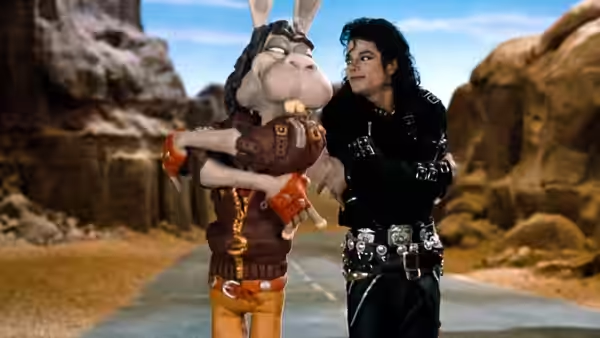
Bruce Broughton’s music has to serve the fantasy alongside the musical performances that are the film’s main attraction, and the latter remain the stronger reason to listen. The animated Leave Me Alone segment is a welcome example of an individual piece having enough character to justify itself. Its invention holds our attention without requiring the fairytale to do so. It also makes the lack of a satisfying connection between the separate pieces more apparent.
Most critics have found the storytelling wanting, and we agree, though the pleasures of the performance material should not be dismissed. Judged as a musical fantasy, this needed a stronger story to justify the time spent away from the music. Anyone coming chiefly for Michael Jackson may find enough scattered moments to tolerate the rest. For an evening’s film rather than a selection of musical clips, choose something else.