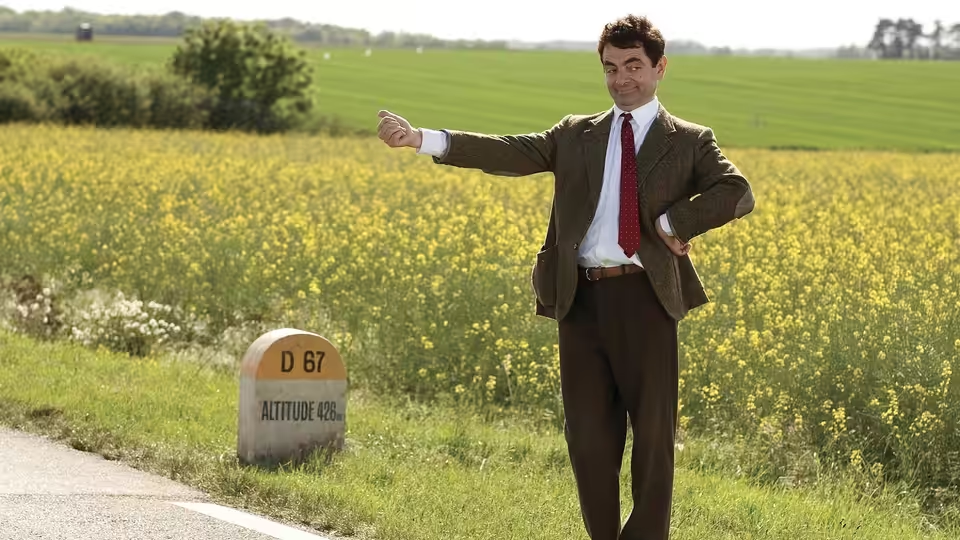
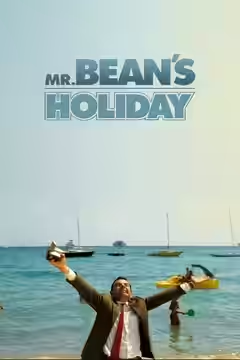
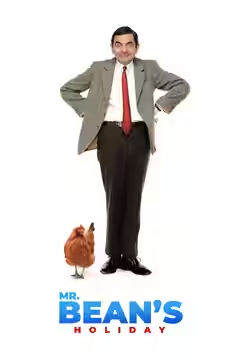
Rowan Atkinson still makes ordinary tasks look alarmingly difficult, and his partnership with Maxim Baldry provides some welcome warmth. There are too few good jokes for 90 minutes, but patient admirers will find enough to enjoy.
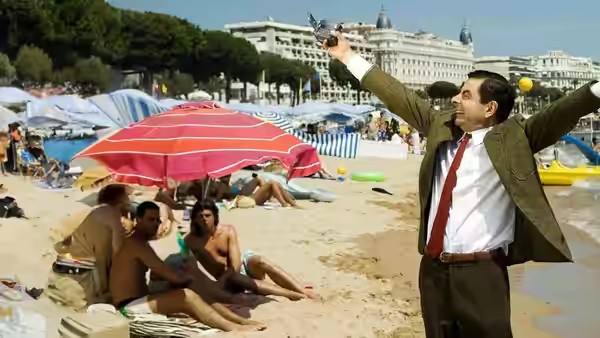
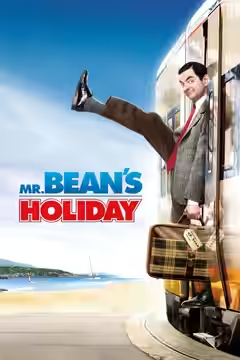
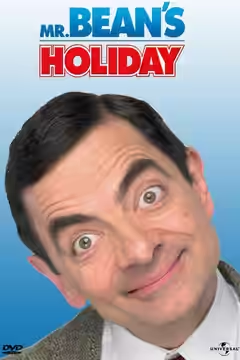
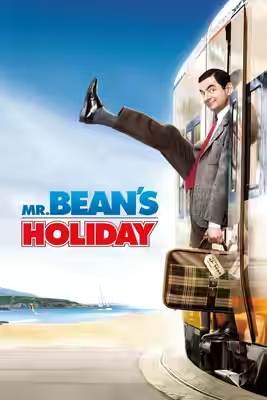
Steve Bendelack’s Mr. Bean’s Holiday is a slight comedy with enough good clowning to please existing admirers, and too much waiting between laughs to recruit many others. It asks us to enjoy Rowan Atkinson doing ordinary things badly, without caring greatly about where the holiday takes him. That is a reasonable invitation for a family film. Sustaining it for 90 minutes proves harder, especially when the next joke involves another prolonged inspection of Bean’s face.
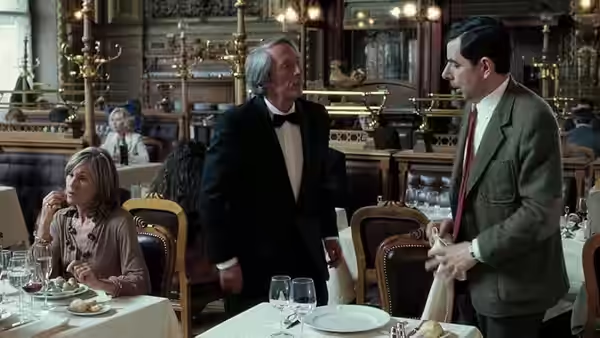
The Parisian seafood episode gives him the sort of concrete difficulty he needs: food to deal with and no easy way of looking competent. His comic strength is the pause while Bean considers what to do, followed by the confidence with which he pursues an unpromising solution. We laughed at the busking scene, because the effort of putting on a performance becomes as funny as the performance itself. There is invention here beyond the familiar grimacing, and the routine benefits from having something for him to accomplish.
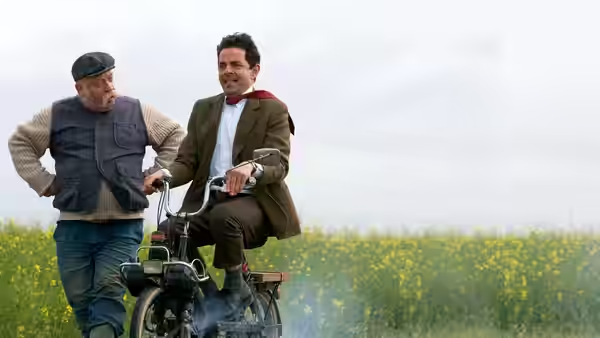
The partnership with Stepan, played by Maxim Baldry, also helps. The two performers establish an affection that makes their scenes worth watching even when the jokes are modest. Bean becomes easier company as a result, though he also loses some of the awkwardness that makes his behaviour funny in the first place. There are passages where we can feel the film being careful to keep him likeable, when letting him be difficult might have produced a better laugh.
Baz Irvine’s bright cinematography helps sell the idea of a holiday, but attractive surroundings cannot fill every gap between jokes. Michael Carlin’s production design gives the public mishaps a suitably orderly setting; the restaurant supplies a useful degree of formality for Bean to struggle against. Howard Goodall’s music reinforces the friendliness, sometimes more persuasively than the comic writing does. The film is easy to look at and listen to, including during stretches when there is little else to occupy us.
Hamish McColl and Robin Driscoll’s screenplay is less successful at developing comic situations than at supplying them. Too often a difficulty is established, the face-pulling begins, and we are left waiting for a further idea. Tony Cranstoun’s editing cannot disguise the shortage of material, particularly in the uneven second half, where individual routines feel stretched rather than allowed to grow. A short physical-comedy sketch can survive on one recognisable irritation; a feature needs to keep finding something else for its central character to do.
The supporting performances offer some compensation. Willem Dafoe brings a welcome comic sharpness to Carson Clay, while Emma de Caunes makes Sabine appealing despite being given too little to do. Neither can solve the shortage of laughs, but both give us reasons to remain interested beyond Bean himself. Judged against physical comedy that keeps building new complications out of a simple task, this is too often content to make the original difficulty last longer.
Most critics disagree with us about how much these pleasures are worth, finding the film too thin and too rarely funny. We think that undervalues the precision of the clowning and the warmth between Bean and Stepan, although the complaint about the gag rate is fair. Try it if watching Bean struggle with a meal already sounds like a decent use of an evening; this is not the film to change a sceptic’s mind.