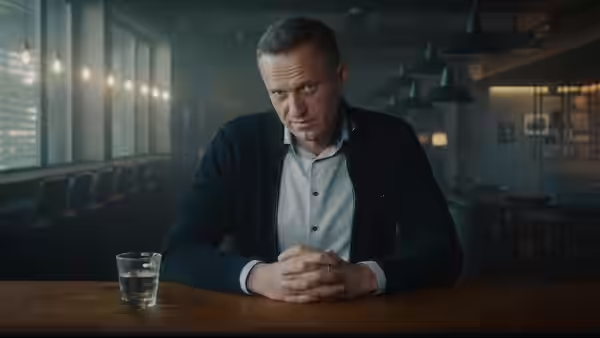
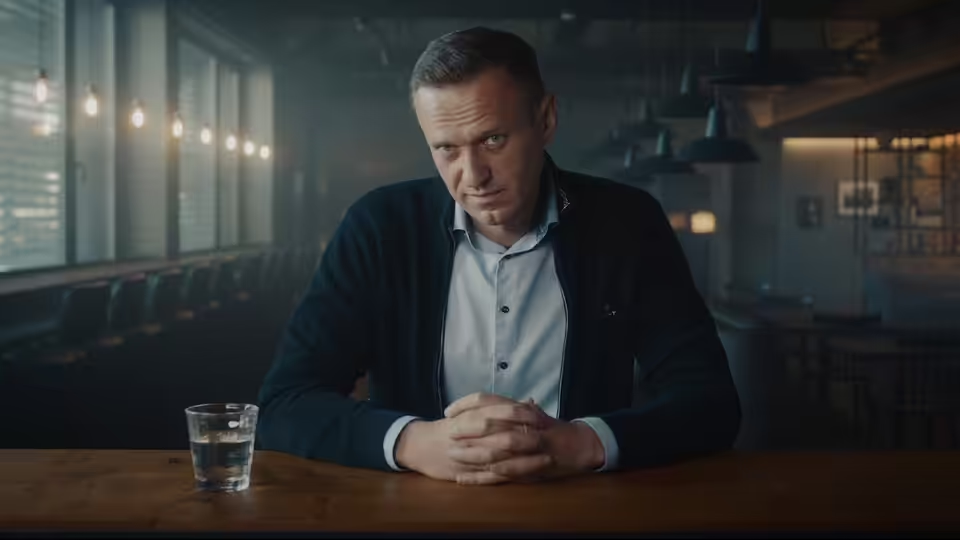
Alexei Navalny sits at a restaurant table, hands clasped and looking toward the camera
Film review

Navalny

2022 · Directed by Daniel Roher · 1h 38m

In a sentenceA man investigates his own poisoning, and somehow still knows exactly where the camera is

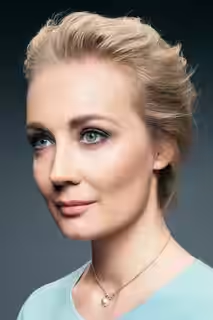
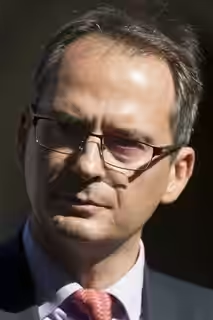
Alexei Navalny investigates the attempt to poison him, seeking evidence of who organised an attack on his life. Daniel Roher follows the inquiry, with Yulia Navalnaya and Christo Grozev also appearing as themselves. His political struggle continues alongside the search, but the immediate task is to establish what happened and expose those responsible. Navalny takes an active part in investigating the plot against him. Rather than covering his life from the beginning, the documentary concentrates on the poisoning investigation and the people involved in it.

Plays from YouTube when you press play; nothing loads from them until then.

Fi1m review

Daniel Roher’s Navalny is a tense, accessible documentary about the investigation into an attempt on its subject’s life. The close access pays off, though its limited interest in his political history leaves important questions unanswered.

Daniel Roher’s Navalny is a gripping documentary with a serious limitation: it gives its subject’s political history too little attention. The director builds around Alexei Navalny’s efforts to uncover the poisoning plot, keeping the immediate question of responsibility firmly in view. That gives the film a clear purpose and considerable urgency, with little opportunity for the attention to wander. We recommend it as an account of an investigation, with reservations about how little context accompanies the man conducting it.

His screen presence does a great deal of the work, and the director recognises the appeal of a subject who seems comfortable being watched. Niki Waltl’s cinematography makes that close access count, encouraging us to study the man while the investigation proceeds. His composure can be reassuring, even when reassurance is hardly what the circumstances warrant. We found ourselves warming to him, and then questioning how readily we had done so; his confidence in front of the camera makes sympathy come almost before scrutiny.

Editors Langdon Page and Maya Hawke keep the enquiry moving, giving the pursuit of evidence the forward pull of a thriller. At 98 minutes, the film is compact, and that concentration is largely to its advantage. There is satisfaction in following people trying to establish what happened, particularly when the person pursuing answers was himself the target of the attack. The editing makes the investigation accessible without making it feel effortless, although the pace also helps the director move past questions that deserve a longer hearing.

Matt Robertson and Marius de Vries supply music that fits the thriller approach, though the circumstances hardly need help generating apprehension. We were frightened by watching a man investigate an attempt on his own life. His involvement makes the search for answers unsettling in a way that an account delivered at a safe distance could scarcely manage. The director is persuasive when he allows that situation to carry the drama, but the more encouraging tone sometimes makes the danger feel more containable than the film gives us reason to believe.

The principal problem is the space given to the subject’s earlier political career. There is too little of it to make this a searching portrait, and his considerable personal appeal goes insufficiently challenged. A documentary need not become a complete biography to ask what its subject believes, how those beliefs developed or which parts of his record warrant closer examination. Those matters receive too little attention here, particularly for a film that encourages such strong sympathy with the person at its centre.

That shortcoming matters because the film encourages us to support its subject beyond the investigation itself. A political documentary ought to leave enough room for awkward context, however compelling the immediate events might be. Even so, the access and the skill of the editing are substantial reasons to watch, and the enquiry rarely loses its grip. There is enough here to justify an evening, provided its narrow scope is understood. Do not let it be the only account of Alexei Navalny’s politics you encounter.
Critical consensus AI synthesised

77
Positive
13
Mixed
6
Negative
0

Most critics respond warmly to Navalny, with praise clustering around its close access to its subject and the suspense of the poisoning investigation. The reviews repeatedly describe a documentary that moves like a thriller, singling out a recorded phone call as its most tense sequence. Navalny’s charisma and courage also draw praise, while several critics find the film humane as well as gripping. Even more reserved assessments acknowledge how effectively it holds attention.

The main reservation concerns how little space the film gives Navalny’s earlier life and political history. That concern appears in enthusiastic reviews too, though critics differ over how much it matters. Sight and Sound offers the sharpest dissent, challenging the buoyant framing of his political struggle as well as the missing context. The New Yorker raises a different doubt: whether the film’s revelations can reach beyond a sympathetic Western audience. The spread is broad, despite substantial agreement about the suspense.

Radio Times
★★★★★ · Caroline Frost
100

Frost presents the documentary as a fascinating portrait of a courageous, charismatic subject. She praises Navalny’s efforts to uncover the poisoning plot, while noting gaps in the account of his history.

Read the full review →
Empire
14 April 2022 · John Nugent
90*

Nugent calls the documentary an urgent, searing account that feels especially timely. He praises its exceptional access, particularly the sequence in which Navalny tricks a suspected poisoner into describing the operation.

Read the full review →
Variety
25 January 2022 · festival review · Owen Gleiberman
90*

Gleiberman calls the documentary a must-see, stirring account of Navalny’s courage and resistance to authoritarian rule. He especially praises the suspenseful investigation that leads to Navalny’s recorded phone confession from one of the poisoning plotters.

Read the full review →
The i Paper
12 April 2022 · Christina Newland
85*

Newland finds the documentary gripping, disturbing and humane, and calls it unmissable. She especially praises Navalny’s screen presence, which makes the film immediately compelling.

Read the full review →
Los Angeles Times
11 April 2022 · Justin Chang
82*

Chang finds the documentary gripping and sharply assembled, while noting its uneasy mix of timeliness and escapism. He especially praises the electrifying scene in which Navalny tricks an alleged poisoning operative into revealing incriminating details.

Read the full review →
The Guardian
27 January 2022 · festival review · Adrian Horton
80*

Horton finds the documentary riveting and damning, while noting it skims over thorny context about Navalny’s political history. She praises the jaw-dropping prank call that exposes details of the poisoning plot.

Read the full review →

Straight answers AI written, from our review

Is Navalny worth watching?
Navalny is worth watching as a tense, accessible documentary about a poisoning investigation, and we score it 78 out of 100. We recommend it for its close access and thriller-like editing, but its limited scrutiny of Navalny’s political history makes it an investigation to follow rather than a rounded political portrait.
How long is Navalny, and what is it rated?
Navalny runs 1h 38m. It is a documentary film.
Where can I watch Navalny in Italy?
Navalny is available to rent from Amazon Prime Video from €3.99. Availability is checked daily; the links above go straight to each service.
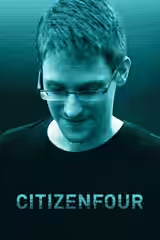
How does Navalny compare to Citizenfour?
Navalny is a brisk investigation led by a camera-confident subject, while Citizenfour pays closer attention to the discomfort of being filmed amid political danger. We favour Navalny for a clearly focused pursuit of evidence and Citizenfour for sustained apprehension, though both are less satisfying when they move beyond their central encounters.
What should I watch after Navalny?
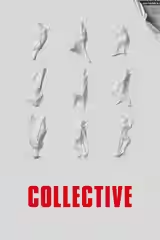
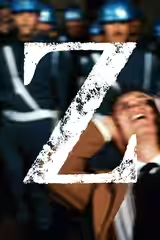
After Navalny, try Citizenfour (2014, Fi1m 83): Another close encounter with political danger, attentive to the discomfort of being filmed. Then Collective (2019, Fi1m 88): Patient investigative work drives this documentary, with more room for institutions than individual charisma; and Z (1969, Fi1m 84): Political violence becomes a procedural thriller, with anger sharpening every stage of the investigation.

Cast

Awards

Academy Awards, 2023

Won
Best Documentary Feature Film

Sundance Audience Award: U.S. Documentary, 2022

Won
Sundance Audience Award: U.S. Documentary

Sundance Festival Favorite Award, 2022

Won
Sundance Festival Favorite Award

If you liked this, try…

  1. Citizenfour (2014, Fi1m 83)Another close encounter with political danger, attentive to the discomfort of being filmed.

  2. Collective (2019, Fi1m 88)Patient investigative work drives this documentary, with more room for institutions than individual charisma.

  3. Z (1969, Fi1m 84)Political violence becomes a procedural thriller, with anger sharpening every stage of the investigation.

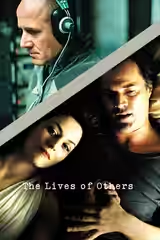
  4. The Lives of Others (2006, Fi1m 84)For the surveillance and moral pressure, explored through fiction rather than documentary access.

  5. The Thin Blue Line (1988, Fi1m 90)An investigation whose careful assembly keeps asking how persuasive stories become accepted facts.