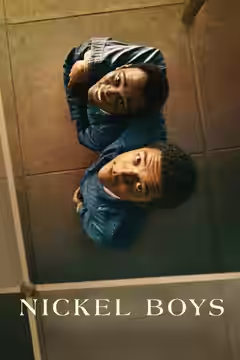
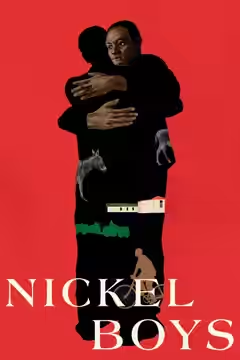
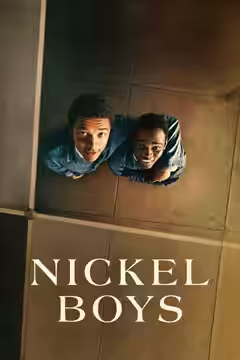
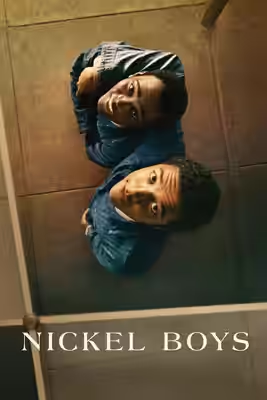
Nickel Boys poster

Nickel Boys

2024 · Directed by RaMell Ross
2h 20mDramaHistory12A
85
Fi1m score
89
Critics · 19
Audience · not yet

Where to watch in the UK

Checked 10 September at 22:29. Prices and availability change; the service’s page is the last word.

Plays from YouTube when you press play; nothing loads from them until then.

Synopsis

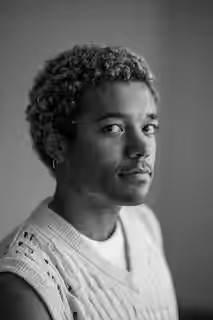
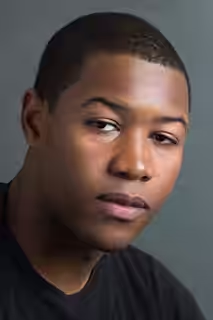
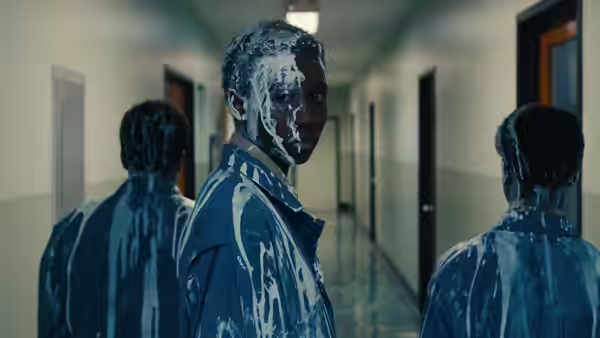
Elwood is a serious teenager in Tallahassee, raised by his grandmother Hattie, who plays him Martin Luther King records until he knows them by heart. A teacher, Mr Hill, finds him a place in college classes across town. On his way there he accepts a lift in a car that turns out to be stolen, and the state of Florida sends him to Nickel Academy, a reform school where the Black boys are worked, beaten and sometimes not seen again. There he meets Turner, who has been inside before and knows how the place runs. RaMell Ross films Colson Whitehead’s novel from behind the boys’ own eyes, with Ethan Herisse, Brandon Wilson and Aunjanue Ellis-Taylor.

Fi1m review

In a sentenceFlorida from inside a boy’s head: orange peel, sky, a stolen car, and a grandmother coming in to hug the camera

RaMell Ross films Colson Whitehead’s novel about a Florida reform school entirely through the eyes of its two boys, and the gamble mostly pays. It is tender where it could have been brutal, exactly made, long, and a little in love with its own method.

Elwood is a serious boy in Tallahassee, raised by his grandmother Hattie, who plays a Martin Luther King record until he knows it by heart. A teacher, Mr Hill, gets him a place in college classes across town. On the way there he takes a lift in a car that turns out to be stolen, and the state of Florida sends him to Nickel Academy, a reform school where the Black boys are worked, beaten and occasionally not seen again. RaMell Ross and Joslyn Barnes have adapted Colson Whitehead’s novel, and their one big decision is that we watch it from behind Elwood’s eyes, and later from behind those of Turner, the friend he makes inside. Our verdict is that the gamble comes off more often than not, and when it does the film is as close as we have come to sitting inside someone else’s memory. It is also 140 minutes long and rather pleased with itself.

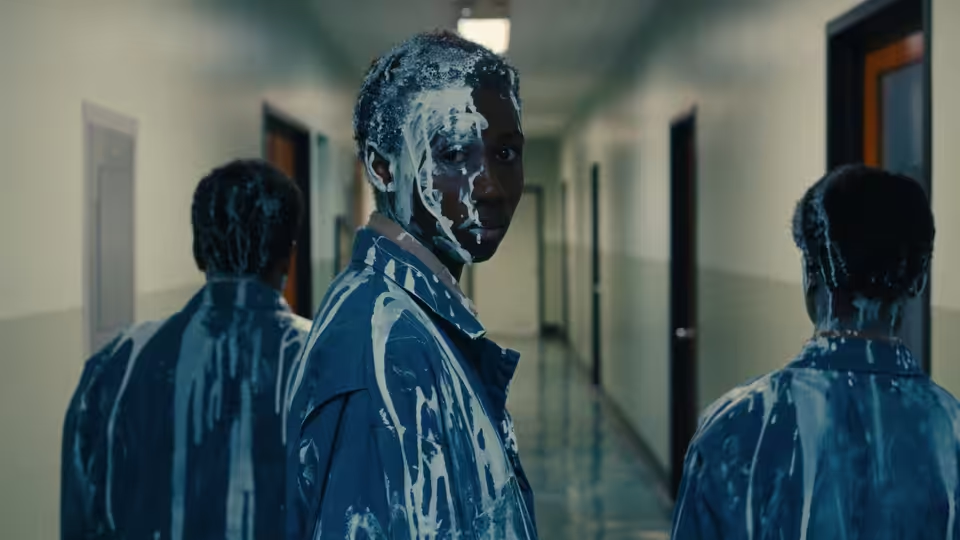
Jomo Fray keeps the camera at the height of a teenager’s head. When Elwood looks down we see his hands, his shoes, an orange being peeled; when someone speaks to him they speak straight into the lens from a foot away, and we cannot look anywhere else. Early on, Hattie comes towards us across a room for a hug, and the screen fills with the shoulder of Aunjanue Ellis-Taylor’s dress and goes dark. We were caught off guard by how much that undid us. Ross has found a way to give an audience something cinema has never managed, which is being held.

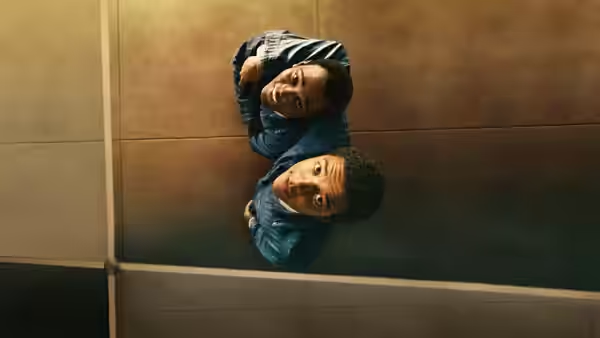
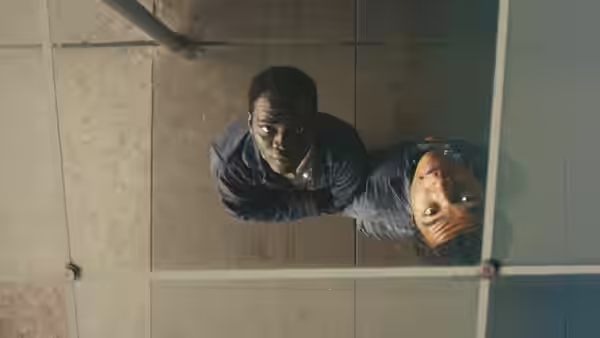
The performances have to work without faces for long stretches, and mostly they do. Ethan Herisse plays Elwood as a voice and a way of standing: careful, upright, still sure the rules will protect him if he follows them. Brandon Wilson’s Turner knows better, and when the film first switches to his eyes we see Elwood properly for the first time, across a canteen table, and are startled at how young he is. Ellis-Taylor has one long scene of talking to a boy who is not answering, and it is the best acting in the film. Hamish Linklater’s Spencer, who runs the place, never raises his voice, which is worse.

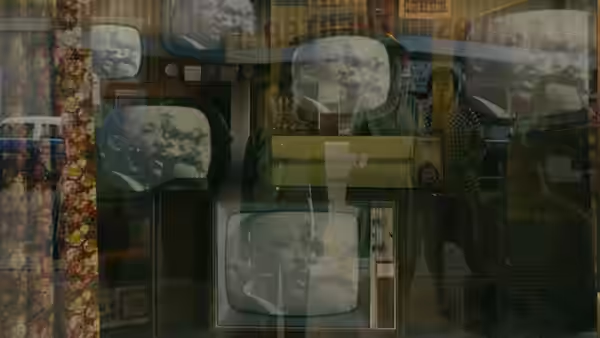
Nicholas Monsour cuts in things Elwood could not have seen: rocket launches, an alligator, an old Hollywood film playing on a shop-window television that reflects the boy watching it. It ought to be pretentious and mostly is not; these are the pictures a mind keeps alongside its own. Alex Somers and Scott Alario score it with hums and held notes that sit under the Florida heat. Nora Mendis builds Nickel as low white buildings and a lawn, with one shed the boys call the White House and do not go near. Brittany Loar’s work shirts are slightly too big, as institutional clothes are.

The method has costs. Whenever a character explains something to the lens, the film tips into the manner of an interview, and we became aware of an actor being asked to hold a look longer than a person would. The middle hour circles: work detail, dormitory, a boxing match, work detail. And because the camera is always one boy or the other, Herisse and Wilson are almost never in a frame together, so the friendship the film rests on has to be taken partly on trust.

Ross’s previous film, Hale County This Morning, This Evening (2018), was a documentary that watched Black lives in Alabama with the same patience and the same refusal to point at the obvious thing. This is that eye given a story to tell. The reviews so far are close to unanimous and several have reached for the largest words available. We stop a little short of them. It is an unusually good film with a method it trusts slightly more than we do.

See it in a cinema; at home the frame shrinks and the trick of being someone else shrinks with it. The 12A is honest. The violence happens off screen or behind a door, which is how Elwood experiences it and how the film insists we do too. Take someone whose hand you would not mind holding.
Critical consensus AI synthesised

89
Positive
18
Mixed
1
Negative
0

The reviews agree to an unusual degree, and they agree about one thing above all: the decision to shoot the film in the first person, so that the camera is the boys and we see the reform school through their eyes. Almost every critic treats that choice as the film’s achievement, praising it for putting the viewer inside the experience without turning the abuse into spectacle, and several credit the use of archival footage and flash-forwards alongside it. Where performances are mentioned, Aunjanue Ellis-Taylor’s is the one singled out. The spread is narrow; the great majority score it highly, with only a few reservations at the edges. Deadline finds the point-of-view camerawork repetitive and the film overlong, more Malick than Whitehead, and The Playlist thinks the technique creates distance as the film goes on. NME notes some meandering while still recommending it. Those are the only real dissents, and even they praise the risk taken.

Little White Lies
18 December 2024 · 5/5/5 · Sam Bodrojan
100

The critic hails the film as a miracle and masterpiece, the defining American film of the 2020s and 2024's most harrowing and transcendent work. It singles out the first-person POV cinematography and intuitive avant-garde imagery that make the adaptation both formally rigorous and emotionally accessible.

Read the full review →
Radio Times
★★★★★ · Patrick Cremona
100

The review describes an audacious adaptation that is an original work of heart-wrenching power. It singles out the unique point-of-view visual approach that creates a tactile, profoundly immersive experience with innovative use of archival footage and flash-forwards.

Read the full review →
Time Out
13 December 2024 · ★★★★★ · Sophie Monks Kaufman
100

The review calls it a soulful, heartbreaking masterpiece that changes how viewers think about image construction. It singles out the first-person POV shooting and loving eye that leads with sensitivity despite the devastating story of racist injustice.

Read the full review →
The New Yorker
6 December 2024 · Richard Brody
95*

The critic hails the film as a glorious exception that renders the novel innovatively yet faithfully, achieving an advance in narrative form through its daring point-of-view technique that fuses observation and sensation. He singles out the expressive first-person perspective that registers the cause of characters' emotions and gives cinematic form to the bearing of witness.

Read the full review →
IndieWire
13 December 2024 · David Ehrlich
90*

Ross's visionary first-person adaptation injects radical new life into the novel, creating a staggeringly beautiful story of resilience through its immersive subjective camera work. The film blends narrative and documentary sensibilities to challenge conventional cinema while honoring the characters' experiences.

Read the full review →
Los Angeles Times
20 December 2024 · Amy Nicholson
90*

The critic calls the film a priceless paean to the lives of victimized reform-school kids, praising how Ross turns the characters into the camera so the audience sees the world literally through their eyes and celebrates their humanity. She singles out the soul-stirring visuals, the epic banal of small moments shot with grandeur, and a mesmerizing montage, while noting minor issues with dialogue delivery.

Read the full review →

Cast

Stills

Awards

Academy Awards, 2025

Nominated
Best Picture

If you liked this, try…

Hale County This Morning, This Evening poster

Hale County This Morning, This Evening

2018 · Ross’s documentary, where this way of looking was worked out on real people first.

Son of Saul poster

Son of Saul

2015 · Another camera glued to one man’s shoulder, refusing to show what it will not.

Lady in the Lake poster

Lady in the Lake

1947 · Hollywood tried the first-person camera decades ago; instructive to see how badly.

Scum poster

Scum

1979 · The British borstal film: blunter, angrier, and just as sure who is to blame.

Killer of Sheep poster

Killer of Sheep

1978 · Black American life in small unhurried moments, shot for almost nothing and unforgettable.