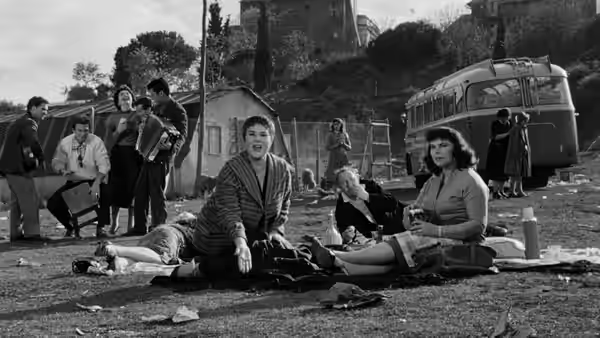
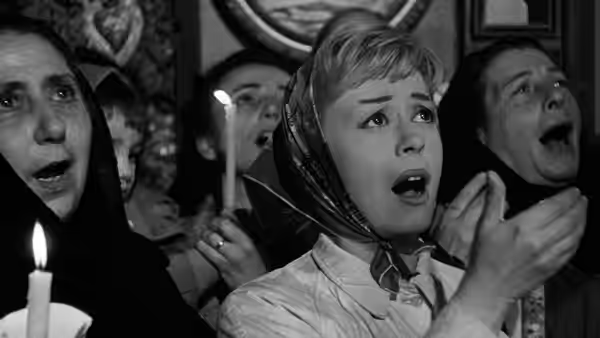
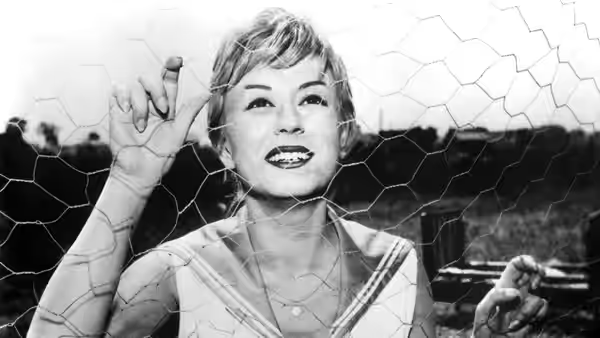
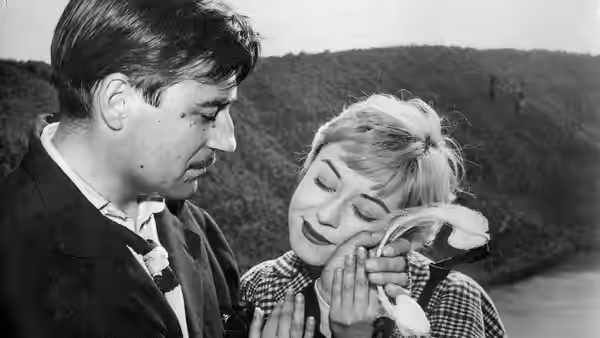
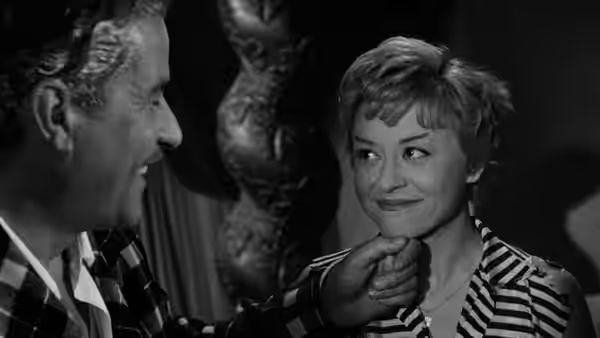
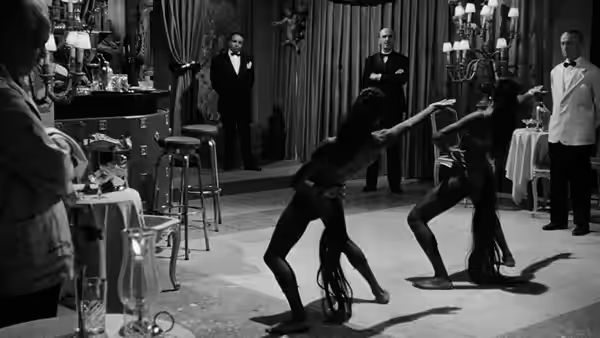
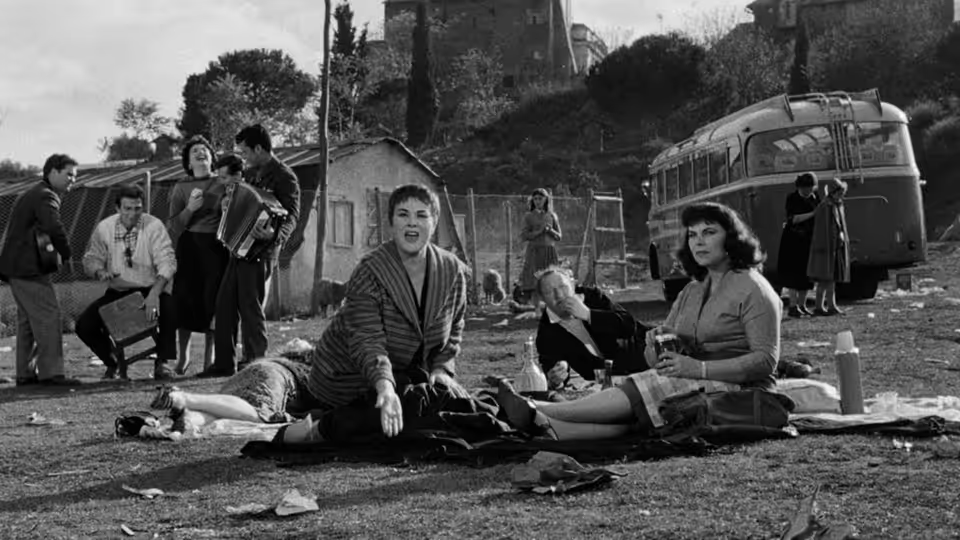
People gather beside a camper van as a woman sits among them on the ground
Film review

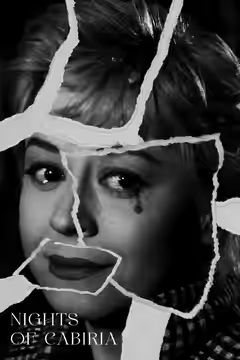
Nights of Cabiria

1957 · Directed by Federico Fellini · 1h 50m

In a sentenceWe spent rather a lot of this film wishing someone would be kind to Cabiria

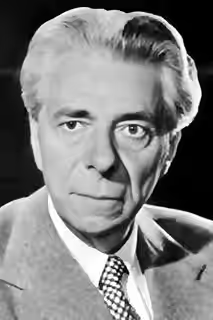
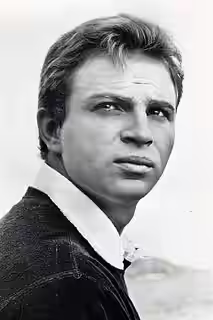
In Rome, Maria ‘Cabiria’ Ceccarelli (Giulietta Masina) works as a streetwalker and keeps hoping for a better life. Betrayal gives her reason to give up on other people; she does not. Wanda (Franca Marzi) and Alberto Lazzari (Amedeo Nazzari) are among the figures in her story. Cabiria has to go on living with the disappointments she suffers, while holding on to the hope that things can change. For her, carrying on means remaining open to people who may hurt her.

Plays from YouTube when you press play; nothing loads from them until then.

Fi1m review

Nights of Cabiria earns its force through Giulietta Masina, whose expressive performance makes hope feel costly. Federico Fellini presses the suffering harder than he needs to, but we warmly recommend this portrait of a woman who refuses to give up.

Nights of Cabiria is deeply moving, though its director sometimes presses harder than he needs to. Federico Fellini centres the film on a Roman streetwalker, Maria ‘Cabiria’ Ceccarelli, played by Giulietta Masina, whose hope survives betrayal. The danger is that she will become someone we are required to pity for the whole evening. Her performance prevents that, and makes the film worth recommending even when we want the director to ease off.

The first thing to admire is how much room she gives Cabiria to be difficult. Her exuberance can be funny without making her seem foolish, and her vulnerability does not tidy away the awkwardness. We were moved by the effort beneath that liveliness, by the way hurt remains legible in such an expressive face. She makes carrying on seem tiring, which is what persuades us to believe in the hope.

Aldo Tonti’s cinematography is most valuable for the attention it gives that face. We can watch the performance closely without feeling that the camera is competing with it, and the film benefits from that patience. Piero Gherardi’s production design and costumes accommodate an actress whose physical presence can fill an image. The work suits her broadness, allowing us to accept the comedy without wishing she would settle down and behave as though she were in a more solemn drama.

Leo Catozzo’s editing has a difficult job: it must give that acting room while keeping the shifts between comedy and pain from feeling managed. The rhythm generally lets us accept both, though there are moments when we feel the film preparing us to be moved. Nino Rota’s music is appealing on its own terms, but we sometimes want less help from it. Cabiria has already secured our attention, and a further invitation to sympathise can feel unnecessary.

The screenplay credits include Federico Fellini, Ennio Flaiano, Tullio Pinelli and Pier Paolo Pasolini, and its strongest quality is its tolerance of a heroine who will not behave tidily. Cabiria can be hard to take without ceasing to matter. The comedy helps because it allows an awkward, exuberant woman to exist alongside the suffering one. It gives us something to respond to beyond her troubles, so that we are not simply waiting for another misfortune to tell us how to feel.

Our reservation concerns how insistently those troubles are presented. At times, Federico Fellini seems to need Cabiria to suffer again to demonstrate something we have already understood about her. We feel the repetition, and it briefly weakens our trust in the storytelling. Still, Giulietta Masina makes the continued hope credible enough that we do not dismiss it as consolation supplied by a sympathetic director.

Melancholy comedy can become tiresome when it asks us to admire people merely for enduring. This film gives its heroine a personality that does not always invite approval, and an actress willing to make that personality large. The broadness may be an obstacle for anyone who prefers quieter acting, though we think restraint would cost this performance much of its humour. Watch it for Giulietta Masina, with fair warning that the warmth does not make this an easy evening.

Critical consensus AI synthesised

81
Positive
6
Mixed
1
Negative
0

Most critics respond warmly to Nights of Cabiria, with praise concentrated on Giulietta Masina’s performance. The reviews repeatedly describe her Cabiria as expressive, emotionally vivid and resilient, finding both fragility and exuberance in the character. Fellini’s sympathy for her also draws admiration, particularly his ability to find hope amid hardship. Several critics find the film deeply moving, while its mixture of satire and melancholy gives the praise a broader basis than the central performance alone.

The disagreement concerns how persuasively that hope survives the suffering. The Guardian supplies the main dissent, admiring Masina’s exuberance but finding the cruelty hard to bear and the optimism unconvincing. The spread therefore runs from strong enthusiasm to qualified admiration, rather than outright rejection. Even the reservation leaves the consensus around Masina largely intact; the emotional treatment of Cabiria divides critics more than the acting does.

Los Angeles Times
31 July 1998 · Kenneth Turan
95*

Turan gives the film an emphatically admiring verdict, calling it a classic whose vitality endures. He especially praises Giulietta Masina’s vivid, emotionally nuanced performance as Cabiria.

Read the full review →
The New York Times
3 July 1998 · Janet Maslin
95*

Maslin calls the restored film a cinematic masterpiece and a deeply moving antidote to current spectacle. She particularly praises Giulietta Masina’s heartbreaking performance and Fellini’s soulful vision of Cabiria’s resilience.

Read the full review →
Time Out
15 March 2012
81*

Time Out’s description favors Fellini’s film over the musical it inspired. It singles out the resilient prostitute at the story’s center, though the review text is unavailable.

Read the full review →
RogerEbert.com
76*

The page appears to be a Great Movies review of the 1957 film. Its verdict and specific praise cannot be verified because the article is blocked.

Read the full review →
Empire
1 January 2000 · Kim Newman
75*

Newman finds the film an evocative blend of satire and melancholy, with Fellini's emerging genius on display. He singles out Giulietta Masina's fragile, emotionally vivid performance as the film's heart.

Read the full review →
The Guardian
23 July 1999 · Peter Bradshaw
55*

Bradshaw admires the film but finds its final cruelty almost unbearable and its closing uplift unconvincing. He singles out Giulietta Masina’s exuberant performance as Cabiria for praise.

Read the full review →

Straight answers AI written, from our review

Is Nights of Cabiria worth watching?
Nights of Cabiria is warmly worth watching for Giulietta Masina’s funny, moving portrait of stubborn hope, and we score it 88. We recommend it to anyone drawn to melancholy comedy and expressive acting, though Fellini presses Cabiria’s suffering harder than necessary, and the warmth does not make this an easy evening.
How long is Nights of Cabiria, and what is it rated?
Nights of Cabiria runs 1h 50m. It is a drama and comedy film.
Where can I watch Nights of Cabiria in Romania?
Nights of Cabiria is not on any streaming or rental service in Romania at the moment. It is available in 4 other countries; change your country at the top of the page to see where. Availability is checked daily.
How does Nights of Cabiria compare to The Apartment?
Nights of Cabiria presses its heroine’s suffering harder than The Apartment, though both use comedy to make loneliness matter without making their characters saints. We favour The Apartment for its patience with flawed people, despite a second half that takes too long; Nights of Cabiria is our choice for the expressive force of Giulietta Masina’s performance.
What should I watch after Nights of Cabiria?
After Nights of Cabiria, try The Apartment (1960, Fi1m 91): Comedy makes room for loneliness without asking its characters to become saints. Then Happy-Go-Lucky (2008, Fi1m 83): An optimistic heroine tests how readily we mistake kindness for stupidity.

Cast

Awards

Academy Awards, 1958

Won
Best International Feature Film

Grolla d'oro for Best Leading Actress, 1958

Won
Grolla d'oro for Best Leading Actress

International Submission to the Academy Awards, 1958

Nominated
International Submission to the Academy Awards

If you liked this, try…

  1. La Strada (1954) · not on Fi1m yetAnother expressive central performance makes hardship difficult to dismiss and harder to forget.

  2. The Apartment (1960, Fi1m 91)Comedy makes room for loneliness without asking its characters to become saints.

  3. Cléo from 5 to 7 (1962) · not on Fi1m yetA woman’s passage through the city becomes an unusually attentive character study.

  4. Happy-Go-Lucky (2008, Fi1m 83)An optimistic heroine tests how readily we mistake kindness for stupidity.

  5. The Lunchbox (2013) · not on Fi1m yetSmall hopes and ordinary disappointments receive the attention usually reserved for grand romances.