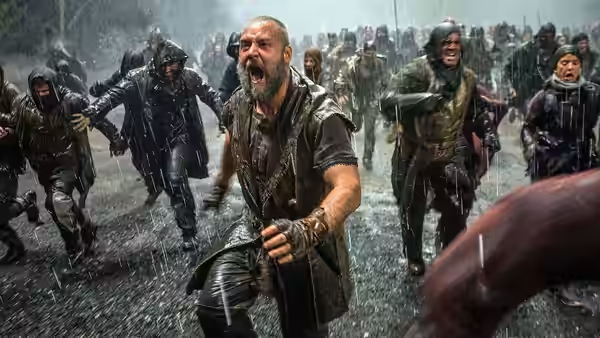
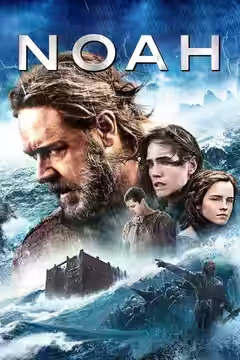
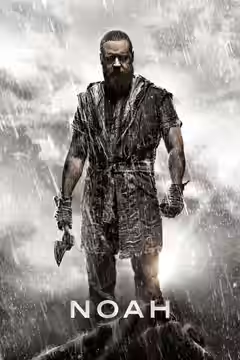
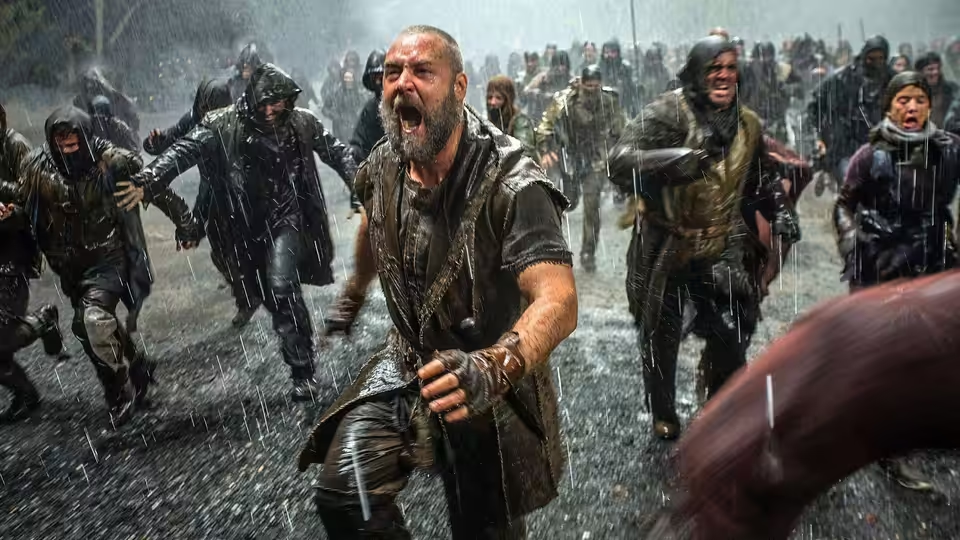
Noah (Russell Crowe) charges through a rain-soaked crowd as people flee around him
Film review

Noah

2014 · Directed by Darren Aronofsky · 2h 18m

In a sentenceStone angels do the carpentry, God speaks only in dreams, and Russell Crowe glowers at the rain for two hours

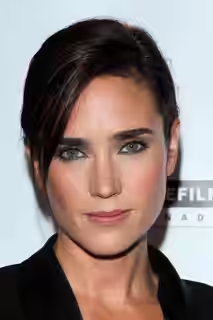
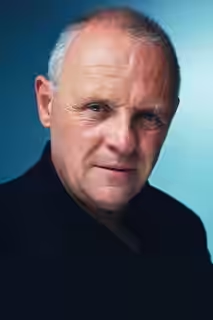
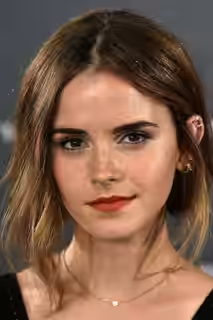
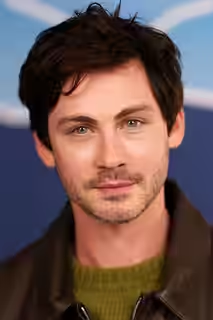
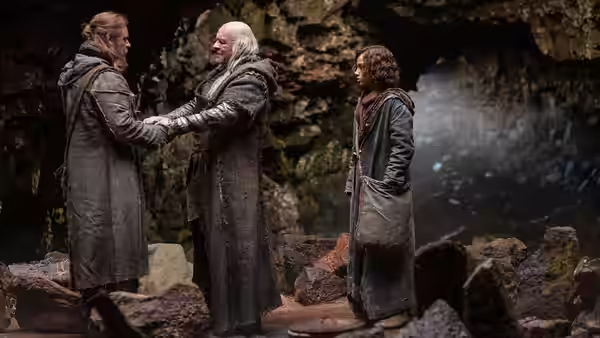
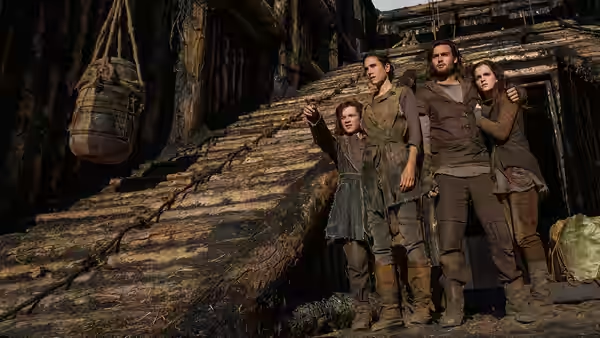
The world is a scorched grey plain and the descendants of Cain have stripped it of everything they can burn or sell. Noah (Russell Crowe) lives apart with his wife Naameh (Jennifer Connelly) and their sons Shem (Douglas Booth), Ham (Logan Lerman) and Japheth (Leo McHugh Carroll). A dream of drowning sends him across the wasteland to his grandfather Methuselah (Anthony Hopkins), on a mountain guarded by the Watchers, fallen angels encased in rock. On the way the family takes in a wounded girl, Ila (Emma Watson). Methuselah gives Noah a seed from Eden; a forest rises; and Noah begins building a timber box to hold two of every animal while Tubal-cain (Ray Winstone) and his army gather outside.

Plays from YouTube when you press play; nothing loads from them until then.

Fi1m review

Darren Aronofsky’s flood is huge, strange and often magnificent to look at, and for stretches it is also solemn to the point of tedium. The creation sequence alone is worth ten minutes of anyone’s time; the boat trip is harder work.

Darren Aronofsky, writing with Ari Handel, has taken the few pages of Genesis that cover the flood and made from them a 138-minute film about a man told to save the animals and let everyone else drown, who then does exactly that and does not enjoy it. That is the admirable thing about Noah: it treats the story as a horror, which is what it is. It is also, for long stretches, a slog. We came out impressed by perhaps forty minutes and worn down by the rest.

The best of those forty minutes is the creation. Noah tells his family how the world began, and Aronofsky and his editor Andrew Weisblum lay it out as a run of stills and time-lapse: a burst of light, a boiling sea, a fish that becomes a lizard that becomes an ape, each frame held a fraction of a second under Crowe’s flat, unhurried voice. It is the six days of scripture and several billion years of fossils in one breath, and the film makes no fuss about it. We sat forward, and stayed forward. Matthew Libatique shoots the pre-flood world as black soil under white sky, so that it looks like a place already dead.

Mark Friedberg’s ark is a barn the height of a hill, a rectangle of timber tarred black, with no prow and no keel, and the sight of it going up on a bare plain is the film’s second great image. Michael Wilkinson dresses everyone in felted wool and stitched hide, with nothing to pin the story to a century. Then there are the Watchers, fallen angels sealed in rock, lumbering about on too many limbs with light leaking from their eyes, voiced by Nick Nolte, Mark Margolis and Kevin Durand. We laughed when the first one walked into frame, and we do not think we were meant to. Twenty minutes later they were hauling logs and we had stopped noticing.

Russell Crowe carries it. He plays Noah as a heavy, quiet man who listens more than he speaks, and when the message turns out harsher than he expected he hardens rather than breaks, without a speech to mark the change. Jennifer Connelly’s Naameh is the one person who argues back, and the film needs her every time she does. Emma Watson gives Ila a steadiness that becomes the second half’s only warmth. Ray Winstone’s Tubal-cain bellows about a man’s right to take what he can, which is the script’s one counter-argument, and it is a good bellow. Anthony Hopkins turns up on a mountain, works a miracle and asks after berries.

The trouble is the boat. Once the doors close the film has one argument to have and it has it three times, with the rain going and Clint Mansell’s choir swelling under each round in case we had missed the stakes. Somewhere in the second hour we were bored, and then cross that a film this odd had managed it. One stretch cuts through, and we will not detail it beyond saying it concerns what the family hears through the timber once the doors are shut. It horrified us, and it is the only time the cost of the story lands without a line to explain it. The second half then takes a turn we will not describe, and handles it with more solemnity than sense.

Aronofsky has always made films about one person and one fixed idea: the number in Pi (1998), the perfect performance in Black Swan (2010). Noah is the same film with a studio budget and a story everyone knows the end of, and the obsession that was frightening in a small room becomes wearing on a barge.

If you see it, see it for the creation, for the ark rising on the plain, and for the minutes after the doors close. It runs 138 minutes and carries a 12 certificate, which given what happens outside the hull strikes us as generous. At home the Watchers look smaller and the arguments can be paused.

Critical consensus AI synthesised

60
Positive
13
Mixed
8
Negative
6
Empire
23 April 2012 · ★★★★ · Dan Jolin
80

Jolin calls the film an inventive, ambitious mythological epic, while noting that its harshness and revisions to the biblical story may infuriate as much as inspire. He especially praises Aronofsky’s striking creation sequence, which compresses billions of years of evolution into minutes.

Read the full review →
Total Film
31 March 2014 · ★★★★ · Curtis Woloschuk
80

The critic calls the film an audacious, uncompromising epic and praises its ambitious execution. They single out the flood sequence for its impressive orchestration and the emotional force of Crowe’s performance.

Read the full review →
Los Angeles Times
27 March 2014 · Kenneth Turan
70*

Turan finds the film grandiose and often overwrought, but says its cinematic energy makes it riveting. He praises Aronofsky’s bold, highly personal retelling of the biblical story and its willingness to blend the expected with the unexpected.

Read the full review →
Sight and Sound
6 April 2014 · Jonathan Romney
70*

Romney finds the film flawed but substantial, praising its audacious, visionary ambition. He particularly admires Russell Crowe’s grounded portrayal, which gives the film’s strangeness a human center.

Read the full review →
The Hollywood Reporter
20 March 2014 · Todd McCarthy
70*

McCarthy finds the film arresting and audacious, though its environmental messaging can be heavy-handed and parts of its ending feel off-kilter. He especially praises Russell Crowe’s grounded performance and the film’s technical achievements.

Read the full review →
The New Yorker
30 March 2014 · David Denby
70*

Denby finds Noah wildly excessive and uneven, but ultimately a daring work of art. He especially praises its apocalyptic imagery and Icelandic landscapes, which make the end of the world visually magnificent.

Read the full review →

Straight answers AI written, from our review

Is Noah worth watching?
Noah is worth watching only in parts, and we scored it 58. Darren Aronofsky's flood has a creation sequence, an ark rising on a bare plain and a horrifying few minutes after the doors close that repay anyone's attention, but the long argument aboard the boat is a slog. It suits patient viewers who want a strange, solemn take on the story rather than an adventure.
How long is Noah, and what is it rated?
Noah runs 2h 18m. It is a drama and adventure film.
Where can I watch Noah in Bulgaria?
Noah is streaming on HBO Max and Netflix in Bulgaria, and it is also available to buy from Apple TV from лв 7.99. Availability is checked daily; the links above go straight to each service.
How violent or frightening is Noah, and is it suitable for children?
Noah carries a UK 12 certificate, which we think generous given what happens outside the hull once the flood comes. The violence is mostly implied rather than shown, but the film treats the drowning of the world as a horror, and what the family hears through the timber is hard to sit through. Older teenagers will manage; younger children and the squeamish should skip it.
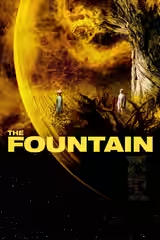
How does Noah compare to The Fountain?
Noah and The Fountain are both Darren Aronofsky films about one person and one fixed idea about eternity, the first on a studio budget and the second on a fraction of it. The Fountain is the more sincere and, at 96 minutes, the tighter of the two, though it is too short to earn everything it reaches for. Noah has the grander images and the longer stretches of tedium; choose it for spectacle, the earlier film for feeling.
What should I watch after Noah?
After Noah, try The Fountain (2006, Fi1m 66): Aronofsky chasing the same obsession with eternity, on a fraction of the money. Then The Tree of Life (2011, Fi1m 84): Malick does the creation of the universe at feature length and means every frame; and Aguirre, the Wrath of God (1972, Fi1m 91): One man, one river, one fixed idea, and Herzog watching it drown him.

Cast

If you liked this, try…

  1. The Fountain (2006, Fi1m 66)Aronofsky chasing the same obsession with eternity, on a fraction of the money.

  2. The Tree of Life (2011, Fi1m 84)Malick does the creation of the universe at feature length and means every frame.

  3. The Last Temptation of Christ (1988) · not on Fi1m yetScorsese takes scripture as seriously as Aronofsky and argues with it harder.

  4. Aguirre, the Wrath of God (1972, Fi1m 91)One man, one river, one fixed idea, and Herzog watching it drown him.

  5. Andrei Rublev (1966, Fi1m 86)Tarkovsky’s medieval Russia: faith, mud and a bell being cast, at patient length.