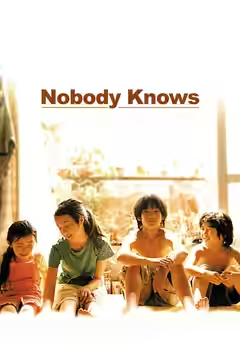
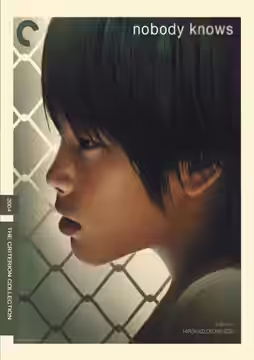
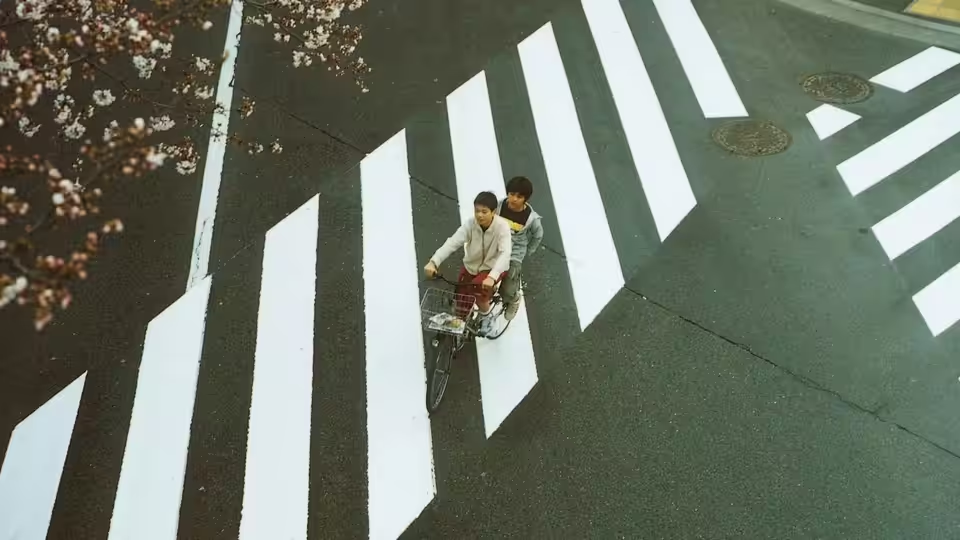
Two boys ride a bicycle across a zebra crossing beneath overhanging blossoms
Film review

Nobody Knows

2004 · Directed by Hirokazu Kore-eda · 2h 21m

In a sentenceThe mother leaves money and a note, and four children in a flat make both last far longer than they should have to

Keiko (YOU) moves into a small flat with her son Akira (Yūya Yagira) and lets it be understood that it is just the two of them. That night the younger children, Shigeru (Hiei Kimura) and Yuki (Momoko Shimizu), are brought in quietly, and their sister Kyoko (Ayu Kitaura) slips in separately. Over dinner Keiko sets the rules: no going out, no noise, no appearing on the balcony. Akira alone may leave the flat, to shop. Then Keiko goes away for work, leaving an envelope of cash and a note, and Akira is left to run a household of four children on what is in the envelope, and to decide how long to wait.

Fi1m review

Kore-eda’s film about four children left to themselves in a flat is patient, exact and the saddest thing about childhood we have seen in years. It is also twenty minutes too long. We recommend it without hesitation.

Keiko (YOU) moves into a flat with her son Akira (Yūya Yagira) and lets it be understood that it is just the two of them. That night Shigeru (Hiei Kimura) and Yuki (Momoko Shimizu) are brought in quietly; Kyoko (Ayu Kitaura) arrives on her own. The rules are explained over dinner: no school, no going outside, no noise. Then Keiko goes away for work, leaves Akira an envelope of cash and a note, and the film settles in to watch what four children do with a flat and a shrinking pile of money.

It is one of the best films about children we know, and it gets there by refusing to raise its voice. Hirokazu Kore-eda, who wrote, edited and produced as well as directed, has not written a single scene in which anyone says what the film is about. The children do not weep for the camera. Nobody shouts at the mother. The film records what is in the fridge, what is on the balcony and who is wearing whose shoes, and it trusts us to do the arithmetic.

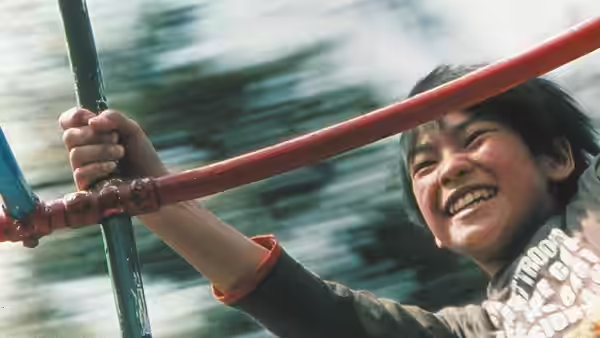
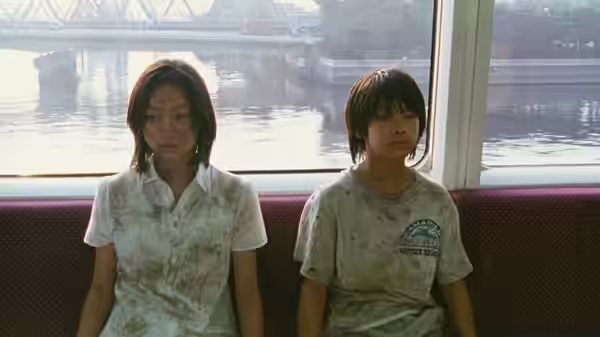
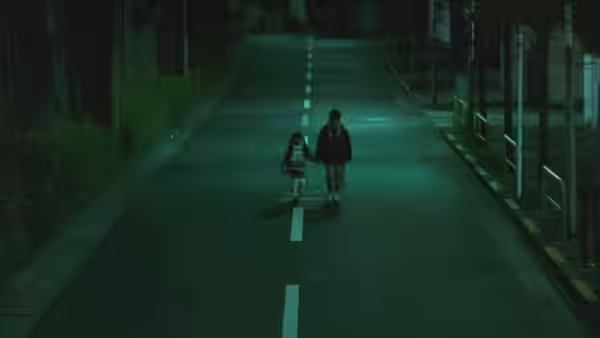
Yutaka Yamazaki shoots nearly everything handheld and close, at child height, and spends an unusual amount of time on hands and feet: Akira counting coins at a convenience store till, Yuki’s sandals that squeak with every step, nail varnish going on and chipping off. The production designers, Keiko Mitsumatsu and Toshihiro Isomi, let the flat change in front of us. It starts tidy and bright and ends with crayon on the walls, washing-up in the bath and a row of seedlings growing in instant-noodle pots on the balcony. Titi Matsumura’s music is mostly acoustic guitar, used sparingly, and it stays out of the flat for long stretches.

What moved us more than we expected was not any of the obvious things. It was those noodle pots. The children have brought seeds back from the park and planted them in rubbish, and the plants come up, and someone has to remember to water them. We also felt a steady anger, which the film never asks for, at YOU’s Keiko. She is played not as a monster but as a girl: a sing-song voice, a giggle, presents from the station kiosk, and one honest question to Akira about whether she is not allowed to be happy too. The performance is so light that it takes a while to notice how cold it is.

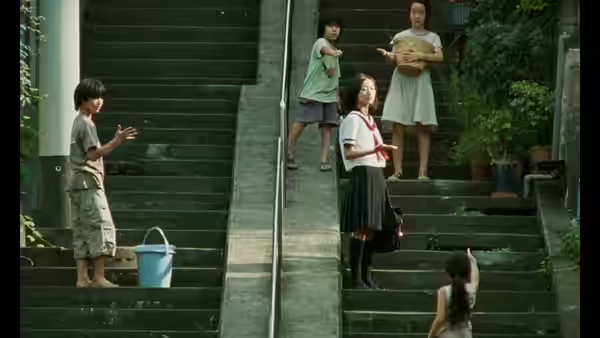
Yūya Yagira carries the film, and the shooting has plainly gone on long enough that we can watch him change; his face lengthens and his shoulders drop as the months pass. He is a boy who does the shopping, cooks, deals with the adults who come to the door, and still wants to play baseball with children his own age. Ayu Kitaura’s Kyoko, who wants a piano and settles for picking out notes on a toy one, is the quietest of the four and we think the saddest. Hanae Kan arrives midway as Saki, a schoolgirl who starts spending afternoons at the flat, and the scenes with her are the most conventionally written in the film.

It is 141 minutes and does not need to be. The middle hour, in which the money runs out and the seasons turn, repeats itself: another trip to the shop, another unpaid bill, another empty rice box. We think that is partly the point and partly a director editing his own footage and finding it hard to let any of it go. The second half takes a turn we will not describe, and the film’s handling of it, with the music up and the camera looking away, is the one place it reaches for an effect it had not needed before.

Kore-eda has made warmer films since, and busier ones. This is the barest, and it belongs alongside Loach’s Kes among films that simply watch a child the adults have given up on and wait to see what happens.

It is a 12 certificate. Nothing in it would frighten a child. Nearly all of it will frighten a parent.

Critical consensus AI synthesised

78
Positive
5
Mixed
2
Negative
0
IndieWire
28 January 2005 · Michael Koresky, with responses from Neal Block and Jeff Reichert
90*

The critics find the film emotionally overwhelming and remarkably complete, with Koresky especially praising its restraint. They single out the children’s naturalistic performances and the intimate, unshowy way Kore-eda captures their relationships.

Read the full review →
Empire
1 January 2000 · David Parkinson
85*

Parkinson gives the film a strongly positive verdict, praising Kore-eda’s restrained, naturalistic treatment of the children’s abandonment. He singles out the innocence and insight of its child’s-eye view of the adult world.

Read the full review →
The Guardian
5 November 2004 · Peter Bradshaw
80*

Bradshaw finds the film powerful, humane, and deeply moving. He singles out the remarkably fresh performances from the child actors for praise.

Read the full review →
Slant Magazine
14 January 2005 · ★★★/4 · Ed Gonzalez
75

Gonzalez praises the film as a serene, emotionally affecting meditation on familial togetherness. He singles out Yagira Yūya’s unsettling, complex performance and the film’s quietly devastating depiction of the children’s hardship.

Read the full review →
Screen Daily
26 May 2004 · Allan Hunter
64*

The review text is unavailable in the page extract, so its verdict cannot be established. No specific praise or criticism is visible.

Read the full review →
Time Out
· GA
64*

The page is identified as a review, but its text is unavailable, so the critic’s verdict cannot be determined. No specific praise or complaint is visible in the supplied page.

Read the full review →

Straight answers AI written, from our review

Is Nobody Knows worth watching?
Nobody Knows is worth watching for anyone who can sit with a quiet, patient drama about children left to fend for themselves, and we scored it 87. Kore-eda never raises his voice, and the film is twenty minutes longer than it needs to be, but it is one of the saddest and most exact films about childhood we know.
How long is Nobody Knows, and what is it rated?
Nobody Knows runs 2h 21m. It is a drama film.
Where can I watch Nobody Knows in Lithuania?
Nobody Knows is not on any streaming or rental service in Lithuania at the moment. It is available in 6 other countries; change your country at the top of the page to see where. Availability is checked daily.
How violent or frightening is Nobody Knows, and is it suitable for children?
Nobody Knows is a 12A in the UK, and nothing in it would frighten a child; there is no violence to speak of. What it contains is four children in a flat with a shrinking envelope of cash and a mother who has gone away, and the second half takes a turn we will not describe. It is parents who will find it hard to watch.
How does Nobody Knows compare to Shoplifters?
Nobody Knows is the barer and sadder of the two Kore-eda films, and the one we hold higher. Shoplifters is warmer and funnier, with a makeshift family that chooses each other, while here the children are simply left and the camera waits to see what happens. Start with Shoplifters if you want to be comforted; come to this one when you are ready.
What should I watch after Nobody Knows?
After Nobody Knows, try Shoplifters (2018, Fi1m 89): Kore-eda again, a makeshift family held together by theft and kindness in roughly equal measure. Then Ratcatcher (1999, Fi1m 88): Glasgow during the bin strike, a boy nobody is watching, and a canal that keeps calling; and The Florida Project (2017, Fi1m 88): Children running wild in a budget motel while the adults fail them in bright pastel colours.

Cast

Awards

International Submission to the Academy Awards, 2005

Nominated
International Submission to the Academy Awards

Hōchi Film Award for Best Picture, 2004

Won
Hōchi Film Award for Best Picture

If you liked this, try…

  1. Shoplifters (2018, Fi1m 89)Kore-eda again, a makeshift family held together by theft and kindness in roughly equal measure.

  2. Ratcatcher (1999, Fi1m 88)Glasgow during the bin strike, a boy nobody is watching, and a canal that keeps calling.

  3. The Florida Project (2017, Fi1m 88)Children running wild in a budget motel while the adults fail them in bright pastel colours.

  4. Children of Heaven (1997) · not reviewed yetA Tehran brother and sister share one pair of shoes; small stakes, enormous consequences.

  5. Pather Panchali (1955, Fi1m 93)Ray’s Bengali village childhood, poverty seen from knee height, patient and unsentimental.