Film review

Old School

2003 · Directed by Todd Phillips · 1h 32m · MPA R

In a sentenceWill Ferrell runs naked down a suburban street and the film spends the next eighty minutes trying to catch him up

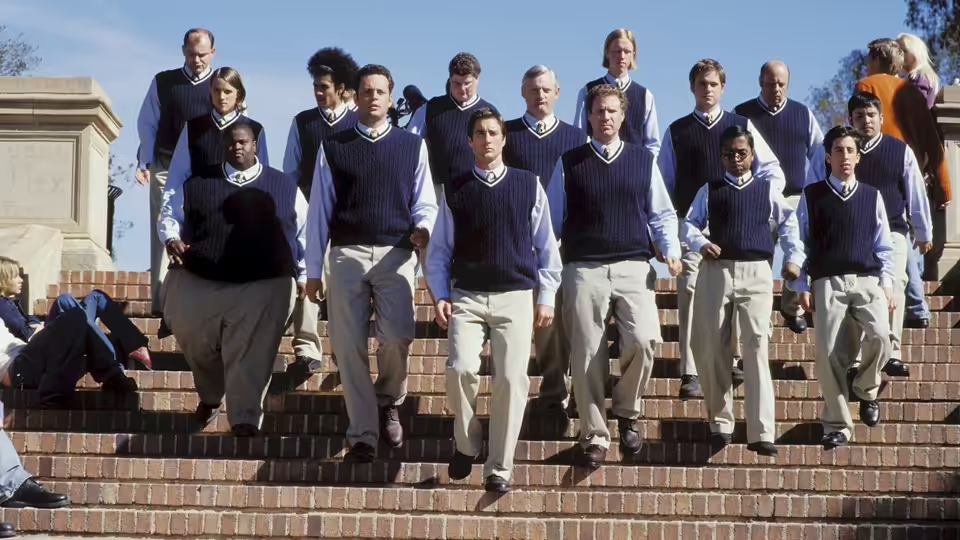
Mitch Martin (Luke Wilson) comes home early from a business trip to find his girlfriend Heidi (Juliette Lewis) blindfolded in the living room and a crowd of strangers she has invited. He moves out, into a rented house on the edge of a university campus. Frank Ricard (Will Ferrell) has just married Marissa (Perrey Reeves); Bernard “Beanie” Campbell (Vince Vaughn) has a wife, a small son and a chain of stereo shops, and misses being twenty. Beanie throws Mitch a party for the whole campus, Frank gets drunk and takes his clothes off, and by morning Mitch has two problems: Nicole (Ellen Pompeo), an old crush now going out with Mark (Craig Kilborn), and Dean Gordon Pritchard (Jeremy Piven), who remembers the three of them from school and has found a rule that says the house is for students only.

Plays from YouTube when you press play; nothing loads from them until then.

Fi1m review

Vince Vaughn talks and Will Ferrell takes his clothes off, and for long stretches that is enough. Todd Phillips has also written a plot about a dean and a zoning rule, and he cares about it no more than we do.

Todd Phillips wants Old School to be Animal House for men who have started to go bald. Mitch Martin (Luke Wilson) has been humiliated by his girlfriend and has rented a house on a campus. Frank Ricard (Will Ferrell) has been married about a week and already misses drinking. Beanie Campbell (Vince Vaughn) has a wife, a son and a business, and treats the house the way a lawyer treats a loophole. The script by Phillips and Scot Armstrong gets about forty minutes out of this before it has to find a plot, and the plot is where the film goes wrong.

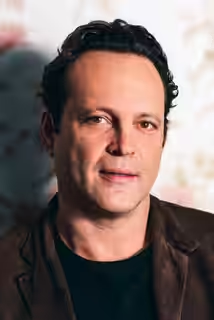
Vaughn is the reason it works when it works. He talks the way other actors run, in long flat bursts of salesman’s patter, and Beanie is a man who has never lost an argument because he has never stopped to have one. He covers his small son’s ears before swearing and says “earmuffs” first, and the film gets three good laughs out of the word alone. When Phillips lets him negotiate, with the dean, with his wife, with bored undergraduates, the film moves.

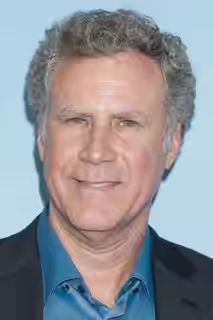
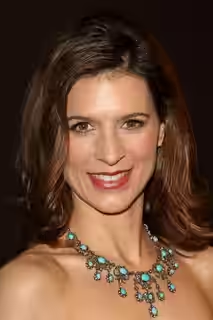
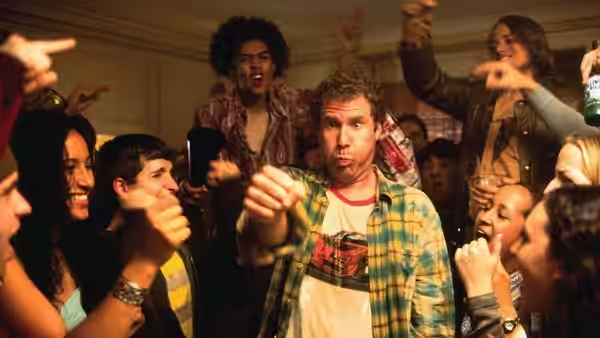
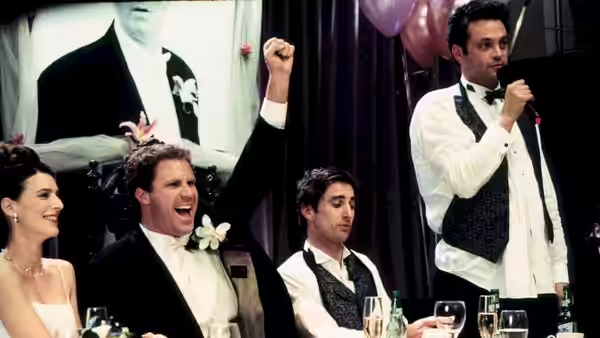
Ferrell has the scene everyone remembers. Frank, a few drinks into Mitch’s party, announces that everyone is going streaking, strips, and jogs off down the road with nobody behind him. We laughed out loud: the joke is not the nakedness but the pride on Ferrell’s face, and the several seconds it takes the pride to leave. He plays Frank as a large, gentle man who has been told to grow up and cannot see the point, and when Marissa (Perrey Reeves) finds out what he has done, the hurt on both faces is real. Wilson is the straight man and is given nothing but straightness.

Mark Irwin lights everything flat and bright, so the house, the campus and the dean’s office all look like the same television set; nothing is ugly and nothing is worth looking at twice. Clark Hunter’s production design fills the house with wood panelling, borrowed mattresses and a hot tub. Nancy Fisher puts Frank in tucked-in polo shirts and khakis, the uniform of a man who has surrendered. Michael Jablow cuts the film as a string of sketches: a scene runs until the joke lands and then we are somewhere else. Theodore Shapiro’s score is sparse and the film leans on pop songs instead, a fair decision for a comedy about men who peaked at nineteen.

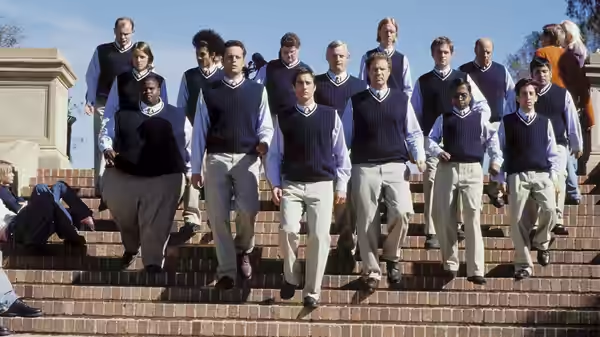
The plot is the trouble. Jeremy Piven’s Dean Pritchard wants the house back, and the film becomes a sequence of tests the new fraternity must pass, set pieces rather than a story. Piven plays him as a nasal whiner and nothing more. Ellen Pompeo’s Nicole is a prize to be won back from Craig Kilborn’s Mark. The taste problem arrives early: Mitch wakes up after the party next to Darcie (Elisha Cuthbert) and learns the next day that she is his boss’s daughter and still at school. Phillips plays this as a wince for Mitch. We did not laugh, and the film does not notice that it asked us to. The one who survives all this is Joseph “Blue” Pulaski (Patrick Cranshaw), an old man who pledges because nobody has ever asked him to join anything, and Cranshaw plays him with a sweetness the film around him lacks. The second half takes turns we will not describe.

Phillips made Road Trip three years earlier, and this is that film with better actors and the same nerve. Animal House came out in 1978 and did not care whether anyone approved of it; Old School cares a good deal, and by the last act has started apologising for its first. The reviews so far have been cooler than we are, and we can see why: as storytelling it barely holds together. But it runs 92 minutes, it has two clowns who know what they are doing, and it has more lines people still say to each other than most comedies manage in twice the time.

Watch it with someone who will say those lines along with it. Alone, you will notice how long the gaps between the jokes are.
Critical consensus AI synthesised

46
Positive
0
Mixed
5
Negative
6

The reviews are lukewarm at best and cool for the most part: not one critic recommends Old School outright, and most place it somewhere between harmless and unfunny. Most reviews measure it against Animal House and find it the tamer copy. Where praise exists, it lands on the two leads. Vince Vaughn is repeatedly picked out as the reliable source of laughs, and Will Ferrell’s compulsive nudist earns a grudging chuckle even from critics who dislike the rest.

The complaints cluster on structure. Several reviews find a promising first half that runs out of ideas, with sub-plots left hanging and an ending that backs away from the misbehaviour it has spent an hour celebrating; The AV Club adds that the editing leaves it feeling unfinished. The spread is narrow, from mild approval to flat dismissal, with Radio Times the warmest voice and Eye for Film the harshest, extending its objections to the leads themselves and calling Vaughn wasted.

Los Angeles Times
21 February 2003 · Manohla Dargis
60*

The critic notes that enjoyment depends on finding Will Ferrell's antics funny and praises the disconnect between what the male characters say and do for adding pathos. Vince Vaughn stands out as the ideal poster boy for the happily whipped.

Read the full review →
Radio Times
★★★ · Sloan Freer
60

This early romp from Todd Phillips is a spirit-lifting scream and a well-scripted frat-boy flick with a twist that is hard not to warm to. Vaughn and Ferrell are singled out as natural clowns whose combined chemistry elevates it beyond an Animal House carbon copy.

Read the full review →
Variety
12 February 2003 · Dennis Harvey
60*

The review describes it as a slickly made but unmemorable kinder, gentler Animal House that is less fresh than the director's prior Road Trip. It singles out the strong pacing and song choices as brighter spots amid mostly forced humor.

Read the full review →
Empire
1 January 2000 · William Thomas
55*

The film starts with promise in its first half through funny set-pieces and a look at male attitudes to ageing but quickly loses steam with underdeveloped sub-plots. It is redeemed somewhat by strong comic turns from Vince Vaughn and Will Ferrell but falls short of its Animal House ambitions, remaining a harmless and intermittently funny comedy.

Read the full review →
The Guardian
9 May 2003 · Peter Bradshaw
55*

The critic finds guaranteed deplorable taste in this frat-boy comedy about three sad thirty-somethings trying to relive college days. Vince Vaughn provides the laughs, but the rest is crass and broad with little else to recommend it.

Read the full review →
The New York Times
21 February 2003 · Elvis Mitchell
40*

The review calls the comedy sloppy and derivative of Animal House, lacking the original's refreshing bad taste. It singles out the director's self-plagiarism from his own Frat House documentary as a notable flaw.

Read the full review →

Cast

If you liked this, try…

Animal House poster

Animal House

1978 · The original fraternity riot, ruder and surer of itself than anything that copied it

Anchorman: The Legend of Ron Burgundy poster78

Anchorman: The Legend of Ron Burgundy

2004 · Ferrell given a whole film to be proud and wrong in, with a better script

Wedding Crashers poster

Wedding Crashers

2005 · Vaughn talking at full speed for two hours, which is the point of him

Withnail and I poster88

Withnail and I

1987 · Two men refusing to grow up in a cold flat; the British, bleaker version

Sink or Swim poster

Sink or Swim

2018 · Middle-aged Frenchmen take up synchronised swimming; the same ache, handled with more care