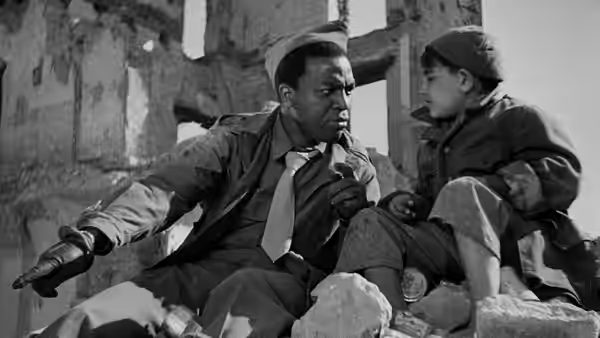
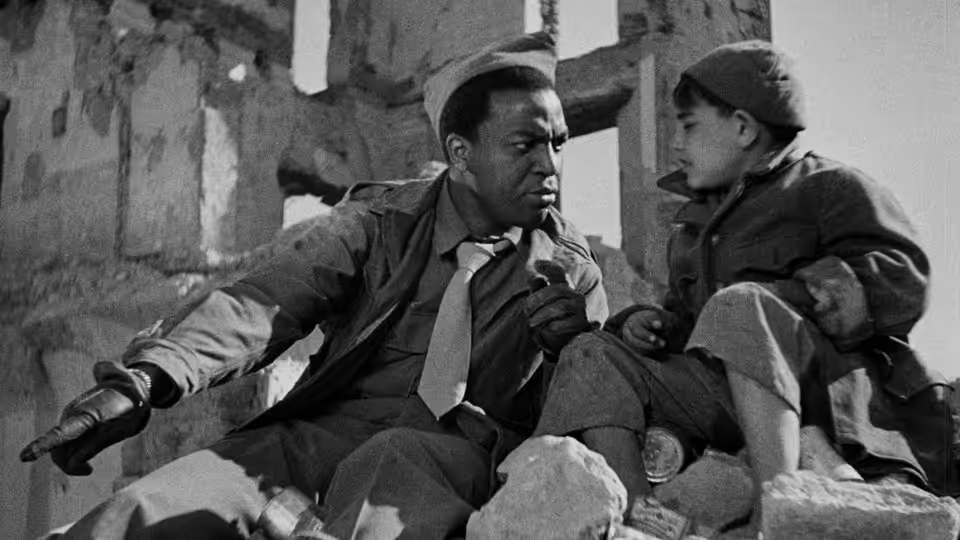
An American soldier and a young boy sit among rubble in a ruined city
Film review

Paisan

1946 · Directed by Roberto Rossellini · 2h 05m · IGAC M/12

In a sentenceThe ruined landscapes need no help; a few of the soldiers could use another rehearsal

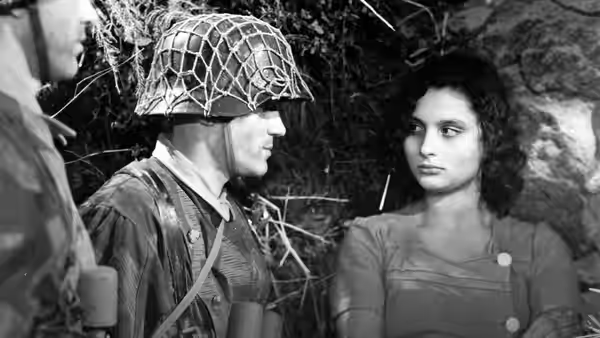
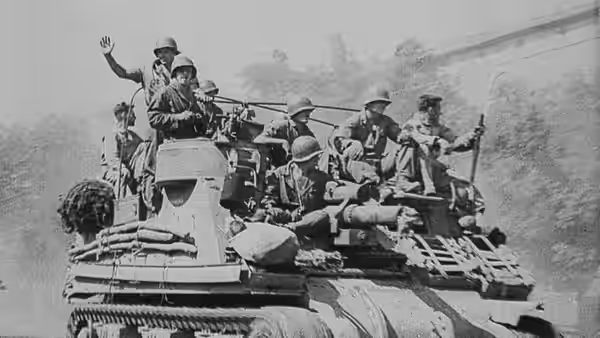
In wartime Italy, Carmela (Carmela Sazio), Joe (Robert Van Loon) and an American soldier (Benjamin Emanuel) are among the people in six separate stories. Other figures include an American MP (Dots Johnson), Pasquale (Alfonsino Pasca) and Francesca (Maria Michi), with American and German soldiers also in the cast. The account of the war moves from one group of people to another rather than following a single lead. These encounters take place amid ravaged landscapes, without the continuous heroic narrative of a conventional war film.

Plays from YouTube when you press play; nothing loads from them until then.

Fi1m review

Roberto Rossellini’s six-part war film is moving, demanding and worth the effort. Its damaged landscapes and fractured storytelling give it unusual force, though some awkward American performances briefly make the war feel like an amateur production.

Roberto Rossellini’s Paisan is a rewarding war film with a real cost in patience. Across six stories of wartime Italy, it repeatedly gives up the comfort of following people we have begun to know. That can be frustrating, particularly when a new episode takes time to establish its hold. But the broken-up storytelling allows for experiences that would struggle to fit into a single soldier’s progress through the fighting. We recommend it warmly, with fair warning that its acting does not always match the conviction of its direction.

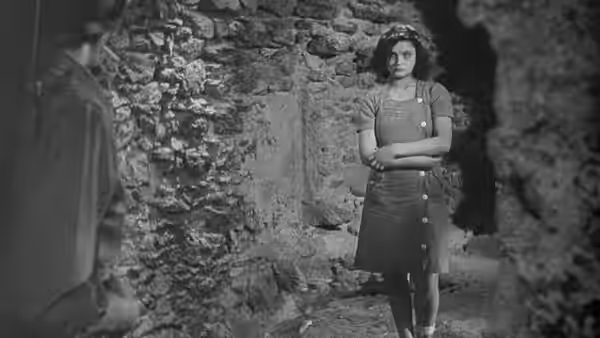
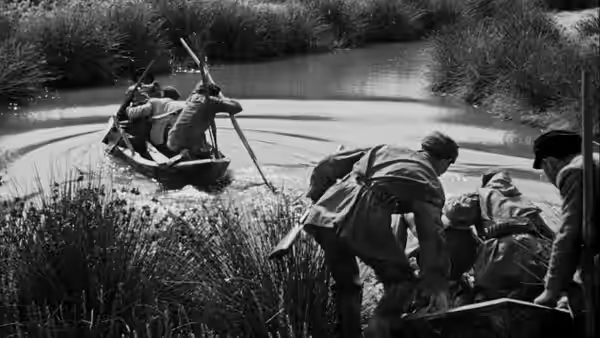
Otello Martelli’s cinematography gives us a strong reason to stay with it. The ravaged landscapes retain a beauty that does not make them reassuring, and the photography allows us to notice both their appeal and their damage. We were unsettled by that beauty, because it made us linger over places marked by suffering. The destruction remains visible however much we admire the image. This is where the film’s convincing sense of reality matters most: the surroundings demand attention even when we might prefer to concentrate on the people.

The performances are less dependable, and it would be indulgent to pretend otherwise. Roberto Rossellini brings professional and non-professional actors together with considerable sensitivity, but some of the American acting is awkward enough to interrupt our attention. At those points we become conscious of people trying to get through a scene, which is a serious problem for a film so dependent on our belief. Naturalness cannot simply be assumed because a performer lacks polish. Even so, the unevenness does not destroy the wider impression of ordinary lives caught in war.

Eraldo Da Roma’s editing has the difficult job of making separate stories belong to the same film without disguising their breaks. The changes ask us to adjust repeatedly, and the cutting does not make that process entirely comfortable. Attachment has to be built again, and not every section earns it equally quickly. Over 125 minutes, the repeated fresh starts can become tiring, especially when a performance makes the business of getting acquainted harder. We would keep those breaks, though some of the passages around them could use tightening.

Renzo Rossellini’s music makes less of an impression than the photography, though that says more about the strength of the images than any failure of the score. Our attention keeps returning to the damaged places and the people within them. Against the familiar pleasures of a war film, the lack of a sustained heroic story can seem almost wilfully unhelpful. It also prevents us from settling into the easy expectation that one person’s courage will explain what the fighting means for everyone else.

What makes the film worth its demands is Roberto Rossellini’s care for people whose experiences do not readily make a satisfying evening’s drama. We need not call every rough passage a virtue to recognise how much that care achieves. The awkward acting remains awkward, and viewers who need a firm attachment to one protagonist may find the changes exhausting. For us, the attention given to those different lives more than repays the effort. Choose it when there is time to give each new story a fair hearing.
Critical consensus AI synthesised

74
Positive
3
Mixed
1
Negative
0
Time Out
15 March 2012
80*

The available description presents the film as remarkable and wholly authentic. It singles out the six vignettes of wartime life in Italy.

Read the full review →
Variety
31 December 1945 · Variety Staff
80*

The review is strongly positive about Rossellini’s ability to create a convincing sense of reality. It singles out his sensitive direction and the seamless blend of professional and non-professional actors.

Read the full review →
Los Angeles Times
31 January 2010 · Sam Adams
70*

Adams regards Paisan as a radical, less audience-friendly work whose fractured stories abandon heroic narrative. He praises the ravaged landscapes’ beauty, while noting that some American actors are painfully amateurish.

Read the full review →
The New York Times
30 March 1948 · Bosley Crowther
64*

The article appears to review Paisan alongside other new openings, but its verdict cannot be verified from the accessible page. The page provides no readable text identifying what the critic praised or criticized.

Read the full review →

Straight answers AI written, from our review

Is Paisan worth watching?
Paisan is worth watching for its moving attention to ordinary lives in wartime Italy, and we score it 84 out of 100. We recommend it to viewers willing to give six separate stories time to take hold, though the repeated fresh starts demand patience and some awkward American performances interrupt its convincing sense of reality.
How long is Paisan, and what is it rated?
Paisan runs 2h 05m and is rated M/12 by the IGAC in Portugal. It is a drama and war film.
Where can I watch Paisan in Portugal?
Paisan is not on any streaming or rental service in Portugal at the moment. It is available in 6 other countries; change your country at the top of the page to see where. Availability is checked daily.
How violent or frightening is Paisan, and is it suitable for children?
Paisan has no UK or US certificate supplied here, and we would not assume it is suitable for children. Its ravaged landscapes and attention to wartime suffering are unsettling, but we cannot give a precise account of graphic violence from the available detail. We recommend caution for younger or sensitive viewers rather than treating the missing certificate as reassurance.
How does Paisan compare to Rome, Open City?
Paisan offers six separate wartime encounters, while Rome, Open City makes its suffering felt through people whose company we enjoy. We favour Rome, Open City for viewers seeking that warmth and attachment, despite its overinsistent villains and music; Paisan suits those willing to accept uneven acting and repeated fresh starts for a broader range of ordinary wartime lives.
What should I watch after Paisan?
After Paisan, try Rome Open City (1945, Fi1m 89): For another war film that gives civilians their full share of attention. Then The Battle of Algiers (1966, Fi1m 93): For street-level conflict filmed with the urgency of events still unfolding.

Cast

Awards

Academy Awards, 1950

Nominated
Best Writing, Original Screenplay

If you liked this, try…

  1. Rome Open City (1945, Fi1m 89)For another war film that gives civilians their full share of attention.

  2. The Burmese Harp (1956) · not on Fi1m yetFor a quieter examination of what soldiers owe the dead.

  3. The Battle of Algiers (1966, Fi1m 93)For street-level conflict filmed with the urgency of events still unfolding.

  4. The Ascent (1977) · not on Fi1m yetFor wartime moral choices made painfully concrete through faces and landscape.

  5. The Train (1964) · not on Fi1m yetFor a more conventional thriller equally attentive to war’s physical damage.

Paisan (1946) review: moving war stories with uneven acting (Portugal) | Fi1m