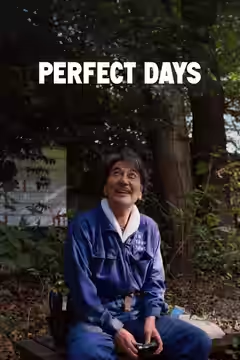
Perfect Days poster

Perfect Days

2023 · Directed by Wim Wenders
2h 04mDramaPG
83
Fi1m score
82
Critics · 17
Audience · not yet

Where to watch in the UK

Checked 10 September at 22:29. Prices and availability change; the service’s page is the last word.

Plays from YouTube when you press play; nothing loads from them until then.

Synopsis

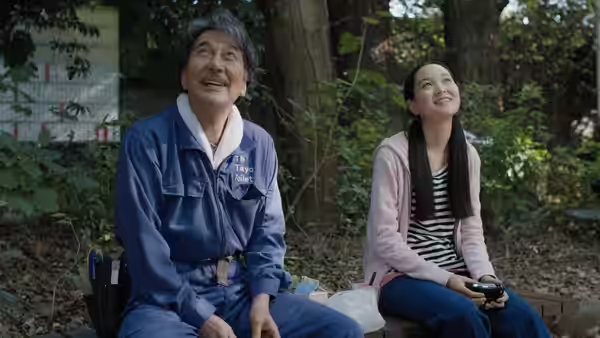
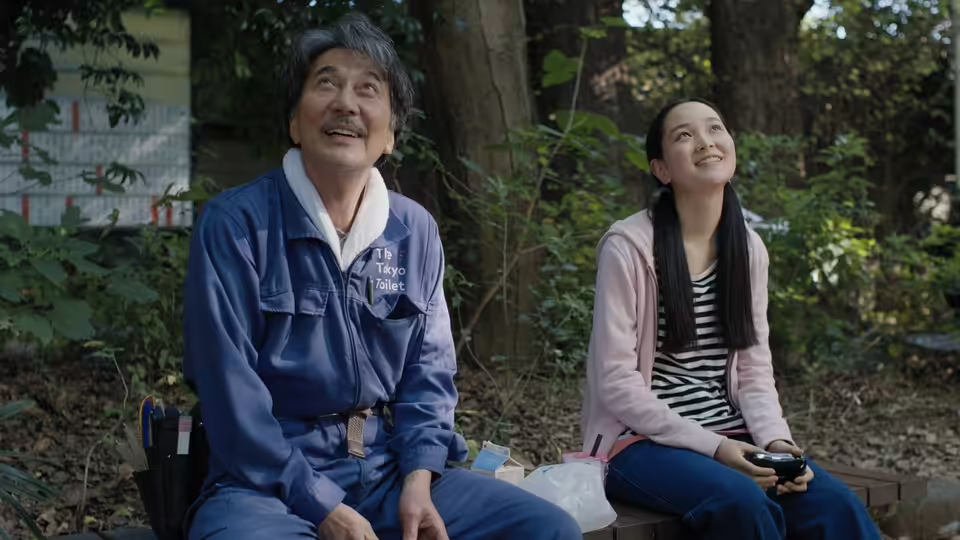
Hirayama (Koji Yakusho) cleans public lavatories in Tokyo. He wakes before dawn to the sound of a neighbour sweeping the street, waters the seedlings on his windowsill, buys a can of coffee from the machine outside his door and drives his small van across the city, playing cassettes of old American and British rock. He works alone, or as good as; his young colleague Takashi (Tokio Emoto) turns up late and talks about a girl called Aya (Aoi Yamada). At lunch Hirayama photographs the light through the trees with a film camera. In the evening there is the bathhouse, a bar where Mama (Sayuri Ishikawa) sings, and a paperback in bed.

Fi1m review

In a sentenceWenders finds enlightenment in a Tokyo public lavatory and, slightly to our annoyance, so did we

Wim Wenders follows a Tokyo toilet cleaner through a week of near-identical days and, thanks to Koji Yakusho’s almost wordless performance, makes the repetition hold. It is the best fiction film Wenders has made in years, and a little too fond of its hero’s calm.

Wim Wenders has been to Tokyo before: Tokyo-Ga, in 1985, was a documentary in which he went looking for the city Yasujiro Ozu had filmed and mostly failed to find it. Perfect Days is what happens when he stops looking and sits still. Hirayama (Koji Yakusho) cleans public lavatories. Wenders and his co-writer Takuma Takasaki watch him do it, day after day, for 124 minutes, and the bet is that a routine shown carefully enough becomes a life. It mostly pays off.

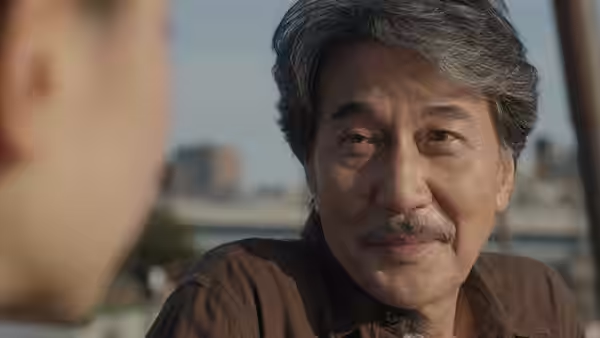
Yakusho says almost nothing. What he has instead is a face that notices things and does not say so: the nod to a child lost in a park, the mirror on a stick he uses to check under a rim, the way he stops with a can of coffee halfway to his mouth because the sky has done something. The film’s whole case, that a man scrubbing lavatories can be at peace and deserve two hours of our attention, rests on him, and he carries it without ever appearing to know he is carrying anything.

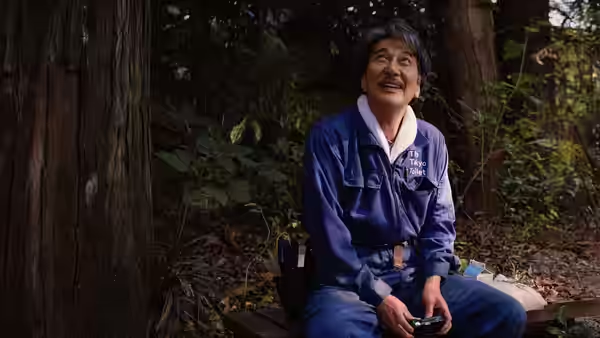
Franz Lustig shoots in a squarish 4:3 frame, which keeps the city out of the way and Hirayama’s face in the centre of it, and he shoots the mornings in the thin grey light before the sun has decided. The lavatories themselves, glass and cedar and concrete, each one different, are the only extravagance in the film. Towako Kuwajima’s production design keeps Hirayama’s flat down to a futon, a shelf of cassettes, a shelf of paperbacks and seedlings in a window. Daisuke Iga puts him in blue overalls with THE TOKYO TOILET across the back.

Toni Froschhammer’s editing is the quiet cleverness here. The day repeats, but each repeat is trimmed, so by the fourth morning we know the order of things and are allowed to skip ahead, and any change, a phone call at the wrong hour, a colleague who does not appear, lands like an alarm. That is how the film got us: we had settled into the pattern without noticing, and when it first broke we were more put out than a missed shift should make anyone. There is no composer. The songs Hirayama plays in the van do the work, Lou Reed’s “Perfect Day” among them, and Wenders lets each one run long enough that we hear it the way Hirayama does.

What works less well is the young colleague, Takashi (Tokio Emoto), who is late, broke and lovesick, and played at a pitch the rest of the film does not share. Aoi Yamada, as the girl he is chasing, gets one scene in the van with a cassette that is worth more than all of his. The dialogue, when it finally arrives, has a habit of sounding like a card in a gift shop; a line about now being now is repeated as if it were wisdom. And the film’s argument that a poor man can be content is softened by things it tells us about Hirayama in the second half, which we will not describe, except to say that they make his life look less like a fate and more like a decision, and a decision is a smaller thing to celebrate.

Wenders’s best fiction films, Paris, Texas in 1984 and Wings of Desire in 1987, were about men standing slightly outside their own lives and watching. This is the closest he has come to them in a long time. The debt to Ozu is paid openly: the low camera, the trains, the relative who arrives unannounced and stays, and nobody saying out loud what they feel about it.

What moved us most was the lunch hour. Hirayama sits under the same trees each day and photographs the light through the leaves with a small film camera, and we had not expected to care about a man photographing leaves. We did, because Lustig shows us the light as Hirayama sees it and Yakusho’s face tells us it is the reason he gets up.

It is a PG, and there is nothing in it a child could not see. Whether a child would sit through it is another matter. Watch it on a weekday evening when you have nowhere to be, and do not check the time; Hirayama would not.

Critical consensus AI synthesised

82
Positive
16
Mixed
1
Negative
0

The reviews for Perfect Days are close to unanimous, and the praise settles in two places. The first is Koji Yakusho, whose near-wordless performance as Hirayama, a Tokyo toilet cleaner at peace with his routine, is called restrained, soulful and rich in interior life by almost every critic who writes about it. The second is Wim Wenders himself, with most critics naming this his strongest fiction film in decades, several noting the debt to Ozu and the care with which Tokyo’s streets, trees and shadows are photographed. Reservations are few and mild. Time Out finds it warm but a rung below the director’s best work. The Playlist thinks the class commentary is underdeveloped, The Skinny detects some cutesiness in the script, and Paste feels the tranquillity tips into syrup. Nobody dislikes it; the spread runs from good to excellent, with nearly everyone in the upper half.

Sight and Sound
22 February 2024
90*

Wim Wenders captures the beauty of the everyday in his best fiction film since Wings of Desire. The delicate, meditative film adapts the director’s documentary approach to a fictional subject centered on a Tokyo toilet cleaner's quiet routine.

Read the full review →
Empire
19 February 2024 · Alex Godfrey
85*

The film tenderly explores how routine can bring bliss and comfort to a solitary Tokyo toilet cleaner. It praises the lead performance for its nuance and the film's serene, meditative quality as a rare soul-cleansing experience.

Read the full review →
Los Angeles Times
8 February 2024 · Robert Abele
85*

The review describes the film as a beautifully observed paean to caretaking, led by Koji Yakusho's sublime performance as a solitary man at peace with his routine existence cleaning public toilets. It singles out the exquisite pleasure of the near-silent lead performance and the film's hard-won wisdom of acceptance.

Read the full review →
Vulture
2 February 2024 · festival review · Bilge Ebiri
85*

The film feels like a lifelong Wenders dream realized, the best he has made in years, with Yakusho's face and Tokyo's architecture captured with rare sensitivity. It finds profound humanity in the humdrum details of one man's contented routine.

Read the full review →
The AV Club
7 February 2024 · B+ · Murtada Elfadl
83

Wenders achieves a sweet and simple return to form with this patient, observational portrait of a Tokyo janitor whose routine reveals wonder in ordinary moments. Yakusho's subtle, compelling performance anchors the film's appreciation of small joys and human connection.

Read the full review →
Little White Lies
22 February 2024 · 3/4/4 · Hannah Strong
80

Wim Wenders’ gentle character study features a beautifully restrained performance from Kôji Yakusho as a toilet cleaner who lives a simple life in Tokyo. The film’s profound simplicity and poetic balance are highlighted, with Yakusho conveying everything through subtle glances and movements.

Read the full review →

Cast

Stills

Awards

Academy Awards, 2024

Nominated
Best International Feature Film

International Submission to the Academy Awards, 2024

Nominated
International Submission to the Academy Awards

Cannes Film Festival, 2023

Nominated
Palme d'Or

If you liked this, try…

Paterson poster

Paterson

2016 · A New Jersey bus driver writes poems and repeats his week; Jarmusch’s gentlest film.

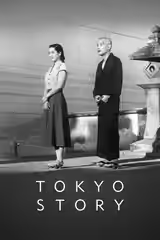
Tokyo Story poster

Tokyo Story

1953 · Ozu’s parents visit their grown children; the film Wenders has been chasing for forty years.

Wings of Desire poster

Wings of Desire

1987 · Wenders’s angels over Berlin, watching and taking notes; the same patience, a bigger canvas.

Jeanne Dielman, 23 quai du Commerce, 1080 Bruxelles poster

Jeanne Dielman, 23 quai du Commerce, 1080 Bruxelles

1975 · Akerman’s three hours of a widow’s routine, and what happens when it slips.

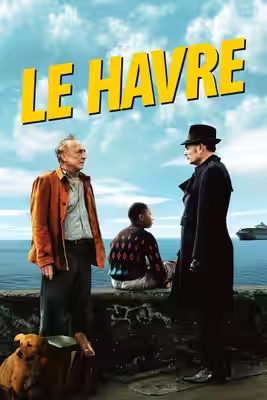
Le Havre poster

Le Havre

2011 · Kaurismäki’s shoeshine man helps a boy hide; deadpan, kind and quietly stubborn.