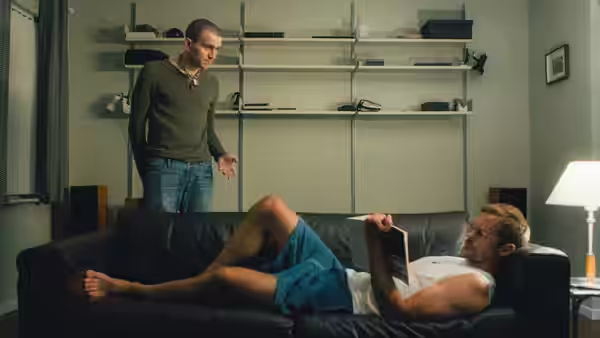
Harry Melling makes Pillion a funny, tender romance about the risks of wanting to please. Harry Lighton treats its BDSM relationship with care, though the narrow attention to its central couple sometimes leaves too little to discover.
Pillion takes the familiar business of wanting someone more than they seem to want us and gives it a frank sexual setting. Harry Lighton, writing and directing, finds room for comedy without treating a submissive relationship as a joke. We recommend it for the care it takes with Colin’s pleasure and uncertainty, and for Harry Melling’s unusually open performance. Its limitation is the tightness of its focus: the central couple absorb so much attention that the romance sometimes feels short of somewhere else to go.
Colin (Harry Melling) is the reason that narrowness remains bearable. Harry Melling lets the need to be liked show, without making Colin seem incapable of knowing his own desires. We were more unsettled than we expected by his eagerness to please Ray: the performance makes it hard to tell how much reassurance will ever be enough. That unease gives the sexual frankness a purpose beyond provocation, and keeps our attention on what Colin hopes the relationship will give him.
Alexander Skarsgård plays Ray with a reserve that makes a useful contrast to all this exposed feeling. His comic restraint helps: he leaves space for us to recognise the awkwardness without obligingly pointing it out. The attraction between the actors is persuasive enough to explain why Colin might accept an arrangement that cannot answer every need. Crucially, the film allows submission to be something Colin wants, while still asking whether this particular relationship gives him enough affection.
The family scenes provide welcome company beyond the central pair. Lesley Sharp brings spirit to Peggy, whose illness receives attention without swallowing the character. There is warmth in Colin’s scenes with his father, too, and these encounters make his need for connection easier to understand. The treatment of the BDSM biker community is similarly humane, allowing its members the ordinary consideration that films can forget to extend to people whose sex lives might startle an audience.
Nick Morris is the cinematographer, with production design by Francesca Massariol; Gareth C. Scales edits and Oliver Coates provides the music. Their contributions serve a film whose sexual frankness never requires its characters to become exhibits. The most effective changes of mood nevertheless come through the performers, particularly the contrast between Colin’s openness and Ray’s reticence. Harry Lighton’s handling of comedy leaves Colin his dignity, which matters more than extracting every possible laugh from his uncertainty.
The narrow focus becomes a problem when the relationship has to carry nearly everything. Harry Lighton’s close attention to Colin can leave the surrounding life underdeveloped, and the imbalance sometimes tells us little we have not already understood. A romance needs some uncertainty about the other person, but Ray’s reserve occasionally becomes a limit on what there is to watch. A little more curiosity about the people around the couple would have helped. The performances sustain our interest through these stretches, though they cannot supply everything the writing leaves out.
For a shared evening, the important warning is the film’s sexual explicitness. The 18 certificate deserves attention before its warmth encourages anyone to make it a casual choice for mixed company. Nor should that warmth be mistaken for a promise of uncomplicated reassurance about being loved. See it with someone willing to talk about what Colin wants, rather than someone waiting to have his desires explained away.