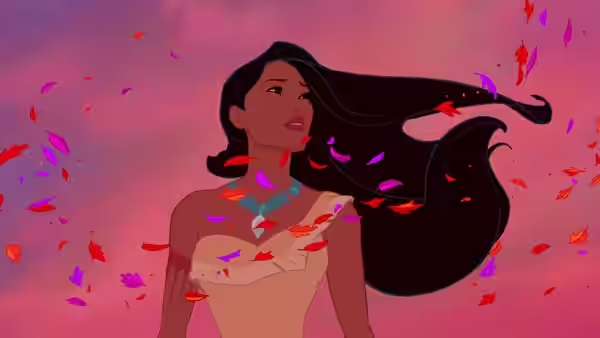
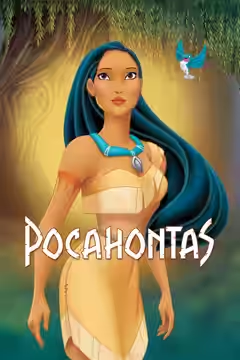
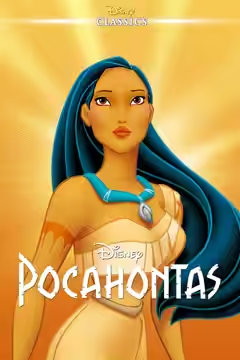
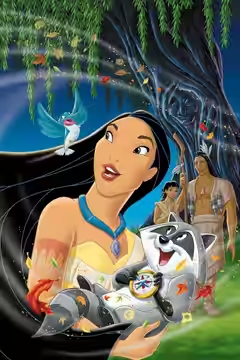
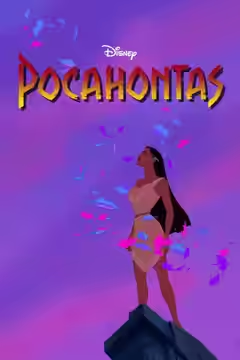
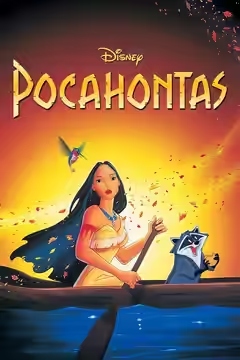
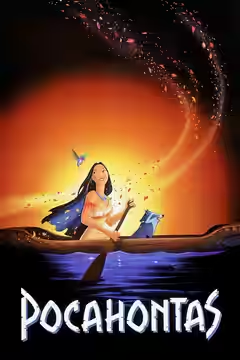
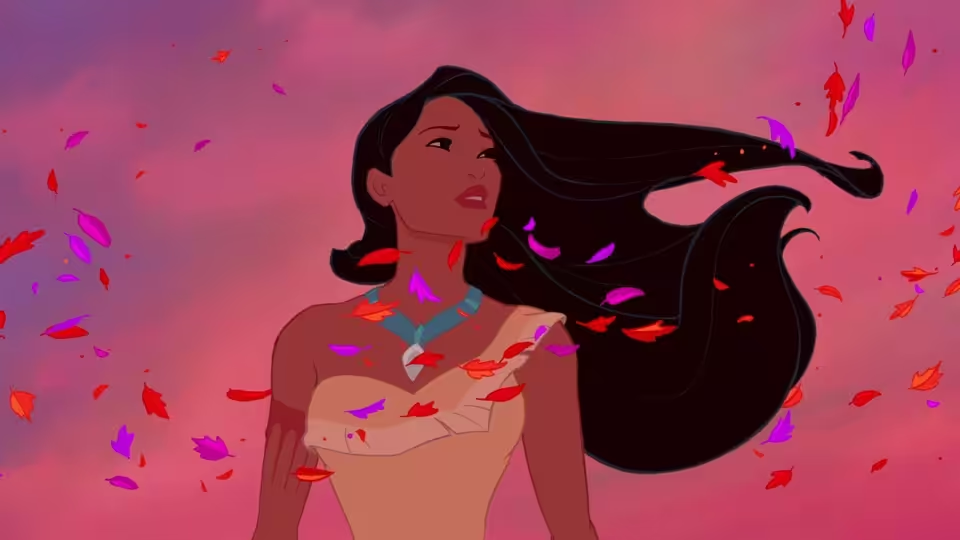
Pocahontas standing amid swirling red and purple petals under a pink sky
Film review

Pocahontas

1995 · Directed by Mike Gabriel, Eric Goldberg · 1h 21m

In a sentenceEighty-one minutes of handsome scenery and a love story that happens in about three conversations

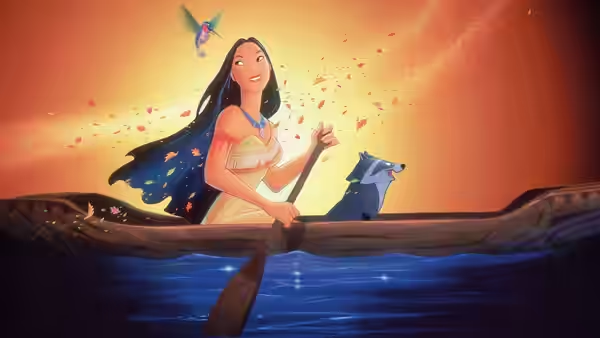
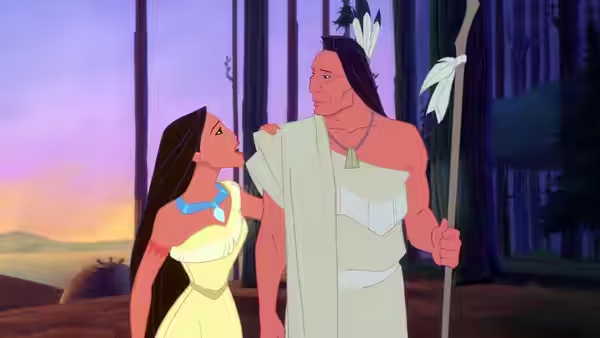
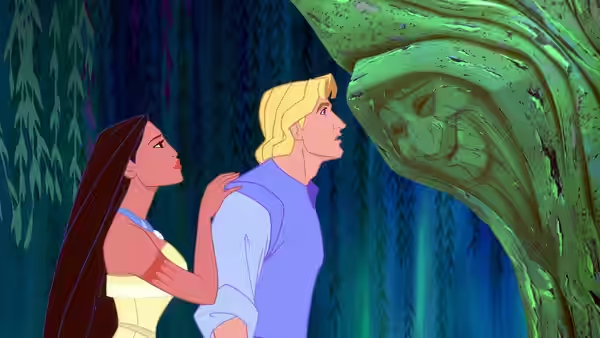
London, 1607. The Virginia Company sails for the New World under Governor Ratcliffe (David Ogden Stiers), who wants gold, with Captain John Smith (Mel Gibson) aboard. A storm nearly drowns young Thomas (Christian Bale); Smith hauls him back. In Virginia, Pocahontas (Irene Bedard), daughter of Chief Powhatan (Russell Means), is told she is to marry a warrior and would rather not. She has been dreaming of a spinning arrow, and takes the question to Grandmother Willow (Linda Hunt), a tree that talks, with a raccoon called Meeko and a hummingbird called Flit in tow. Then white sails appear in the bay, the settlers start digging, and Pocahontas follows a stranger through the woods to a waterfall.

Fi1m review

Disney’s most handsome film of the decade and one of its least alive. The forests, rivers and one great song are worth seeing; the romance, the villain and the history are thin, and it is over before it has started.

Pocahontas was the first Disney animated feature built on people who actually lived, and the studio treated it like a public monument. Directors Mike Gabriel and Eric Goldberg give the Virginia of 1607 tall straight trunks, flat planes of green and gold, and a heroine drawn in the long lines of a fashion plate, while the English settlers are short, round and dirty. The script, by Carl Binder, Susannah Grant and Philip LaZebnik, wants a love story that stops a war, and it wants to be careful with the history. It gets the look. It does not get much of a story, and at 81 minutes it barely has time to try.

The forest is the best thing in it. Mist sits on the river, leaves come off the trees in spirals, and the wide shots are held long enough for us to enjoy the geometry. The ‘Colors of the Wind’ sequence, in which Pocahontas pulls John Smith through the woods while an eagle turns overhead, is the one stretch where the drawing, Alan Menken’s tune and what the film wants to say are all the same thing. Judy Kuhn sings it plainly and without a wobble. We were lifted by it, more than we expected to be by a film we had sat down to with our arms folded. Then it ends, the plot has to come back, and there is not much of one waiting.

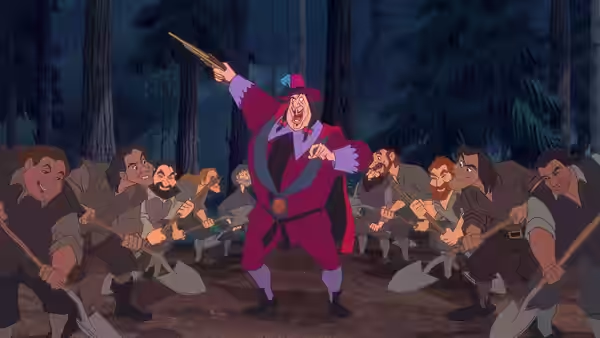
The other songs do their jobs and no more. ‘Just Around the Riverbend’ gets Pocahontas into a canoe and over a waterfall; ‘Mine, Mine, Mine’ has the settlers tearing up the ground while Ratcliffe dreams of gold. ‘Savages’, late on, gives both sides the same word to shout at each other, and it made us uncomfortable. Having the invaded and the invaders sing identical verses is not fairness, though the film plainly believes it is. Menken’s score underneath is slow and stately, flutes and long chords, and H. Lee Peterson cuts the songs well and the scenes between them as if they were in the way.

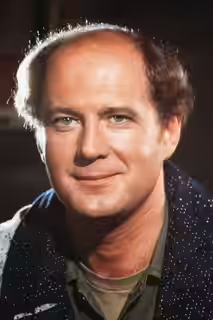
Irene Bedard speaks Pocahontas with a stillness the drawing suits, and Russell Means gives Powhatan a low, unhurried authority the film could have used more of. Mel Gibson’s John Smith is a pleasant blank with good hair. David Ogden Stiers plays Governor Ratcliffe as a fop in purple with a pug called Percy (Danny Mann), and he is neither frightening nor funny; he wants gold, he says so, and that is the character. Billy Connolly and Joe Baker, as the sailors Ben and Lon, get the few decent lines the settlers are allowed, and Christian Bale’s Thomas is the one Englishman written with a change in him.

The animals carry the comedy, and it is telling that they do not speak. Meeko the raccoon (John Kassir) steals biscuits and torments the pug; Flit the hummingbird (Frank Welker) disapproves of everything. Their business is drawn with a snap the rest of the film lacks, and a small child will follow them happily while the adults on screen stand still and look at the horizon.

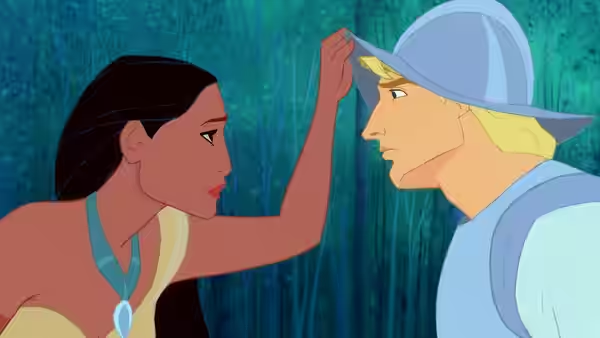
Which brings us to the romance. Pocahontas and Smith meet at a waterfall, talk twice, and are by then in love enough to change the course of two nations. The story credits run to twelve names, with three more on the script, and that many hands produced a film in which a colonial landing is a misunderstanding two attractive people can clear up between them. Nobody wants anything for long. The settlers dig, the warriors wait, Ratcliffe fumes, and the film cuts back to the trees.

Set beside Beauty and the Beast, Aladdin and The Lion King, this is the handsomest of the four and the one with the least going on. Goldberg drew the Genie in Aladdin; here he is co-directing a film that would not know what to do with a joke that size. The seriousness is real, and so is the care in the backgrounds. What is missing is any sense that the people in front of them are in trouble.

Show it to a child for the forest and the song, and be ready to say afterwards that it did not happen like this. The U certificate is fair. For an adult it is over before the kettle has boiled, which most will take as a mercy.

Critical consensus AI synthesised

50
Positive
1
Mixed
3
Negative
4

The reviews split almost evenly, and the critics’ score lands in the middle as a result. Where they agree is on the look of the film: the animation is praised in nearly every review, with the wide, coloured landscapes singled out even by critics who care for little else. Variety goes furthest, calling it a terrific film while conceding it may not appeal to everyone, and several note that children will be happy enough.

The reservations gather around the songs, which most critics find bland or forgettable, and the ending, which more than one calls half-hearted. The history troubles several: Radio Times finds it flimsy, Empire calls it distorted, and Slant, writing a decade later, objects to its condescending handling of Native American life. Empire is the harshest, naming it the dullest Disney animation in years. The spread is wide, from warm approval to dismissal, with the mixed verdicts leaning towards disappointment: pretty to look at, thin underneath.

Variety
12 June 1995 · Jeremy Gerard
80*

Gerard calls it a terrific movie, though he notes it may lack universal appeal. He praises its vivid animation and the appeal of Pocahontas and John Smith.

Read the full review →
RogerEbert.com
64*

The page did not load, so the critic’s verdict cannot be determined. No praise or complaint from the review was accessible.

Read the full review →
The New York Times
23 June 1995 · Janet Maslin
64*

The page identifies this as a film review, but its text is inaccessible. The available information does not disclose the critic’s verdict or specific praise.

Read the full review →
Radio Times
★★★ · Tom Hutchinson
60

Hutchinson finds the animation visually stunning but the history flimsy. He praises the film’s ecological and romantic messages, while calling its villain excessively over-the-top.

Read the full review →
Los Angeles Times
16 June 1995 · Kenneth Turan
40*

Turan finds the film formulaic and less inspired than its Disney predecessors, though likely to delight children. He praises its gorgeous animation and sweeping, colorful vistas, while faulting its bland songs and half-hearted ending.

Read the full review →
Slant Magazine
23 April 2005 · ★½/4 · Ed Gonzalez
38

Gonzalez gives the film a sharply negative review, criticizing its condescending treatment of Native American life and folklore. He singles out Meeko as an appealing character amid the film’s romance and dialogue.

Read the full review →

Straight answers AI written, from our review

Is Pocahontas worth watching?
Pocahontas is worth watching for its forests and for the ‘Colors of the Wind’ sequence, and not for much else; we scored it 54. The romance happens in about three conversations, the villain is neither frightening nor funny, and the history is thin. Show it to a small child for the scenery and the raccoon, and be ready to explain afterwards that it did not happen like this.
How long is Pocahontas, and what is it rated?
Pocahontas runs 1h 21m. It is an adventure and animation film.
Where can I watch Pocahontas in Ecuador?
Pocahontas is streaming on Disney+ in Ecuador. Availability is checked daily; the links above go straight to each service.
How does Pocahontas compare to Princess Mononoke?
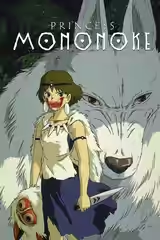
Pocahontas is the handsomer and slighter of the two, and Princess Mononoke is the better film. Both set a forest against people who want to dig it up, but Miyazaki gives every side enough sympathy that the destruction hurts, while Disney settles the matter with two attractive people talking at a waterfall. Choose Pocahontas for a young child and a short evening; choose Princess Mononoke for anyone older who wants the argument made properly.
What should I watch after Pocahontas?
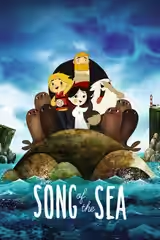
After Pocahontas, try Princess Mononoke (1997, Fi1m 88): Forest gods against an iron works; the argument this film only waves at, made properly. Then Song of the Sea (2014, Fi1m 82): Irish animation in flat planes and folklore, with the restraint Disney could not manage.

Cast

Awards

Academy Awards, 1996

Won
Best Original Musical or Comedy Score

Annie Award for Best Animated Feature, 1995

Won
Annie Award for Best Animated Feature

If you liked this, try…

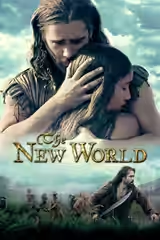
  1. The New World (2005) · not on Fi1m yetTerrence Malick’s telling of the same meeting, slow, adult and full of weather.

  2. Princess Mononoke (1997, Fi1m 88)Forest gods against an iron works; the argument this film only waves at, made properly.

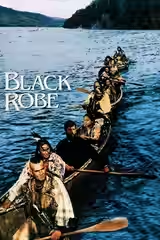
  3. Black Robe (1991) · not on Fi1m yetA Jesuit in seventeenth-century Canada; what first contact actually cost, without songs.

  4. Smoke Signals (1998) · not on Fi1m yetA Native American road comedy told from the inside, funny where this is solemn.

  5. Song of the Sea (2014, Fi1m 82)Irish animation in flat planes and folklore, with the restraint Disney could not manage.