Jack Rosenthal’s script about a boy, a girl and the cricket commentary in his head is small, funny and more tender than it lets on. It was made for television and it looks like it, which matters less than one of the two reviews so far thinks.
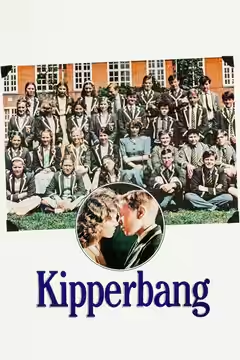
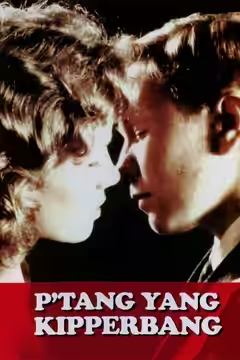
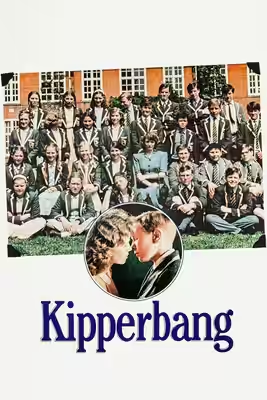
P’tang, Yang, Kipperbang runs 77 minutes and wants almost nothing from you. A boy wants to kiss a girl. A teacher wants the groundsman. The war has been over for three years and nobody has quite worked out what to do with the peace. Jack Rosenthal writes it and Michael Apted directs it, and between them they have made something modest, exact and funny, with a sadness underneath that we did not expect and that stayed with us afterwards.
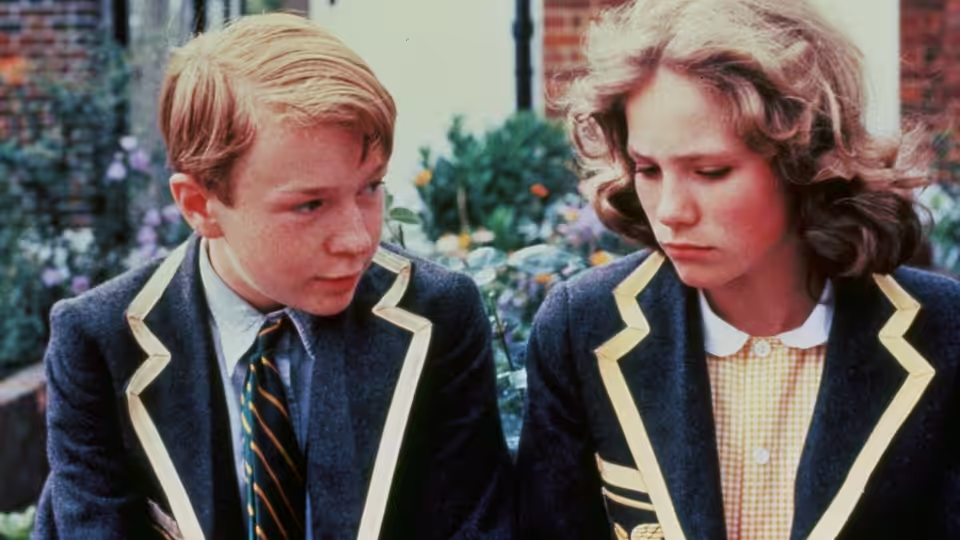
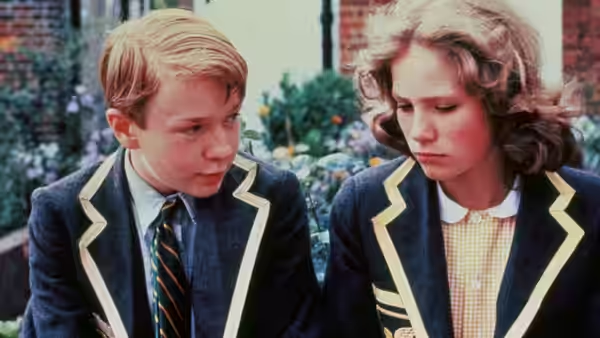
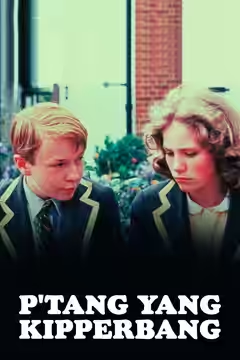
The joke that carries the film is the commentary. Alan Duckworth (John Albasiny) narrates his own life in the voice of a cricket commentator, so that walking past Ann Lawton in a corridor becomes a cover drive and failing to speak to her becomes a wicket. Rosenthal keeps it going without ever letting it become a gag reel; the voice is Alan’s way of making himself the hero of a day in which he is, plainly, not. Albasiny plays him as a boy whose face is always a second behind his thoughts, and he is good at the one thing the part needs, which is wanting something and being unable to say so. We laughed a good deal, mostly at the gap between the commentary and the boy.
Alison Steadman is the reason to insist on the film to anyone who hesitates. Her Miss Land is a woman in her thirties who has been teaching Shakespeare to boys in short trousers for too long, and who looks at Tommy (Garry Cooper), the groundsman, the way Alan looks at Ann. Steadman gives her a brightness in class that drops away the moment the last child is out of the door. One scene with Cooper, which we will not describe, is the best in the film and Alan is nowhere near it. Robert Urquhart’s Headmaster is a decent man running a decent school and faintly puzzled by both.
Abigail Cruttenden has the harder job as Ann, because the script sees her mostly through Alan, and she manages to suggest a girl with a life going on behind that. Maurice Dee’s Geoffrey Whitaker is the handsome boy who gets things without noticing, and Mark Brailsford and Christopher Karallis, as Abbo and Shaz, chatter in a way that sounds like boys rather than lines.
It was made for television, as the Time Out review complains, and it is no use pretending otherwise. Tony Pierce-Roberts shoots the school and the cricket field in flat, even summer light, and the frame is built for the small screen: faces, two-shots, a classroom from the back. John Shirley cuts it at a conversational pace and never hurries a scene that is working. Sue Yelland’s grey flannel, school caps and gymslips do most of the period work, and David Earl’s score is sparing, a few bars where needed and then silence. None of it is cinema in the sense of needing a big screen, and none of it is careless either. The one real limit is scale: when the film reaches for the wider world, the shadow of the war and what Tommy did or did not do in it, it has to do so in dialogue, because it cannot afford to show us.
The reviews so far split down the middle, one calling it wry and highly comic, the other objecting to a television film being sent into cinemas after it had been shown. We are with the first. Where you watch a thing is not what it is, and this is one of Rosenthal’s better scripts, in the line of his television work rather than Puttnam’s larger pictures. Apted, who had just made Coal Miner’s Daughter, directs it without a trace of condescension, which is the thing that most films about children cannot manage.
Watch it at home, where it was built to be watched, with someone who remembers being fourteen. It will not take long and it is kinder than it looks.