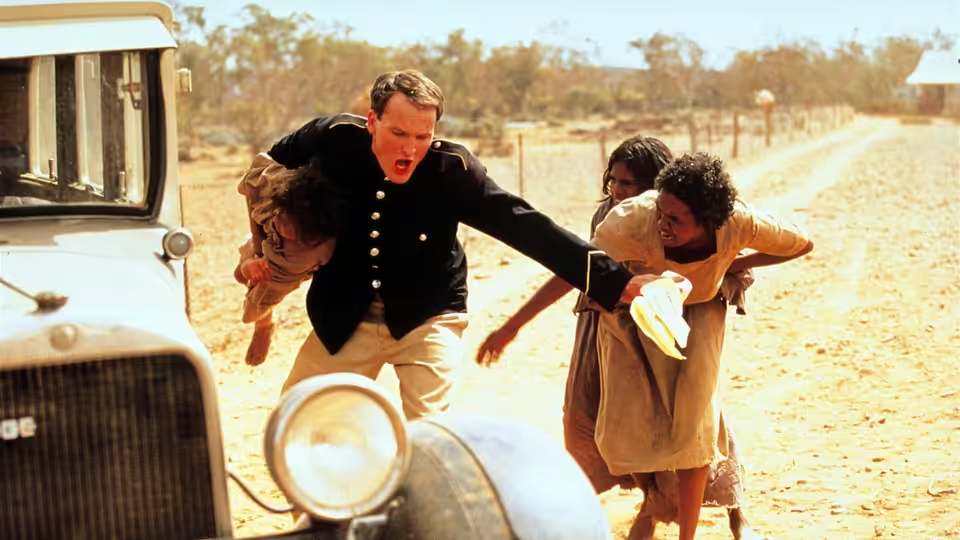
A uniformed man reaches for two girls beside a parked car on a dusty road
Film review

Rabbit-Proof Fence

2002 · Directed by Phillip Noyce · 1h 34m

In a sentenceOfficial concern for children looks rather different when the children are trying to escape it

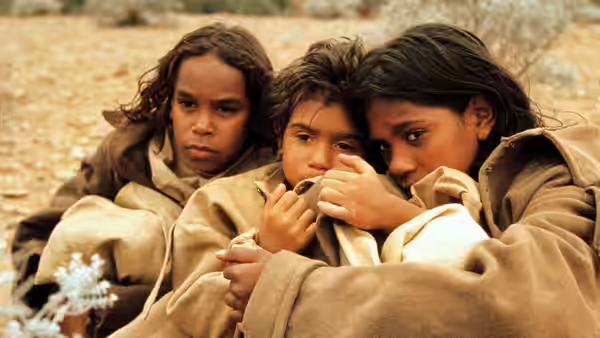
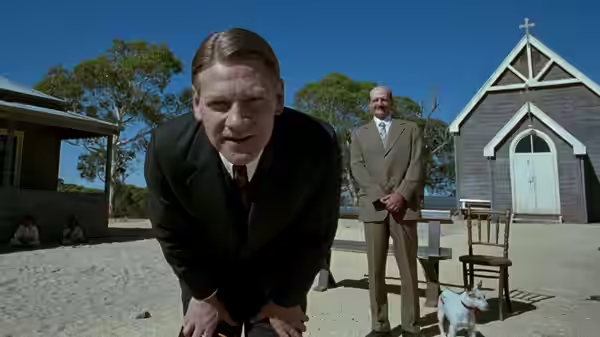
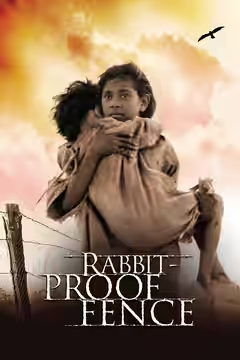
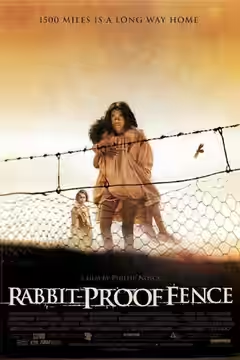
In Australia, three Aboriginal girls try to escape a racist programme that puts their lives under official control. Molly Craig (Everlyn Sampi), Daisy Craig Kadibill (Tianna Sansbury) and Gracie Fields (Laura Monaghan) want to get away from the people deciding their futures. A. O. Neville (Kenneth Branagh) represents that authority. Molly’s family includes her mother (Ningali Lawford) and grandmother (Myarn Lawford), but the officials’ priorities leave little room for family wishes. The girls set out across the Australian landscape, with their safety dependent on decisions they must now make for themselves.

Plays from YouTube when you press play; nothing loads from them until then.

Fi1m review

Phillip Noyce’s historical drama is direct, moving and carried by three young performers whose faces hold our attention. Its portrait of official cruelty can be thin, but the children’s distress never feels manufactured.

Rabbit-Proof Fence is a moving historical drama whose strongest claim on us comes from the children at its centre. Director Phillip Noyce gives their escape the directness of an adventure, making the injustice easy to grasp without requiring a lecture before the story can begin. We understand why getting away matters, even when the adults have become too easy to dismiss. At 94 minutes, the film gives its young cast little unnecessary business to carry.

Everlyn Sampi, playing Molly Craig, supplies the steadiness that keeps the film from becoming a succession of sad images. We watch her face for decisions, and she holds that attention without seeming to solicit our sympathy. Tianna Sansbury as Daisy Craig Kadibill and Laura Monaghan as Gracie Fields give the central group an equally welcome naturalness. We were moved by the effort these children make to remain composed. The young performers allow fear to show without making every expression an appeal to the audience, and that restraint earns our concern.

Christopher Doyle’s photography gives the stark landscape a scale that makes the girls’ vulnerability plain. Its beauty matters because we remain conscious of how exposed a child can be within it. His attention to their faces keeps the scenery from becoming the principal attraction, even when there is plenty to admire around them. Roger Ford, responsible for production design and costumes, works with a useful lack of fuss. The clothes and surroundings do not compete with the children for attention, which suits a film so dependent on small changes of expression.

Editors Veronika Jenet and John Scott keep the escape legible and the pace purposeful. They allow the young performers enough space for us to read a reaction before asking us to worry again. That rhythm helps the film avoid making each new difficulty feel like another scheduled opportunity for distress. Peter Gabriel’s score sustains the unease effectively, although its insistence occasionally feels unnecessary. There are passages where the performances already give us enough to respond to, and a little less musical encouragement would have served them better.

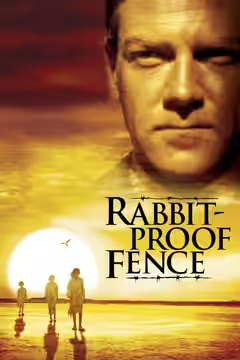
Kenneth Branagh, as A. O. Neville, has the less rewarding task. The character is so firmly defined by his part in the injustice that we are given little reason to watch him closely. We do not need a sympathetic account of a racist official, or a fabricated case for his defence. We do need to understand how a person becomes comfortable exercising this sort of power, and Christine Olsen’s screenplay is less searching there. The certainty of the telling sometimes makes the adults less disturbing than they ought to be.

The adventure structure is a sound choice for this history, because the wish to escape gives the injustice an immediate consequence. Historical dramas can become preoccupied with explaining their importance; here, following the children is sufficient reason to keep watching. We would have welcomed more curiosity about the adults, but the film’s concentration on the girls remains persuasive enough to justify the evening. Give it an evening when there is time for a quiet conversation afterwards.
Critical consensus AI synthesised

72
Positive
8
Mixed
6
Negative
0

Most critics find Rabbit-Proof Fence moving and visually assured, with praise concentrated on the young performers and Christopher Doyle’s cinematography. The girls’ naturalistic acting, particularly Everlyn Sampi’s portrayal of Molly, gives the account of injustice much of its emotional force. Doyle’s treatment of the stark landscape and Peter Gabriel’s score also draw repeated approval, while several reviews welcome the film’s restraint and lack of sentimentality.

The spread runs from enthusiastic to mixed, with no outright negative verdicts among the supplied scores. Reservations concern the handling of the politics and the effectiveness of the drama rather than the subject’s importance. The Los Angeles Times finds the film affecting but criticises its uneven political argument and one-dimensional portrayal of Mr. Neville. Slant Magazine is less persuaded by its emotional reach, finding that it lacks an emotional hook and falls short of its political ambitions.

RogerEbert.com
★★★½/4 · Roger Ebert
88

Ebert gives the film a positive review, finding it moving and powerful. He singles out its beauty and deep sadness.

Read the full review →
Empire
1 January 2000 · Jo Berry
80*

Berry finds the film moving and fascinating, praising its emotional restraint. She singles out the three girls’ performances, especially Everlyn Sampi’s portrayal of Molly.

Read the full review →
Total Film
8 November 2002 · ★★★★ · Total Film
80

The review calls the film moving, haunting and a powerful tribute to the human spirit. It praises the girls’ naturalistic performances and the film’s striking visual storytelling.

Read the full review →
Variety
18 February 2002 · David Stratton
78*

Stratton finds the film emotionally effective and successful in advancing sympathy for the Aboriginal cause, despite its lack of the poetic vision of Walkabout. He especially praises the young performers and the final footage of the real Molly and Daisy.

Read the full review →
The AV Club
22 January 2003 · Keith Phipps
75*

Phipps finds the film memorable and effective, though some choices weaken its dramatic thrust. He praises Christopher Doyle’s imagery, Peter Gabriel’s score, and the young actors’ expressive faces.

Read the full review →
The Guardian
10 November 2002 · Philip French
75*

The critic calls it a forceful, gripping, unsentimental account of injustice. He singles out Christopher Doyle’s beautiful photography of the stark landscape and Peter Gabriel’s haunting score.

Read the full review →

Straight answers AI written, from our review

Is Rabbit-Proof Fence worth watching?
Rabbit-Proof Fence is worth watching for its moving young performances and direct approach to historical injustice, and we score it 80 out of 100. We recommend it for those drawn to a child-centred historical drama, with the caveat that its portrayal of the adults is less searching than its attention to the girls.
How long is Rabbit-Proof Fence, and what is it rated?
Rabbit-Proof Fence runs 1h 34m. It is an adventure and drama film.
Where can I watch Rabbit-Proof Fence in Panama?
Rabbit-Proof Fence is not on any streaming or rental service in Panama at the moment. It is available in 7 other countries; change your country at the top of the page to see where. Availability is checked daily.
How does Rabbit-Proof Fence compare to Walkabout?
Rabbit-Proof Fence is the better choice for a direct historical drama, while Walkabout offers a stranger, more unsettling account of children travelling through the Australian landscape. We find both moving and persuasive in their young performances, though both sometimes simplify the adults or ideas surrounding them; Walkabout asks for closer attention.
Is Rabbit-Proof Fence based on a true story or a book?
Rabbit-Proof Fence is adapted from a novel by Doris Pilkington and presents its history through three Aboriginal girls escaping racist official control. We find that the film makes their situation clear without a preliminary history lesson, so knowing the book is not necessary.
What should I watch after Rabbit-Proof Fence?
After Rabbit-Proof Fence, try Walkabout (1971, Fi1m 85): For a stranger, more unsettling account of children travelling through the Australian landscape. Then The Night of the Hunter (1955, Fi1m 91): Children on the run, with adult menace made frighteningly persuasive through fairy-tale images; and Wadjda (2012, Fi1m 80): A resourceful girl tests rules that the adults around her take for granted.

Cast

Awards

Chlotrudis Award for Best Director, 2003

Nominated
Chlotrudis Award for Best Director

Chlotrudis Award for Best Film, 2003

Nominated
Chlotrudis Award for Best Film

Political Film Society Award for Exposé, 2003

Nominated
Political Film Society Award for Exposé

Political Film Society Award for Human Rights, 2003

Nominated
Political Film Society Award for Human Rights

AACTA Award for Best Actor in a Supporting Role, 2002

Nominated
AACTA Award for Best Actor in a Supporting Role

AACTA Award for Best Adapted Screenplay, 2002

Nominated
AACTA Award for Best Adapted Screenplay

AACTA Award for Best Cinematography, 2002

Nominated
AACTA Award for Best Cinematography

AACTA Award for Best Costume Design, 2002

Nominated
AACTA Award for Best Costume Design

AACTA Award for Best Direction, 2002

Nominated
AACTA Award for Best Direction

AACTA Award for Best Editing, 2002

Nominated
AACTA Award for Best Editing

AACTA Award for Best Film, 2002

Won
AACTA Award for Best Film

AACTA Award for Best Original Music Score, 2002

Won
AACTA Award for Best Original Music Score

AACTA Award for Best Production Design, 2002

Nominated
AACTA Award for Best Production Design

AACTA Award for Best Sound, 2002

Won
AACTA Award for Best Sound

AACTA Award for Best Young Actor, 2002

Nominated
AACTA Award for Best Young Actor

Golden Globes, 2002

Nominated
Best Original Score

London Film Critics Circle Award for Director of the Year, 2002

Won
London Film Critics Circle Award for Director of the Year

National Board of Review Award for Best Director, 2002

Won
National Board of Review Award for Best Director

If you liked this, try…

  1. Walkabout (1971, Fi1m 85)For a stranger, more unsettling account of children travelling through the Australian landscape.

  2. The Night of the Hunter (1955, Fi1m 91)Children on the run, with adult menace made frighteningly persuasive through fairy-tale images.

  3. The Quiet Girl (2022) · not on Fi1m yetAnother young performance that makes watchfulness more affecting than any explanatory speech.

  4. Wadjda (2012, Fi1m 80)A resourceful girl tests rules that the adults around her take for granted.

  5. Theeb (2014) · not on Fi1m yetA child’s desert journey, with danger kept close and sentiment kept under control.

Rabbit-Proof Fence (2002) review: A moving drama with thin villains (Panama) | Fi1m