Rakeysh Omprakash Mehra’s film about Delhi students who play 1920s revolutionaries and then start to mean it is loose, long and alive, and its young cast is the reason to see it. The second half asks us to follow it somewhere we were not quite ready to go.
Rakeysh Omprakash Mehra’s film begins as a lark about a student film and ends as something else, and the whole gamble is whether we will walk the distance between the two with it. We mostly did. Sue McKinley (Alice Patten) wants to film the lives of Bhagat Singh and his comrades using her grandfather’s prison diary, and the only actors she can afford are five Delhi layabouts. The idea, from a story by Kamlesh Pandey and a script by Mehra and Rensil D’Silva, is that playing the dead will change the living. It is a schoolteacher’s idea, and the film knows it, and it works anyway.
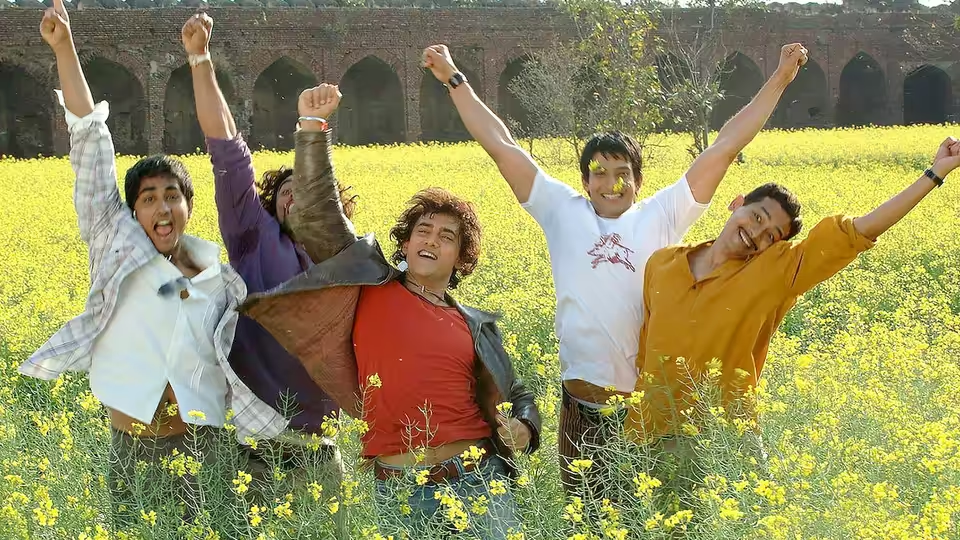
The first hour is the loosest and the best. Aamir Khan plays DJ, a graduate who has stayed on campus for years because the world outside has no use for him, and he plays him big: the Punjabi swagger, the wet eyes, the dancing on the bonnet of a jeep. Siddharth’s Karan is the rich boy who says least and watches most. Kunal Kapoor gives Aslam, the group’s Muslim and its poet, an easy warmth that the plot will later lean on. Sharman Joshi’s Sukhi is the clown and knows no other way to be. Kirron Kher runs the dhaba they drink in and treats them the way an exhausted mother would; Soha Ali Khan’s Sonia is the only one of them with a plan. We believed in them as friends within ten minutes, which is rarer than it sounds.
Atul Kulkarni is the film’s best piece of casting. His Laxman Pandey is a Hindu nationalist who has already fought Aslam in the street when Sue casts him, and the script gives him real speeches and a real grievance rather than a villain’s. Watching him sit at the edge of the group, wanted by nobody, and slowly be let in, is the quietest thing in a loud film and the one we thought about afterwards.
Binod Pradhan shoots the present in hard, saturated colour, orange dust and green campus lawns, and the past in a bleached sepia, so that when P S Bharathi cuts from one to the other we always know where we are. Late on the two begin to bleed into each other, and the cutting does the film’s thinking for it. The rehearsals in a ruined fort, the students in costume against the stone with one lamp on them, are the film’s own picture of itself: boys playing at history and starting to look like it. The framing device creaks. Patten is game and her Hindi is better than it needs to be, but Sue is a window rather than a person; she exists so that someone can be told things. Steven Mackintosh’s James McKinley, the jailer whose diary starts everything, is given a conscience and a voiceover and little else. And the film’s politics are a schoolboy’s: every politician is a crook, every crook is the same crook, and the answer is young men with resolve. That is also, to be fair, roughly what Bhagat Singh believed at twenty-three, and the film has the honesty to show where it took him.
The second half takes a turn we will not describe. We can say that the film gets angry, and that it made us angry with it, on behalf of people we had been laughing at an hour earlier, and that the anger is the achievement. Then it takes a second turn, and here we hesitated. Mehra wants us to follow his students all the way, and the reasoning is done in two scenes and a song where it needed an hour. Most critics have been warmer about the ending than we are.
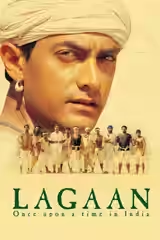
Aamir Khan’s Lagaan (2001) made the Raj a cricket match and asked nothing harder of its audience than to cheer. This asks more, and gets most of it. It is too long, the songs stop the story, and the last half hour argues faster than it thinks. It is also a Hindi film of real scale that is about something and says so. See it with people who will argue about the ending on the way home, because that is what it is for.