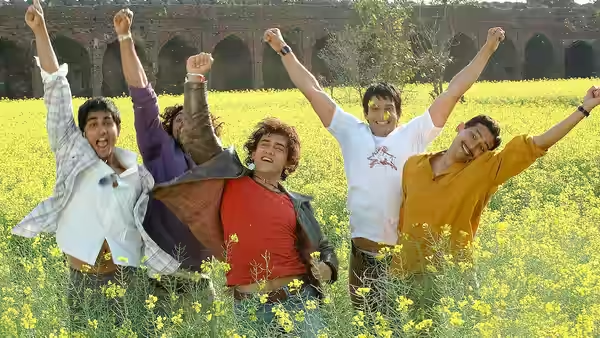
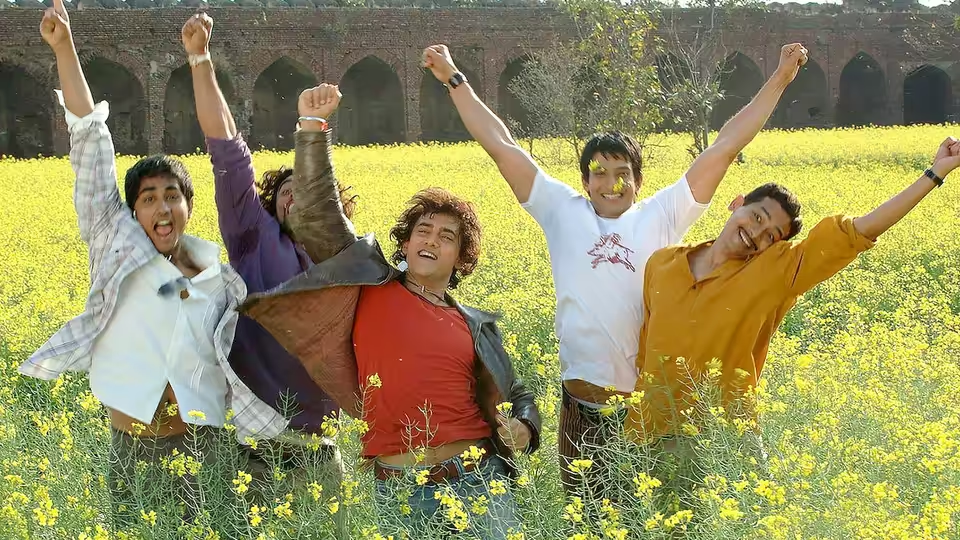
A group of young men cheer with raised arms in a mustard field before an old stone arcade
Film review

Rang De Basanti

2006 · Directed by Rakeysh Omprakash Mehra · 2h 37m

In a sentenceFive Delhi layabouts are cast as dead revolutionaries and the costumes start to fit

Delhi, the present day. Sue McKinley (Alice Patten), a young filmmaker from London, arrives with the diary of her grandfather James McKinley (Steven Mackintosh), a jailer under the Raj who watched Bhagat Singh and Chandrashekhar Azad go to their deaths. She wants to film their story on the ground where it happened, her funding has collapsed, and so she casts amateurs. Her friend Sonia (Soha Ali Khan) leads her to DJ (Aamir Khan), a graduate who has never left the campus, and his friends Karan (Siddharth), Aslam (Kunal Kapoor) and Sukhi (Sharman Joshi), who drink at Mitro’s (Kirron Kher) dhaba and take nothing seriously. Sue also casts Laxman Pandey (Atul Kulkarni), a Hindu nationalist who has already brawled with Aslam. Sonia is engaged to Ajay (R. Madhavan), a fighter pilot. The students put on the dead men’s clothes and begin rehearsing.

Plays from YouTube when you press play; nothing loads from them until then.

Fi1m review

Rakeysh Omprakash Mehra’s film about Delhi students who play 1920s revolutionaries and then start to mean it is loose, long and alive, and its young cast is the reason to see it. The second half asks us to follow it somewhere we were not quite ready to go.

Rakeysh Omprakash Mehra’s film begins as a lark about a student film and ends as something else, and the whole gamble is whether we will walk the distance between the two with it. We mostly did. Sue McKinley (Alice Patten) wants to film the lives of Bhagat Singh and his comrades using her grandfather’s prison diary, and the only actors she can afford are five Delhi layabouts. The idea, from a story by Kamlesh Pandey and a script by Mehra and Rensil D’Silva, is that playing the dead will change the living. It is a schoolteacher’s idea, and the film knows it, and it works anyway.

The first hour is the loosest and the best. Aamir Khan plays DJ, a graduate who has stayed on campus for years because the world outside has no use for him, and he plays him big: the Punjabi swagger, the wet eyes, the dancing on the bonnet of a jeep. Siddharth’s Karan is the rich boy who says least and watches most. Kunal Kapoor gives Aslam, the group’s Muslim and its poet, an easy warmth that the plot will later lean on. Sharman Joshi’s Sukhi is the clown and knows no other way to be. Kirron Kher runs the dhaba they drink in and treats them the way an exhausted mother would; Soha Ali Khan’s Sonia is the only one of them with a plan. We believed in them as friends within ten minutes, which is rarer than it sounds.

Atul Kulkarni is the film’s best piece of casting. His Laxman Pandey is a Hindu nationalist who has already fought Aslam in the street when Sue casts him, and the script gives him real speeches and a real grievance rather than a villain’s. Watching him sit at the edge of the group, wanted by nobody, and slowly be let in, is the quietest thing in a loud film and the one we thought about afterwards.

Binod Pradhan shoots the present in hard, saturated colour, orange dust and green campus lawns, and the past in a bleached sepia, so that when P S Bharathi cuts from one to the other we always know where we are. Late on the two begin to bleed into each other, and the cutting does the film’s thinking for it. The rehearsals in a ruined fort, the students in costume against the stone with one lamp on them, are the film’s own picture of itself: boys playing at history and starting to look like it. The framing device creaks. Patten is game and her Hindi is better than it needs to be, but Sue is a window rather than a person; she exists so that someone can be told things. Steven Mackintosh’s James McKinley, the jailer whose diary starts everything, is given a conscience and a voiceover and little else. And the film’s politics are a schoolboy’s: every politician is a crook, every crook is the same crook, and the answer is young men with resolve. That is also, to be fair, roughly what Bhagat Singh believed at twenty-three, and the film has the honesty to show where it took him.

The second half takes a turn we will not describe. We can say that the film gets angry, and that it made us angry with it, on behalf of people we had been laughing at an hour earlier, and that the anger is the achievement. Then it takes a second turn, and here we hesitated. Mehra wants us to follow his students all the way, and the reasoning is done in two scenes and a song where it needed an hour. Most critics have been warmer about the ending than we are.

Aamir Khan’s Lagaan (2001) made the Raj a cricket match and asked nothing harder of its audience than to cheer. This asks more, and gets most of it. It is too long, the songs stop the story, and the last half hour argues faster than it thinks. It is also a Hindi film of real scale that is about something and says so. See it with people who will argue about the ending on the way home, because that is what it is for.
Critical consensus AI synthesised

3 of 6
Positive
2
Mixed
1
Negative
0
Radio Times
★★★★ · Omar Ahmed
80

The critic praises the film’s vitality and genuine passion. They single out its shift from an intimate story into an intense, powerful examination of corruption and religious bigotry.

Read the full review →
Variety
6 February 2006 · Derek Elley
70*

The critic sees the film as a largely successful, ambitious step forward for commercial Hindi cinema, though its emotional distance weakens the climax. He praises its well-drawn characters and the natural transition from a playful student story into political action-drama.

Read the full review →
Time Out
8 February 2006 · AS
64*

The page identifies this as a film review, but the critic’s verdict is not available in the page text. Its description gives the documentary’s premise but does not reveal what the critic praises or criticizes.

Read the full review →

Straight answers AI written, from our review

Is Rang De Basanti worth watching?
Rang De Basanti is worth watching for anyone with patience for a long, loose Hindi film that starts as a lark and ends as something angrier, and we scored it 76. Aamir Khan, Siddharth, Kunal Kapoor and especially Atul Kulkarni make the friends convincing within minutes. The last half hour argues faster than it thinks, and the songs stop the story.
How long is Rang De Basanti, and what is it rated?
Rang De Basanti runs 2h 37m. It is a comedy and drama film.
Where can I watch Rang De Basanti in Saudi Arabia?
Rang De Basanti is not on any streaming or rental service in Saudi Arabia at the moment. It is available in 3 other countries; change your country at the top of the page to see where. Availability is checked daily.
How does Rang De Basanti compare to if....?
Rang De Basanti and if.... light the same fuse, young men who stop playing at rebellion and mean it, but Lindsay Anderson's film is the tighter and the angrier of the two, and its school is drawn with sharper observation. Mehra's film is warmer, longer and more generous to its cast, and better company for an evening. Anderson's is the one that lingers.
What should I watch after Rang De Basanti?
After Rang De Basanti, try If.... (1968, Fi1m 82): English public schoolboys discover the armoury; the same fuse, lit forty years earlier. Then Z (1969, Fi1m 84): Costa-Gavras on a political murder and the cover-up, cut like a thriller; and The Battle of Algiers (1966, Fi1m 93): Pontecorvo’s street-level account of an uprising, fair to everyone and comfortable for nobody.

Cast

Awards

Filmfare Award for Best Film, 2007

Won
Filmfare Award for Best Film

International Submission to the Academy Awards, 2007

Nominated
International Submission to the Academy Awards

Zee Cine Award for Best Film, 2007

Won
Zee Cine Award for Best Film

If you liked this, try…

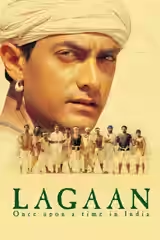
  1. Lagaan (2001) · not on Fi1m yetAamir Khan takes on the Raj with a cricket bat; longer, sunnier, less angry.

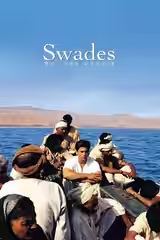
  2. Swades (2004) · not on Fi1m yetAn engineer comes home from NASA and finds the village will not let him leave.

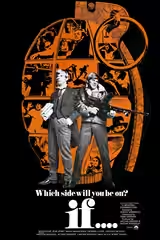
  3. If.... (1968, Fi1m 82)English public schoolboys discover the armoury; the same fuse, lit forty years earlier.

  4. Z (1969, Fi1m 84)Costa-Gavras on a political murder and the cover-up, cut like a thriller.

  5. The Battle of Algiers (1966, Fi1m 93)Pontecorvo’s street-level account of an uprising, fair to everyone and comfortable for nobody.