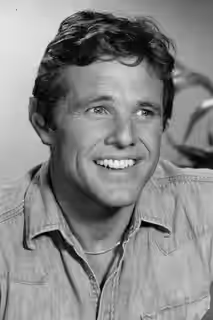
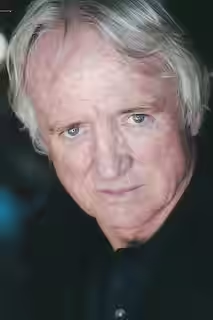
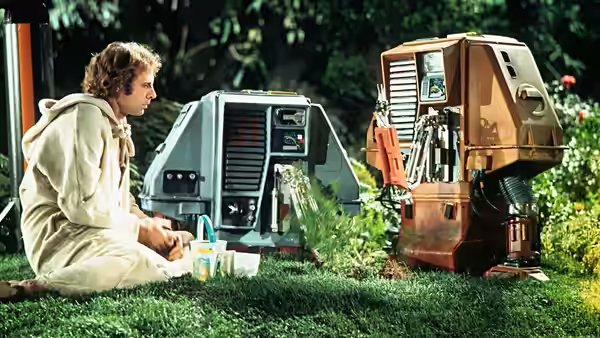
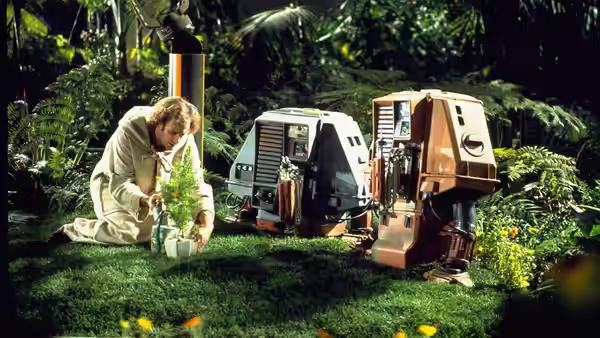
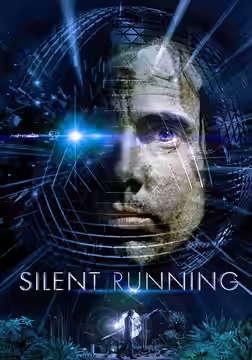
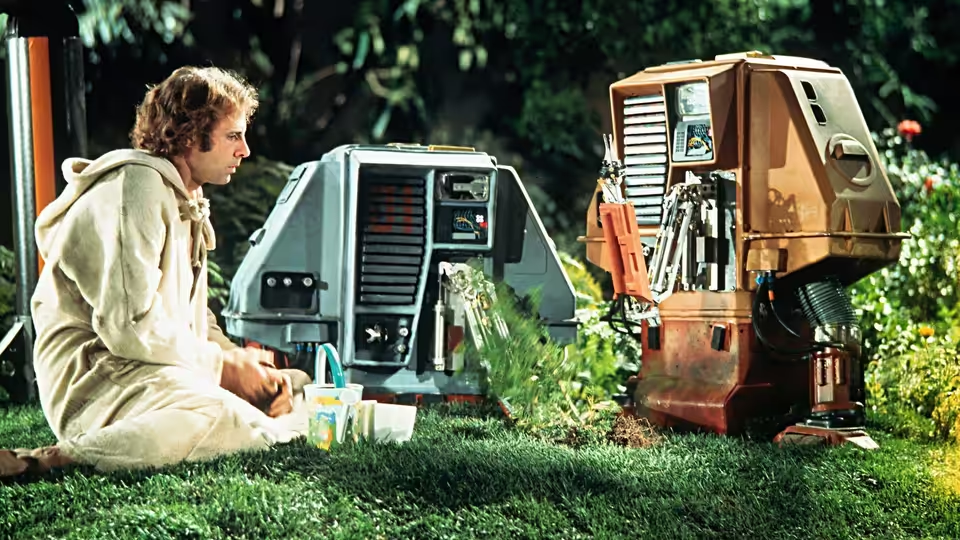
Freeman Lowell (Bruce Dern) sitting on grass with two drones among plants
Film review

Silent Running

1972 · Directed by Douglas Trumbull · 1h 29m

In a sentenceA sweaty botanist, three shuffling robots and the last trees in existence, drifting past Saturn while Joan Baez sings at them

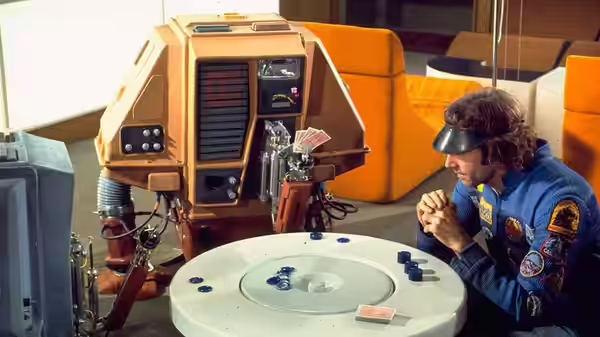
Earth has no forests left. The last of them are kept under glass domes bolted to freighters parked beyond Saturn, and botanist Freeman Lowell (Bruce Dern) has tended the ones aboard the Valley Forge for eight years. His three crewmates, John Keenan (Cliff Potts), Marty Barker (Ron Rifkin) and Andy Wolf (Jesse Vint), race buggies down the dome paths and eat food from packets while Lowell grows cantaloupes and lectures them about it. Then an order comes through: destroy the domes and bring the ships home for commercial service. Lowell will not accept it, and finds himself alone with three squat maintenance drones, which he names Huey, Dewey and Louie and teaches to plant seedlings and play poker.

Plays from YouTube when you press play; nothing loads from them until then.

Fi1m review

Douglas Trumbull’s first film as director is a small, sincere science-fiction fable about a man who loves trees more than people, and its drones are among the most likeable machines ever put on screen. The speeches are shrill and the songs are worse, and we recommend it anyway.

Douglas Trumbull did the effects for 2001: A Space Odyssey, and his first film as director is in part a reply to it. The same deep space, the same slow freighters, and instead of an astronaut who says almost nothing there is Bruce Dern, who will not stop talking. Silent Running is a small film about a man who loves trees more than he loves people, and it is sincere to the point of embarrassment. We like it a good deal, and we would not want it a minute smarter.

The setup takes a quarter of an hour. Earth has no forests left; the last of them sit under glass domes on freighters parked beyond Saturn, and Freeman Lowell (Dern) has looked after the ones on the Valley Forge for eight years. His crewmates, Keenan (Cliff Potts), Barker (Ron Rifkin) and Wolf (Jesse Vint), race buggies down the dome paths and eat out of packets while Lowell grows cantaloupes and tells them what they are missing. Then the order comes to blow up the domes and bring the ships home. Lowell does not accept it. How he ends up alone with three maintenance drones we will let the film tell you; it does so fast.

What follows is the film. Lowell names the drones Huey, Dewey and Louie, teaches them to plant seedlings, teaches them poker, and talks to them because there is no one else. The drones are played by actors inside the casings (Mark Persons, Steven Brown, Cheryl Sparks and Larry Whisenhunt share the credits), and because they are people rather than puppets they walk with a slight rock and turn their heads a fraction late, as if thinking. We laughed at the poker game, at a drone considering its hand, and then Trumbull cut to Lowell eating alone at a long mess table and we stopped. The company he has made for himself is company, and it is not enough.

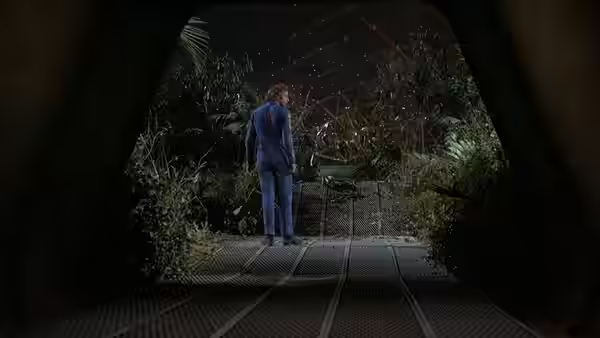
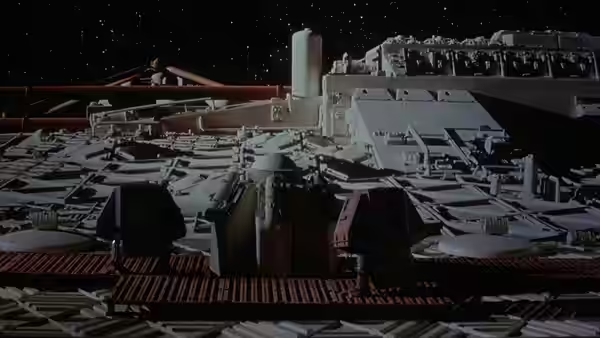
Charles F. Wheeler shoots the ship’s corridors in flat working light, grey metal and yellow stripes, and shoots the domes as if they were a park in late afternoon, sun through leaves, a rabbit in the grass. He does not overwork the contrast. The exteriors are Trumbull’s own, and they are the most convincing space freighters of their decade: long, boxy, hung with domes like lanterns, moving past Saturn’s rings slowly enough that you believe in the weight. Aaron Stell lets those shots run and cuts the arguments short, which is the right way round.

The weakness is the talk. The script, by Deric Washburn, Michael Cimino and Steven Bochco, gives Lowell speeches about what a forest smells like and what children have never seen, and Dern delivers them at a pitch just below shouting. Variety, at the time, thought him miscast, and we half see the case: he is twitchy, damp, a little frightening, not the gentle steward the poster wants. We think it is the film’s best decision, whether or not it was meant as one. A man who would do what Lowell does for a tree would look exactly like this. But the film does not always separate his conviction from its own, and there are stretches where it simply agrees with him.

Then there are the songs. Peter Schickele’s score is spare and decent. The songs Joan Baez sings over the forest are not, and they date the film more than any of the effects do. When she came in over a shot of Lowell walking under the trees we winced, and we winced again the second time. The pictures were already saying it.

Against the genre’s own standards it holds up unusually well. Most science fiction of its decade wanted to be large; this one is 89 minutes long, has four speaking parts and three that whistle, and gets more done than films twice its size. It has been borrowed from ever since, by films with far more money, and none of them has found a better picture of loneliness than three robots planting trees for a man who cannot stop explaining why.

It is a U certificate, and children take to the drones at once. Warn them that Lowell is not a nice man, and let them decide whether he is a good one.
Critical consensus AI synthesised

75
Positive
10
Mixed
1
Negative
0

Most critics like Silent Running a good deal, and the praise gathers in the same three places. Douglas Trumbull’s effects and lived-in spaceship interiors are singled out repeatedly, with several reviewers noting how much he manages on a small budget. Bruce Dern’s performance is the second constant, described as committed, subtle or twitchy depending on the writer. The third is the ecological message itself: the reviews treat it as a quiet, humane counterweight to 2001, and the later ones find it more relevant as the decades pass, not less. The drones come in for particular affection.

The reservations are minor and scattered. One review finds the early scene-setting awkward; another thinks the soundtrack has dated badly. The spread is narrow, with one exception: Variety, writing at release, argues that Dern is miscast and that the casting undermines the drama, a view no later critic shares.

Time Out
21 July 2014 · PH
90*

A wonderful film whose message—that humanity (and its creations) must save itself—contrasts with 2001 by emphasizing personal responsibility and ecological hope. The critic singles out the stunning visuals and strong central ideas for praise, noting they outweigh the somewhat awkward early scene-setting.

Read the full review →
Little White Lies
16 November 2020 · Brian Quinn
85*

Trumbull's directorial debut is a soulful, homespun eco-parable that serves as a tender riposte to the emotional sterility of 2001: A Space Odyssey, prioritizing heart and human (and robotic) connection over grand cosmic spectacle. The critic praises the film's thriftily inventive effects, lived-in spaceship interiors, and especially Bruce Dern's committed performance alongside the endearing drones.

Read the full review →
Empire
1 January 2000 · Adam Smith
80*

The critic praises the film's thoughtful, moving tale of ecological concern in space, highlighting its strident political stance on environmental issues and the poignant ending with the drone tending the flower. Dern's performance is noted positively.

Read the full review →
The Guardian
27 November 2011 · Philip French
80*

The critic praises this 1970s cult sci-fi as a deeply moving and immaculately staged ecological fable. It highlights the humour and imagination in its screenplay and the innovative direction by special-effects expert Douglas Trumbull.

Read the full review →
RogerEbert.com
1 January 1971 · Roger Ebert
75*

The critic praises the film's simplicity and quiet ecological concern, calling it a movie out of the ordinary for science-fiction fans. He highlights the deep-space effects on par with 2001 and Bruce Dern's subtle performance as the uncomplicated protagonist who chooses the last plants over his fellow crew members.

Read the full review →
Slant Magazine
4 December 2020 · Budd Wilkins
70*

Trumbull’s sci-fi fable explores environmental issues and the effects of isolation on human beings. It praises the nuanced portrayal of the protagonist’s obsessive struggle and the memorable drones that develop personality.

Read the full review →

Straight answers AI written, from our review

Is Silent Running worth watching?
Silent Running is worth watching for anyone who likes small, sincere science fiction, and we scored it 76. Bruce Dern's speeches about trees run at a pitch just below shouting and the Joan Baez songs date it badly, but the three shuffling drones are among the most likeable machines ever put on screen. It is 89 minutes, and children take to it at once.
How long is Silent Running, and what is it rated?
Silent Running runs 1h 29m. It is an adventure and science fiction film.
Where can I watch Silent Running in Spain?
Silent Running is available to rent from Amazon Prime Video and Apple TV from €2.99. Availability is checked daily; the links above go straight to each service.
How does Silent Running compare to WALL·E?
Silent Running is the smaller, stranger film, and WALL·E the warmer and more polished one; both are about a lonely tender of what people left behind. Trumbull's live-action film puts a twitchy, damp man at its centre and is sincere to the point of embarrassment, while Stanton's animation is funnier and more moving. We recommend both, but a family evening is safer with the robot.

Cast

If you liked this, try…

Solaris poster87

Solaris

1972 · Made the same year, slower and stranger, and just as certain that space reveals the person

Dark Star poster

Dark Star

1974 · The scruffy comic cousin: bored men, a talking bomb, and a ship nobody has cleaned

WALL·E poster92

WALL·E

2008 · A lonely machine tends what people left behind; Trumbull’s drones would recognise him

Moon poster83

Moon

2009 · One man, one robot, a low budget and a good deal of quiet on the far side

Ikarie XB-1 poster

Ikarie XB-1

1963 · Czech deep-space drama with the lived-in corridors and long silences this film learned from