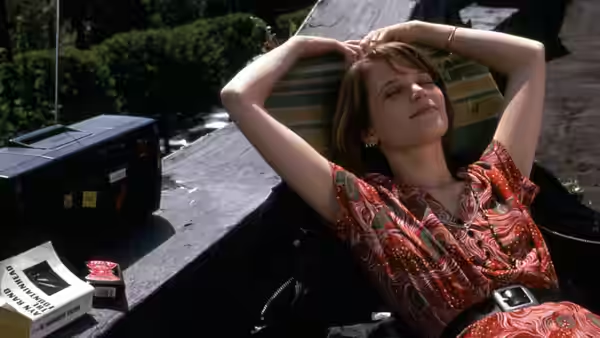
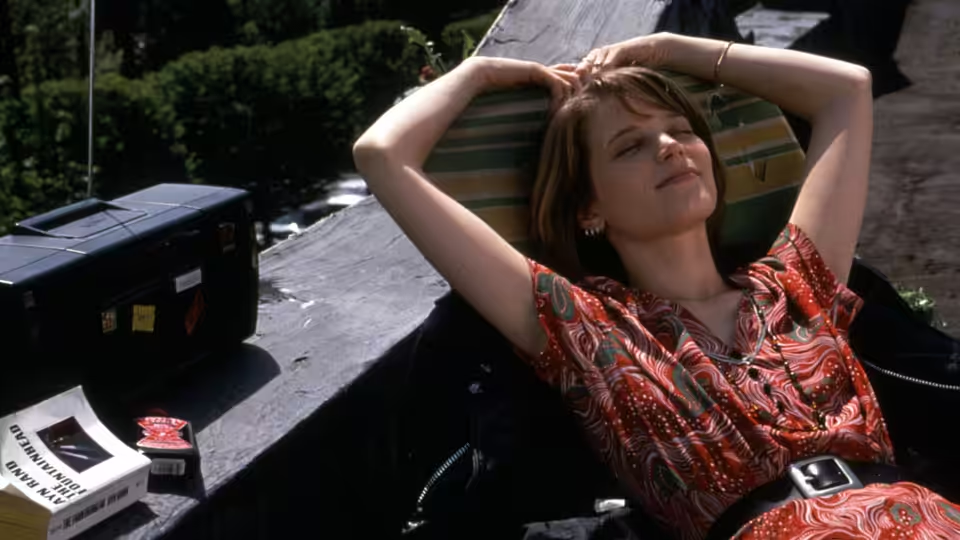
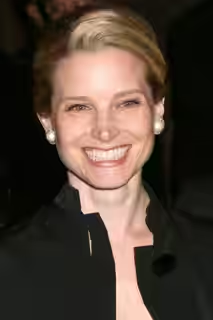
Janet Livermore (Bridget Fonda) reclining outdoors with arms raised behind her head
Film review

Singles

1992 · Directed by Cameron Crowe · 1h 39m

In a sentenceSeattle’s daters could use better advice, but we would let them choose the records

In early-1990s Seattle, Janet Livermore (Bridget Fonda), Steve Dunne (Campbell Scott) and Linda Powell (Kyra Sedgwick) are trying to get their romantic lives in order. Around them are Cliff Poncier (Matt Dillon) and Debbie Hunt (Sheila Kelley), part of the same generation negotiating love and its everyday complications. Set against the city’s music scene, the film follows an ensemble of twentysomethings looking for relationships they can make work. Finding someone to be attracted to is one difficulty; deciding how much of themselves to put into a relationship is another.

Fi1m review

Cameron Crowe’s Seattle romantic comedy is warm, funny and worth an evening for its cast. Paul Westerberg’s music supplies extra feeling, though the writing sometimes settles for an agreeable sketch when a fuller scene is needed.

Singles is a good romantic comedy with an excellent sense of who should be playing it. Cameron Crowe makes the everyday embarrassments of wanting a relationship funny without treating the people involved as fools. The writing can feel slight, and the music occasionally supplies emotion the drama has not earned, but we would happily spend these 99 minutes in this company. Its early-1990s Seattle setting gives it a particular atmosphere; the dating troubles need no period explanation.

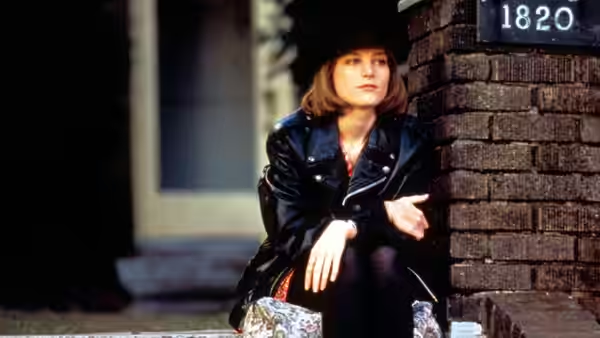
Bridget Fonda, Campbell Scott and Kyra Sedgwick do much of the work that makes Crowe’s screenplay feel perceptive. As Janet Livermore, Fonda makes uncertainty look like something a person is actively trying to overcome, which keeps the performance from becoming merely wistful. Scott’s Steve Dunne has an appealing earnestness, while Sedgwick gives Linda Powell enough reserve to make us pay attention when it shifts. All three understand the small effort involved in trying to appear easier company than we feel.

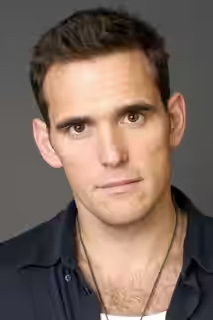
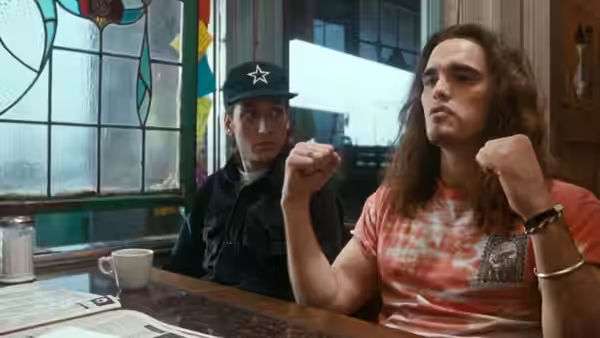
We laughed at Matt Dillon’s Cliff Poncier, particularly the confidence with which he seems to regard himself as a perfectly reasonable romantic prospect. Dillon makes that self-satisfaction funny without asking us to despise the man. His broader comic approach gives the ensemble a useful change of pace, though Crowe sometimes accepts an amusing personality where a more searching scene might have been useful. Fonda is especially good at making hesitation interesting enough to hold our attention alongside the louder comedy.

Ueli Steiger and Tak Fujimoto’s cinematography suits a film that wants us to enjoy being around its characters. The photography makes Seattle feel like somewhere people conduct ordinary lives, and gives the performances room without fussing over them. Stephen J. Lineweaver’s production design supports that ease: the surroundings never seem to be competing with the people for our attention. We would not choose the film for its visual daring, but its unforced appearance helps the actors make the romantic awkwardness believable.

Paul Westerberg’s music gives the film a less guarded warmth. It catches the eagerness and disappointment that Crowe’s jokes sometimes tidy away too quickly, allowing the characters’ feelings to linger. We were moved more by the music than by some of the romantic exchanges, because it gives those ordinary disappointments time to register. That is a pleasure with a drawback: occasionally we begin waiting for the soundtrack to supply what a conversation should have managed itself.

Richard Chew’s editing keeps the ensemble manageable and prevents the lighter material from becoming laborious. The unevenness comes chiefly from Crowe’s screenplay, which finds plenty of recognisable behaviour but does not always stay with it long enough. Some characters invite more curiosity than the writing satisfies, and an agreeable rhythm can become a reason to move on too readily. The cast repeatedly makes these brief encounters feel fuller, but we notice how much responsibility has been handed to them.

A romantic comedy earns considerable goodwill simply by making us care who finds happiness, and Singles clears that hurdle. Its musical setting gives it personality without requiring a particular attachment to the period or the scene. The modest scale suits Crowe’s interest in people trying to explain themselves and not quite succeeding. Choose it when an evening of awkward courtship sounds appealing, with some allowance for conversations that finish just as they become interesting.
Critical consensus AI synthesised

74
Positive
5
Mixed
1
Negative
0

Most critics respond warmly to Singles as a funny, observant romantic comedy about the everyday difficulties of finding love. Praise centres on Cameron Crowe’s handling of relationship problems and an ensemble that makes the characters appealing company. Kyra Sedgwick draws particular notice, alongside Campbell Scott and Bridget Fonda. The reviews also find intelligence beneath the Seattle setting, with Paul Westerberg’s music praised for giving the characters’ lives energy.

The spread is fairly narrow: five reviews are positive, one is mixed and none is negative. The main reservation concerns the balance between the film and its music. Consequence remains fond of the depiction of Seattle’s early-1990s scene but finds that the soundtrack overshadows the film. Time Out notes the limited concert footage, while suggesting there are compensations elsewhere; the available account does not specify them. These reservations stop short of a broader rejection of the comedy.

Radio Times
★★★★ · Alan Jones
80

Jones praises the film as a wonderfully funny romantic comedy about love among Seattle twentysomethings. He singles out its exemplary cast for praise.

Read the full review →
Variety
31 December 1991 · Variety Staff
80*

The critic gives the comedy a warmly positive verdict, praising Cameron Crowe’s clever transformation of everyday relationship problems into comic material. Kyra Sedgwick’s performance as Linda is singled out as superb.

Read the full review →
Empire
26 January 2006 · Chris Heath
75*

The review finds the film a timeless, intelligent romantic comedy rather than a grunge-era cash-in. It praises the well-observed, witty performances of Campbell Scott, Kyra Sedgwick and Bridget Fonda.

Read the full review →
Los Angeles Times
18 September 1992 · PETER RAINER
75*

Rainer finds the film a sweet, companionable comedy about love and its complications. He especially praises the winning ensemble performances and Paul Westerberg’s music, which he says gives the characters’ lives a pulse.

Read the full review →
Time Out
· CM
70*

The review suggests that the film offers compensation for viewers disappointed by the limited concert footage. The available description does not identify what that compensation is.

Read the full review →
Consequence
7 September 2011 · Alex Young
60*

The critic is broadly fond of the film, though its soundtrack overshadows the movie itself. They praise the music and the film’s evocative depiction of Seattle’s early-’90s scene.

Read the full review →

Straight answers AI written, from our review

Is Singles worth watching?
Singles is worth watching for its warm, funny cast and awkward courtship, and we score it 74 out of 100. We recommend it for an easygoing romantic comedy evening, with the caveat that some conversations finish before they become revealing and Paul Westerberg’s music sometimes supplies feeling the writing has not earned.
How long is Singles, and what is it rated?
Singles runs 1h 39m. It is a romance and comedy film.
Where can I watch Singles in Portugal?
Singles is available to rent from Amazon Prime Video from €2.99. Availability is checked daily; the links above go straight to each service.
How violent or frightening is Singles, and is it suitable for children?
Singles has a UK 12 certificate, so it is not a choice for younger children; the classification indicates material suitable for ages 12 and over. We describe romantic complications and embarrassment rather than violence or scares, but cannot give a detailed content assurance on that basis alone.
How does Singles compare to Say Anything...?
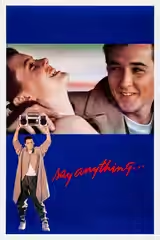
Singles is the broader ensemble comedy, while we recommend Say Anything... as the stronger choice for a romance with a clearer emotional centre. Crowe gives awkward romantic sincerity more room in the latter, though Diane deserves fuller writing; Singles suits an evening when appealing company and a distinctive musical setting matter more than sustained emotional depth.

Cast

If you liked this, try…

  1. Say Anything... (1989, Fi1m 81)Crowe gives awkward romantic sincerity more room, with a clearer emotional centre.

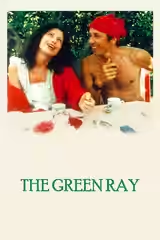
  2. The Green Ray (1986) · not on Fi1m yetFor a more searching account of loneliness and the difficulty of accepting company.

  3. Walking and Talking (1996) · not on Fi1m yetAnother affectionate comedy about dating, with friendship given its proper share of attention.

  4. The Lunchbox (2013) · not on Fi1m yetA quieter courtship that finds considerable feeling in the smallest exchanges.

  5. The Shop Around the Corner (1940) · not on Fi1m yetRomantic misunderstandings handled with patience, wit and unusual kindness towards the embarrassed.

Singles (1992) review: warm romance carried by actors and music (Portugal) | Fi1m