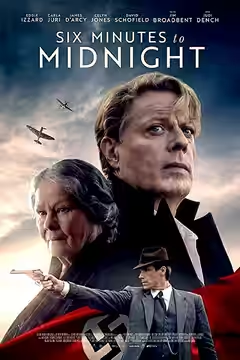
A real school for the daughters of the Nazi elite on the Sussex coast is a remarkable premise, and Andy Goddard’s film spends it on a chase we have seen before. Dench and Marc Streitenfeld’s score are worth something; the thriller around them is not.
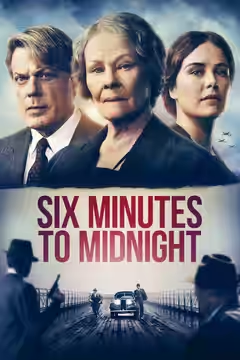
In the last summer before the war there was a boarding school at Bexhill-on-Sea where the daughters of senior Nazis were sent to learn English. That is true, and it is a better starting point than most thrillers get. Six Minutes to Midnight takes it and makes a man-on-the-run picture out of it, with Andy Goddard directing a script he wrote with Suzy Eddie Izzard and Celyn Jones. The school is where the interest is. The chase is where the film spends its time, and we came out knowing more about the running than the school.
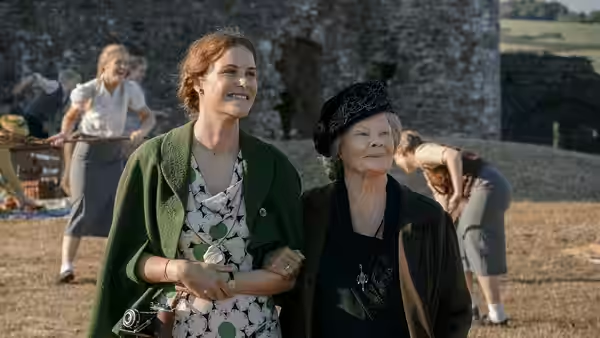
Thomas Miller (Izzard) turns up to teach English after his predecessor has vanished, and it takes the film no time at all to let us know he is there for other reasons. Miss Rocholl (Judi Dench) runs the place with firm courtesy and believes in her girls. Ilse Keller (Carla Juri) teaches them and watches the new man. Captain Drey (James D’Arcy) and Corporal Willis (Celyn Jones) are the British uniforms, Colonel Smith (David Schofield) the voice from London, and Charlie (Jim Broadbent) the local man who happens to be there when a lift is needed. Nearly everybody is who they first appear to be, which in a film whose tagline promises that no one can be trusted is a problem.
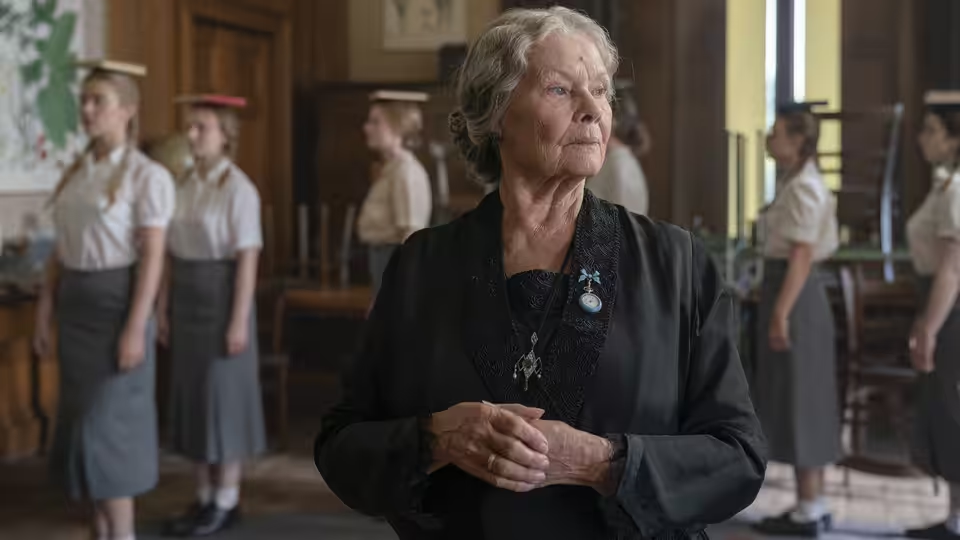
Dench is the reason to stay. She plays Rocholl as a woman who loves her pupils and has decided not to ask what they are being educated for, and she lets us watch the deciding. There is a classroom scene early on in which the girls stand and raise their right arms together, neat and practised, and then sit and open their books. We were chilled by it, more than by anything in the thriller that follows, because the salute is treated as a piece of school routine, like grace before dinner. For a few minutes the film understands exactly what it has.
Then it goes back to the plot. Goddard, Izzard and Jones have written an innocent-man story: a suspicion, a run across country, Drey and Willis behind. It is the shape Hitchcock gave The 39 Steps in 1935, and this film invites the comparison by setting itself in the same decade and the same country, and cannot survive it. The turns arrive on schedule and nobody on screen seems surprised by them. Mike Jones cuts the pursuit cleanly enough, but there is no urgency to find, because the script has given nobody a reason to hurry beyond the fact that the war is coming, and we already know that.
Izzard is a difficulty. She plays Miller stiffly, with a fixed, worried face and a voice that barely alters whether she is taking a lesson or being threatened, and the film needs us to want him to get away. We did not, particularly. Juri does more with less: Keller’s loyalties are the one question the film keeps open for a while, and she plays them with a stillness that makes you look at her. The girls, Astrid (Maria-Victoria Dragus), Gretel (Tijan Marei), Beatrix, Sigrid and Paula, are five names on a register. The film is about them and barely bothers to tell them apart, which is the single biggest waste in it.
The craft is tidy. Chris Seager shoots the coast in a pale wash, grey sea and white sky, and the seafront looks like 1939 without straining for it. Marc Streitenfeld’s score keeps a low pulse under scenes the writing has left flat, and does more to suggest danger than the dialogue manages. At 99 minutes it is not long, and it still finds room to feel slow in the middle, which tells you the problem is not length.
Most critics have landed around where we have, and for the same reasons: the history is fascinating and the film does not trust it. We would have watched a quiet two hours about Rocholl, Keller and five German girls on an English beach in August. What we got is a 12-certificate thriller that is perfectly watchable on a wet evening and will send you to look up the real school afterwards, which is the most useful thing it does.