Alfonso Cuarón’s first film is a quick, rude, handsome bedroom farce with a false HIV diagnosis dropped into the middle of it. The farce is well done and the diagnosis is not, and the film is worth an evening for the former.
Alfonso Cuarón’s first film is a bedroom farce and it opens like one. Tomás Tomás (Daniel Giménez Cacho) is a Mexico City advertising copywriter with a nurse in one flat and his boss in another, on the same night, and the building has a ledge. Written by Cuarón with his brother Carlos Cuarón and running 94 minutes, Sólo con tu pareja is fast and confident and worth your evening. It also wants to be a film about death, and there it is much less sure of itself.
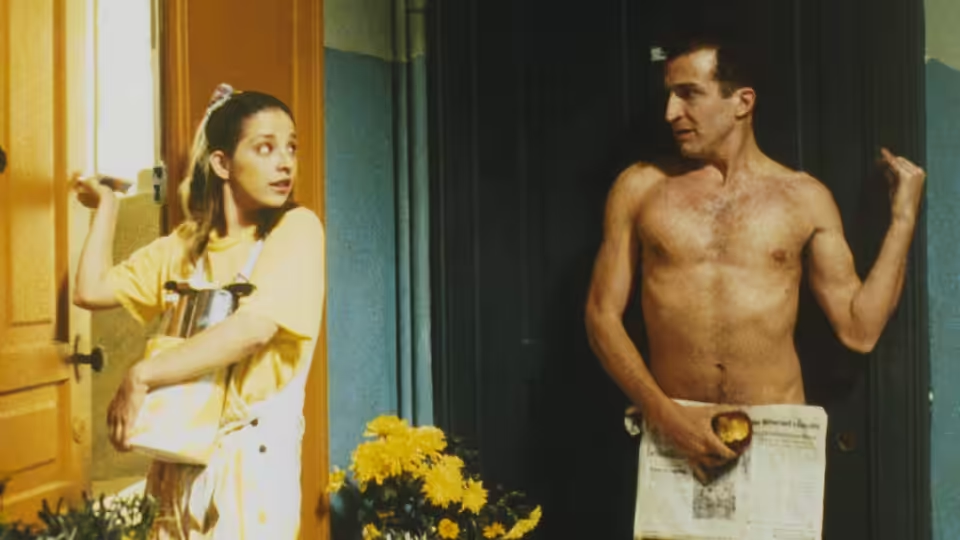
The opening set piece is the best thing in it. Tomás edges along the outside of the building in his underwear between Silvia Silva (Dobrina Cristeva) and Gloria Gold (Isabel Benet), and Emmanuel Lubezki’s camera goes with him, sliding along the wall, in through windows, over beds, with a freedom most debuts cannot afford and this one plainly did not care about affording. We laughed out loud at the second crossing, not at the gag, which is old, but at the camera catching him mid-ledge with the face of a man who has run out of plan. Luis Patlán, editing with Cuarón, cuts the whole night to Mozart, and the cheerfulness of the music against the panic on screen is the film’s joke in miniature.
Then the shadow arrives. Silvia, humiliated, works in the surgery of Tomás’s neighbour and friend Mateo Mateos (Luis de Icaza), and she sees to it that a blood test result reaches Tomás saying he is HIV positive. We know it is false before he does. He does not, and he begins, with a seriousness he has brought to nothing else in his life, to plan how to die. At the same moment Clarisa Negrete (Claudia Ramírez), a flight attendant with a pilot fiancé, moves in across the way, and he falls for her just as he decides he has no right to.
This was a bold thing to attempt in 1992 and we admired the nerve more than the result. Lubezki shoots the scenes of Tomás working out his own death in the same warm evening light as the seductions, and Brigitte Broch’s flat, cluttered surfaces and a bed that has plainly seen use, does not change when his mood does. Perhaps that is the point, that the world goes on looking pretty. But it means the death material never gets its own weight, and the film hurries back to a door slamming as soon as it can. We felt uneasy in these stretches, and not in the way the film meant us to: a womaniser handed a fake diagnosis of a disease then killing a great many people is a darker premise than the brothers seem to have noticed they were writing, and they keep treating it as a plot device.
What holds it together is Giménez Cacho. He plays Tomás as a man who is charming because he has never needed to be anything else, and he lets the charm run down in front of us without once asking to be liked. Claudia Ramírez has less to work with; Clarisa is written as the good woman who arrives to cure him. She plays her dry and unbothered anyway, and the film wakes up when she is in frame. Astrid Hadad, as Mateo’s wife Teresa de Teresa, gets the sharpest lines in the building. Luis de Icaza makes the doctor a decent man permanently one step behind his own neighbours.
The weakest strand is the advert. Tomás is writing a television commercial for a brand of jalapeños with Hernán Cortés (Rodolfo Arias) and Moctezuma (Víctor Carpinteiro) selling the product, and it is a good joke about Mexican history and Mexican advertising exactly once. The film goes back to it. The slapstick in the middle third, the near-misses and wrong rooms, is stock, and Cuarón directs it as if he knows. Carlos Warman’s own music, in the gaps between the Mozart, does its job and no more.
Anyone coming to this from Cuarón’s later films will recognise the camera that will not sit still and the interest in sex as a way of finding out who people are. What is missing is the patience. He had the friend behind the lens who could already do anything, and an idea about mortality he had not yet earned.
Watch it as a debut, and watch the first twenty minutes twice. The ledge alone is worth it.