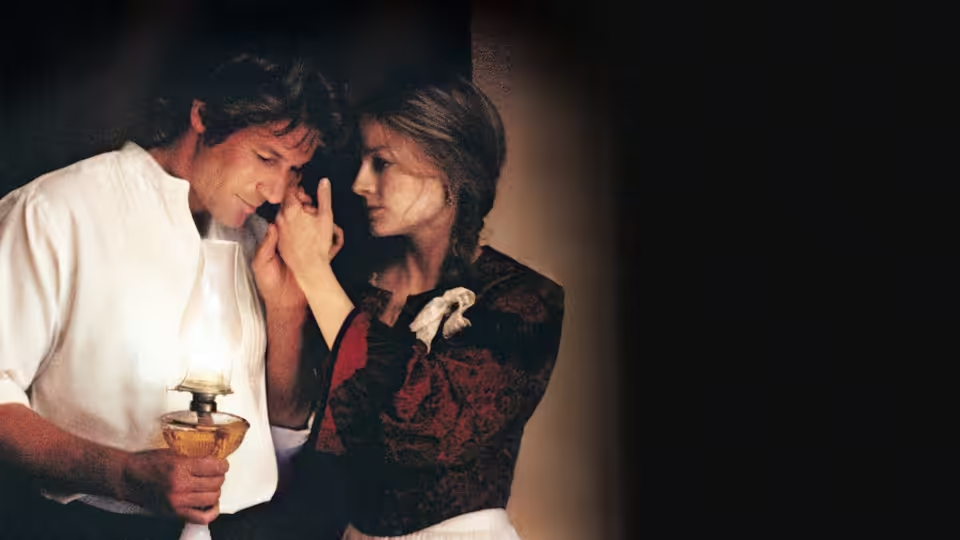
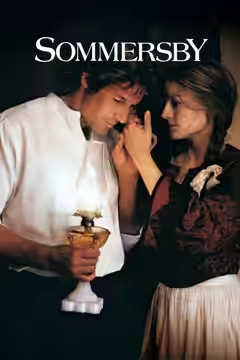
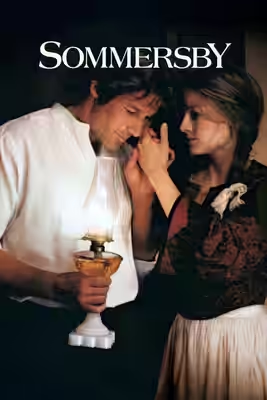
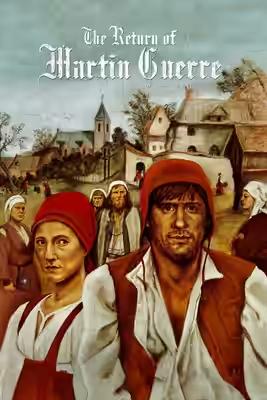
Jon Amiel’s handsome relocation of The Return of Martin Guerre to post-war Tennessee has Jodie Foster at her most watchful and Philippe Rousselot’s loveliest light. It also sands the hard edges off its moral problem, and the last act asks for tears it has not earned.
Jon Amiel takes a sixteenth-century French court case, the one Daniel Vigne filmed in 1982 as The Return of Martin Guerre, and moves it to Tennessee in the years after the Civil War. The bones are the same. A man comes home from a long absence, the town welcomes him, his wife lets him into the house, and the question of whether he is who he says he is sits over every scene. Sarah Kernochan’s screenplay knows that question is the whole film. The trouble is that it also wants us to like everybody, and the two aims pull against each other for most of its 109 minutes.
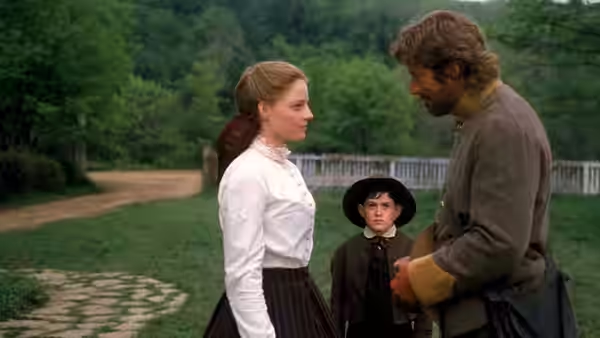
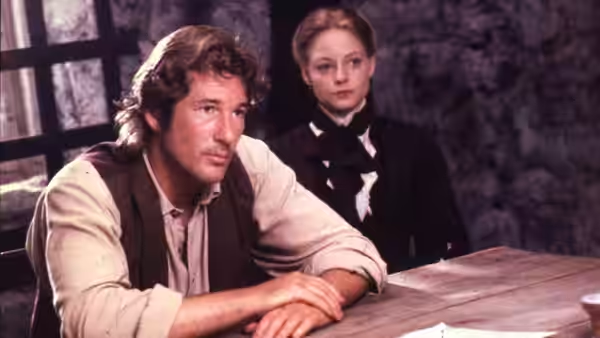
The arrival is the best stretch. Gere walks up a dirt road and the town comes down it to meet him, and Philippe Rousselot shoots the reunion in long late-afternoon light, dust in the air, the whole crowd gold at the edges. Bruno Rubeo’s farmhouse has been let go in the war: boards missing, fields gone to weed, one good room kept clean. Marilyn Vance puts Foster in the same two patched dresses and Gere in a coat that was plainly cut for somebody slightly different. Nothing is announced. The film lets us look at a man in a house and notice what does not fit.
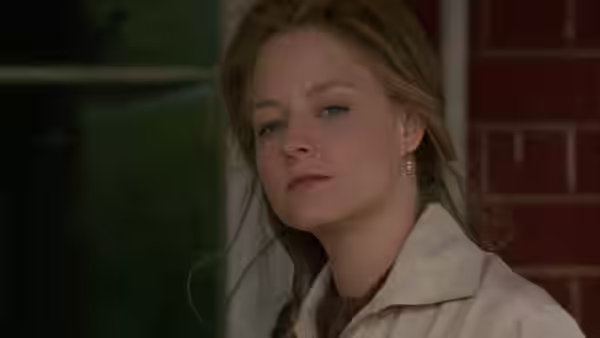
Foster carries it. Laurel has run a farm alone for six years and has learnt to keep her face still, and Foster plays her as a woman doing sums behind her eyes in every scene: the boots, the books, the hands that have softened. She lets us watch Laurel decide, more than once, to stop counting and be happy, and then watch the counting start again. It is a performance made of small refusals. When she finally says what she thinks, late on, she says it quietly.
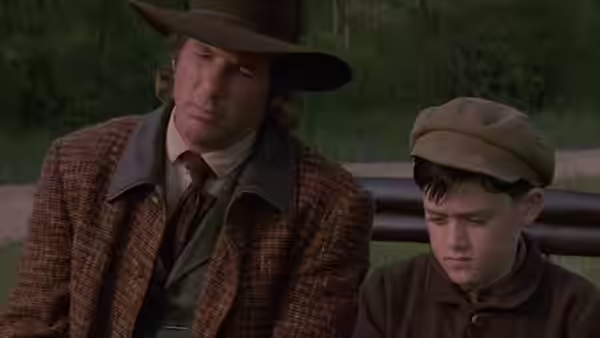
Gere is harder to place, and that is partly the point and partly a limit. He is warm, open and easy with the children of the town, a man anyone would want back, and he is good in the moments when the returned Sommersby is caught not knowing something he should. What he cannot do is suggest a past. The man who left was, by every account in Vine Hill, a brute and a drinker; the man who came back barely seems to have heard of him. Bill Pullman’s Orin has kept Laurel and the farm alive, gets no thanks for it, and plays the obstacle as a decent man being quietly robbed.
The sequence that got us was not the romance but the money. Sommersby stands in the churchyard and asks a ruined town to buy shares in his land and plant tobacco on it, and one by one people come forward with what they have: a watch, a few coins, a cow. Clarice Taylor’s Esther and Frankie Faison’s Joseph, who worked this land before the war without being paid for it, put down their money for a piece of it. We were moved more than we expected to be, and we noticed afterwards that we had stopped caring whether the man was lying. Danny Elfman scores it as straight pastoral, a long string theme that climbs and holds, and in that churchyard it is exactly right. Elsewhere it is poured on.
The softening is the problem. Vigne’s film was about a village that preferred not to ask. Kernochan and Amiel keep the shape and blunt the point: the returned man is good, the land is saved, and the people who object are small or cruel. R. Lee Ermey’s Dick Mead is given about four lines to be the nastiest man in the county. Peter Boyle cuts the first hour with patience and hurries the second as the plot arrives, and James Earl Jones turns up late as a judge to lend the final stretch more weight than the writing has, which is roughly what James Earl Jones is for. The last act takes a turn we will not describe, and then it asks for tears. We had given ours away in the churchyard.
It is worth an evening, mostly for Foster, and it suits a quiet night at home with the lights low, where Rousselot’s light does half the work and the script’s convenient turns matter less. If you have seen the French film, you will spend the last half hour wishing this one had its nerve. If you have not, see this first, then see that, and notice how much changes when a film decides its hero must be good. It carries a 12.