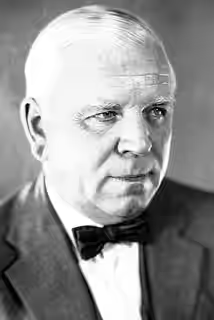
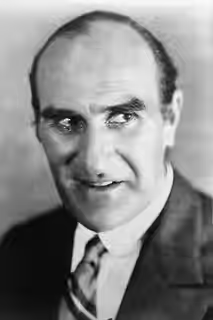
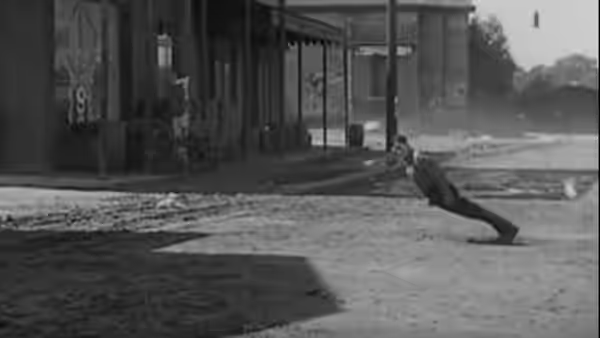
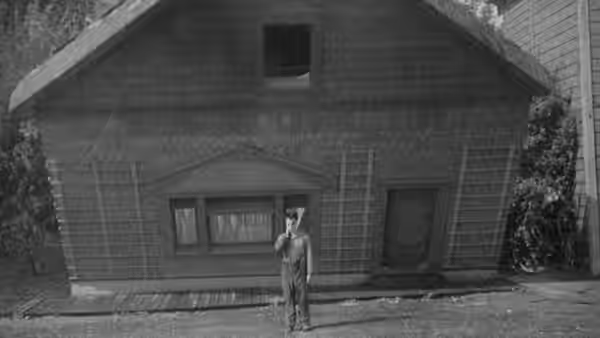
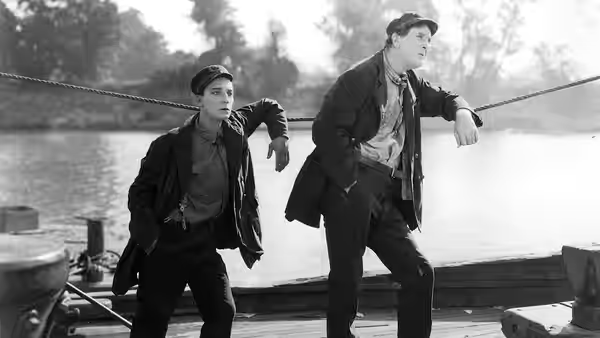
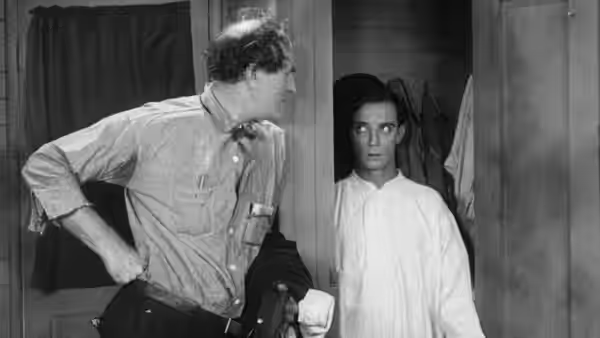
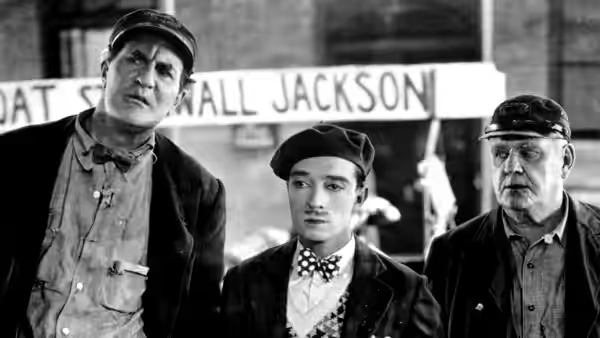
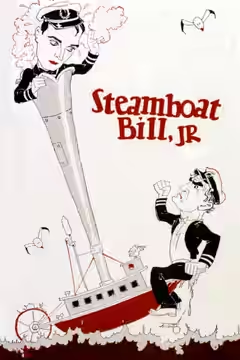
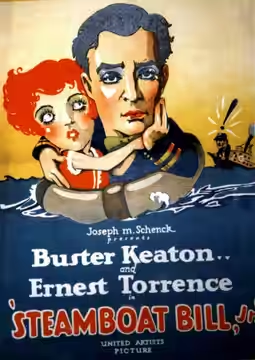
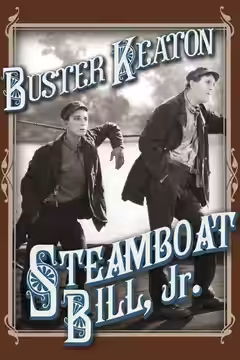
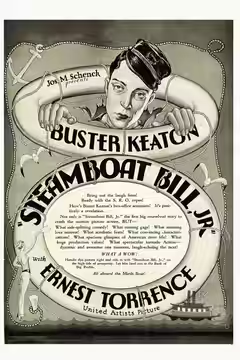
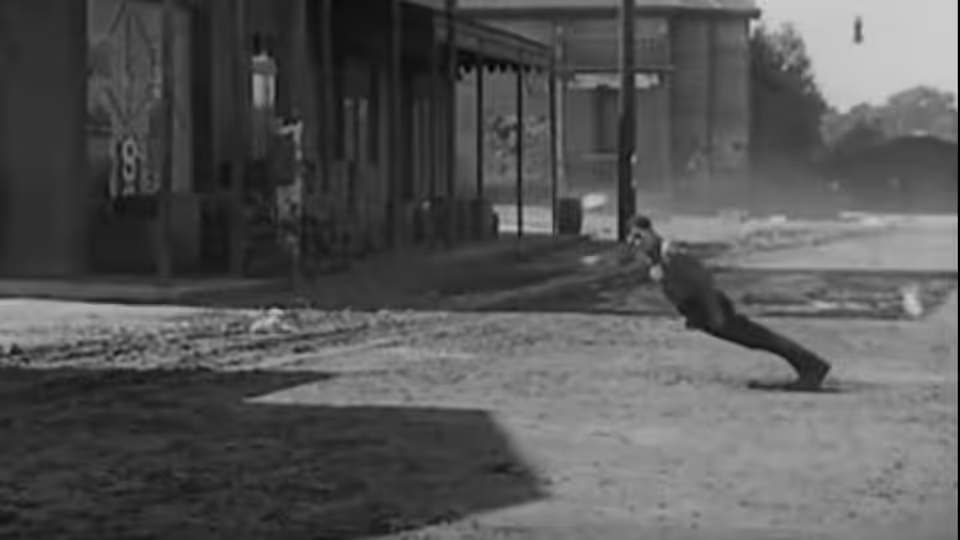
A man braces himself beside a riverside building as water rushes past
Film review

Steamboat Bill, Jr.

1928 · Directed by Charles Reisner, Buster Keaton · 1h 10m

In a sentenceErnest Torrence takes one look at the beret and the ukulele and we can see him wishing for a different son

A small river town. Steamboat Bill Sr. (Ernest Torrence) runs an old paddle steamer with his mate Tom Carter (Tom Lewis). The richest man in town, John King (Tom McGuire), unveils a new steamer and means to put the old boat out of business. Bill has not seen his son since infancy and is expecting a bruiser. What steps off the train is Steamboat Bill Jr. (Buster Keaton), a college boy in a beret and a pencil moustache, with a ukulele. On the same train is Kitty King (Marion Byron), King’s daughter, whom Junior knows. The father sets about making a riverman of his son, beginning with a barber and a hat shop, while the feud between the two men turns courting into a matter of gangplanks after dark.

Plays from YouTube when you press play; nothing loads from them until then.

Fi1m review

Keaton’s riverboat comedy is a neat, well-built farce for most of its length and then, for its last reel, something else entirely: a town blown to pieces around a man who will not flinch. We would tell a stranger to see it.

Buster Keaton plays a riverboat captain’s son who turns out to be the wrong sort of son, and for about fifty minutes Steamboat Bill, Jr. is a neat, well-built comedy about that disappointment. Then the wind gets up. The last reel is one of the great sequences in silent film, a whole town taken apart in front of a fixed camera with Keaton standing in the middle of it, and it lifts a good film into one we would tell a stranger to see. That is the verdict. What follows is mostly an argument that the first fifty minutes deserve better than to be remembered as a wait.

Carl Harbaugh is credited with the story, Keaton with the screenplay, and Keaton and Charles Reisner share the directing credit. The set-up could not be simpler. Ernest Torrence’s Steamboat Bill Sr. runs a paddle steamer that is losing its trade to a new boat owned by John King (Tom McGuire), and he has sent for the son he has not seen since infancy, expecting a bruiser to help him fight back. Torrence is enormous, and he plays the father as a man who has been let down by the size of his son before the boy has opened his mouth. Keaton steps off the train in a beret, a pencil moustache and a ukulele, and the father’s first act is to march him to a barber (Ford West) and have the moustache removed.

The hat shop follows, and it is the best gag in the first half. Junior tries on hats in front of a mirror while his father snatches each one off his head. One of them is a flat porkpie, and it goes back on the shelf with the rest. Bert Haines and Devereaux Jennings shoot it straight into the mirror, so we are watching Keaton watch himself being rejected, and Sherman Kell holds the shot rather than cutting for the laugh. Marion Byron, as King’s daughter Kitty, is the girl Junior already knows and is now forbidden to see; she is small and quick and given almost nothing to do, and does it with good grace. Tom Lewis, as the mate Tom Carter, mostly registers alarm.

The middle stretch is a set of routines strung on the feud between the two old men: crossings between the boats, a night-time visit that goes wrong, a piece of business with a loaf of bread that we will leave you to discover. The story is a clothesline and the romance a formality, and some of the shouting between Torrence and McGuire is played wider than it needs to be. Haines and Jennings keep the frame still and the light flat and white, which is the right choice, because the whole point of a Keaton stunt is that you can see there is no trick.

Then the storm. We will not describe what it does to the town, except to say that a great deal of it comes down and that Keaton stays on his feet in the middle of it. There is one shot in this stretch that everybody knows; it is the most reproduced image in silent comedy, and we have seen it on posters and in clip reels for years. Knowing did nothing at all. We stopped laughing for perhaps three seconds, because what is happening on screen is plainly dangerous and there is no cut to save him, and then we laughed harder than before, because he does not so much as flinch. Whoever was giving directions on set, the timing here belongs to a performer who knew to the inch where his own body would be.

It is a silent film, so there is no composer for us to name; the music you hear depends on the print you are shown, and it is worth seeking out a good one. At 70 minutes it is the right length. The reviews so far are as warm as ours, and they are right to be.

Against Keaton’s own work, The General is grander and Sherlock Jr. cleverer, and neither has twenty minutes as good as the last twenty here. Show it to someone who thinks they do not like silent films, but do not tell them about the hat, and do not tell them what happens in the last reel. The wait is short and the reward is a man standing still while a town falls over.

Critical consensus AI synthesised

87
Positive
7
Mixed
0
Negative
0

Every one of the seven reviews is positive, and the praise gathers in one place: the storm. Critics agree that the cyclone finale is the film’s high point, with the collapsing house front named again and again as the gag that shows what Keaton could do with his own body and a great deal of timber. Most also single out the smaller sight gags, the hospital bed swept down the street among them, and Keaton’s still, unhurried face, which several find as funny as the stunts.

The spread is narrow. Nobody has a serious complaint about the film itself; the reservations that exist are about how it has been packaged. Slant Magazine’s lower mark is for a Keaton collection, whose extras it finds thin, rather than for this film, whose cyclone it admires as much as anyone. The New Yorker is the coolest on the comedy, though warm on Keaton’s discipline and the way the storms answer his hero’s wishes.

Time Out
14 September 2015 · ★★★★★ · Tom Huddleston
100

The review calls the film a comic masterpiece that remains in a class of its own. It praises Keaton’s lovingly framed face and the heart-stopping stunts.

Read the full review →
Empire
27 June 2006 · David Parkinson
90*

Parkinson regards the film as a comic classic and Keaton’s last silent masterpiece. He especially praises the meticulously executed sight gags, including the collapsing house front and the hospital bed swept through the street.

Read the full review →
The Guardian
17 September 2015 · Peter Bradshaw
90*

Bradshaw finds the rerelease a reminder of the film’s remarkable ambition and calls its final storm sequence breathtaking. He singles out Keaton’s miraculous physical comedy and stunt work, especially the famous collapsing-house gag.

Read the full review →
Variety
31 December 1927 · Variety Staff
90*

The critic calls it a pip of a comedy and one of Keaton’s best. They single out the windstorm as a gem and praise the supporting cast.

Read the full review →
The New Yorker
4 October 2010 · Richard Brody
80*

Brody presents the film as funny and celebrates Keaton’s disciplined, stoic screen presence. He singles out the famous falling-house gag and the way the film’s storms echo its hero’s virtuous desires.

Read the full review →
Slant Magazine
18 June 2019 · ★★★½ · Bill Weber
70

Weber praises the collection’s restorations for doing justice to Keaton’s visual genius, while finding its extras little more than advertisements. He singles out Steamboat Bill, Jr.’s cyclone climax as an exhilarating high point of Keaton’s imaginative stuntwork.

Read the full review →

Straight answers AI written, from our review

Is Steamboat Bill, Jr. worth watching?
Steamboat Bill, Jr. is worth watching for anyone at all, silent-film sceptics included, and we scored it 90. The first fifty minutes are a neat, well-built comedy about a riverboat captain disappointed in his son; the last reel, a storm that takes a town apart around Keaton, is one of the great sequences in silent film. At 70 minutes the wait is short.
How long is Steamboat Bill, Jr., and what is it rated?
Steamboat Bill, Jr. runs 1h 10m. It is a comedy and romance film.
Where can I watch Steamboat Bill, Jr. in Saudi Arabia?
Steamboat Bill, Jr. is not on any streaming or rental service in Saudi Arabia at the moment. It is available in 6 other countries; change your country at the top of the page to see where. Availability is checked daily.
How does Steamboat Bill, Jr. compare to The General?
Steamboat Bill, Jr. is the smaller and funnier of the two, while The General is Keaton's grandest film, a locomotive chase staged with the same disregard for his own safety. The General wins on scale and ingenuity; nothing in it, though, matches the last twenty minutes here. Start with the riverboat if you want laughs, the train if you want spectacle.
What should I watch after Steamboat Bill, Jr.?
After Steamboat Bill, Jr., try The General (1926, Fi1m 91): Keaton’s grandest film, a locomotive chase staged with the same disregard for his own safety. Then Modern Times (1936, Fi1m 88): Chaplin keeps silence going into the sound era, with a factory instead of a river.

Cast

If you liked this, try…

  1. The General (1926, Fi1m 91)Keaton’s grandest film, a locomotive chase staged with the same disregard for his own safety.

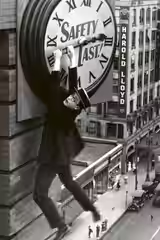
  2. Safety Last! (1923) · not on Fi1m yetHarold Lloyd climbs a building; the other great silent comedian doing the other great stunt.

  3. Modern Times (1936, Fi1m 88)Chaplin keeps silence going into the sound era, with a factory instead of a river.

  4. Monsieur Hulot's Holiday (1953) · not on Fi1m yetTati’s seaside comedy, near-silent and built from the same patient sight gags.

  5. Project A (1983) · not on Fi1m yetJackie Chan, Keaton’s truest heir, falls off a clock tower for real.