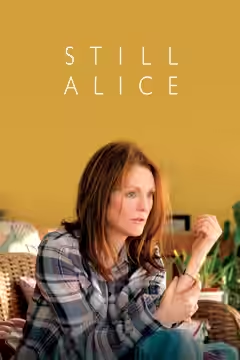
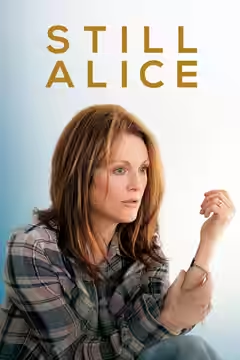
Julianne Moore makes Still Alice painfully convincing, even when the filmmaking settles for the familiar. Her scenes with Kristen Stewart give this restrained Alzheimer’s drama enough emotional force to overcome its cautious storytelling.
Still Alice is a moving drama with a conventional script and an unusually attentive central performance. Richard Glatzer and Wash Westmoreland adapt Lisa Genova’s novel with a clear concern for Alice’s experience of Alzheimer’s, keeping her intelligence central to our understanding of what the illness threatens. That matters in a genre which can too easily turn a person into an occasion for everyone else to learn compassion. Here, Alice remains worth listening to when listening becomes difficult.
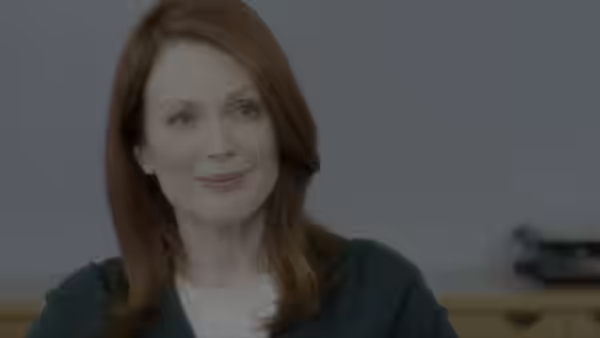
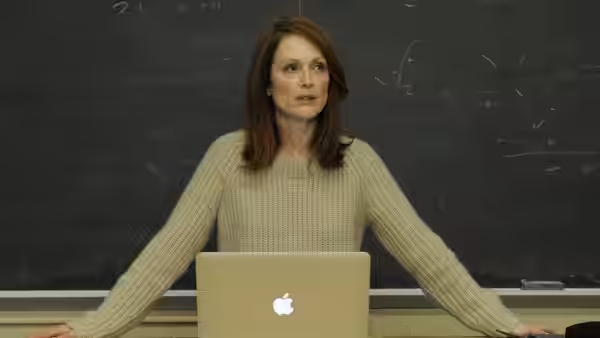
Julianne Moore makes the first signs of confusion hard to dismiss without making them look like a performance of symptoms. Her face and voice register the work involved in trying to remain composed, and we can sense how much being able to think clearly means to Alice. We were frightened by that early disorientation. The effort to understand what is happening is still there, plainly visible, even as Alice struggles to trust her own mind.
Kristen Stewart helps keep the scenes between mother and daughter from becoming another account of Alice’s symptoms. As Lydia Howland, her exchanges with her mother have the unsettled closeness of people whose relationship did not begin with a diagnosis. Affection does not clear away every difficulty, and the performances allow both women to have feelings that are inconvenient to the other. We would have welcomed more of these exchanges; some of the other characters are too lightly drawn to make the same impression.
Denis Lenoir’s cinematography helps us share Alice’s disorientation, but the visual approach is otherwise rather staid. The images seldom seem as alert to Alice’s changing thoughts as her face does, and the film can look too settled for what she is experiencing. Tommaso Ortino’s production design is similarly discreet, leaving Alice’s surroundings with less character than the people occupying them. Keeping attention on the performances works, but it also makes the film depend on them for almost every moment of interest.
Nicolas Chaudeurge’s editing keeps the progression legible, at some cost to the time we spend with each change. We sometimes need longer to absorb what has happened before the film moves on. Ilan Eshkeri’s score has the opposite problem: it presses the sadness beyond what the acting requires. The added emphasis makes some passages feel more conventional than the performances deserve.
The 101-minute running time should not be mistaken for an easy evening. There is real pleasure in watching acting this attentive, even when the subject is painful. Accept the conventional storytelling, and the exchanges between Alice and Lydia are reason enough to stay. Leave a little quiet afterwards rather than asking the next programme to cheer things up.